


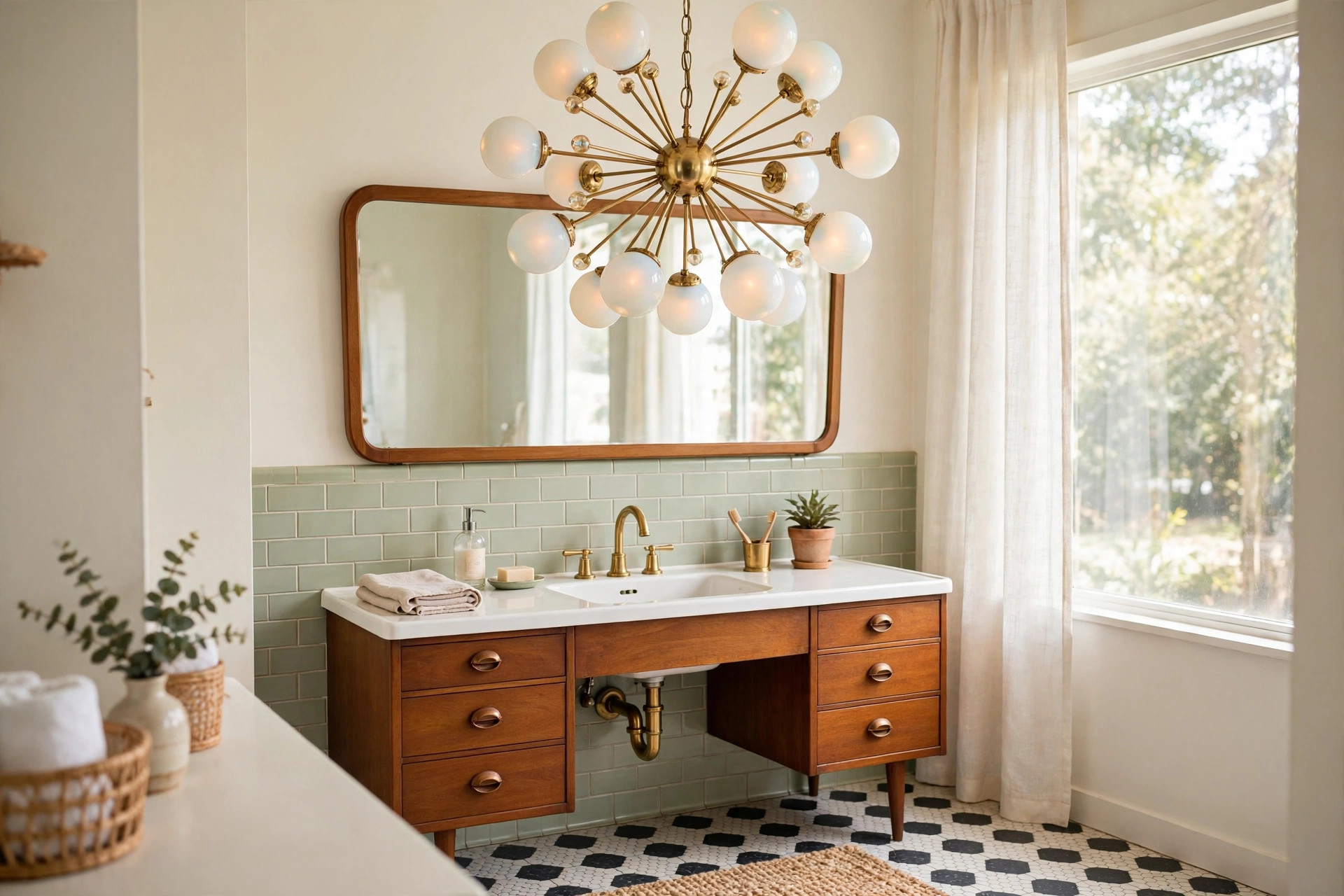
A real mid-century modern chandelier can turn an ordinary retro bathroom into a showpiece — but the market is crowded with new fixtures wearing vintage styling. Learning how to spot a real mid-century modern bathroom chandelier keeps you from paying antique prices for a reproduction, and it helps you find a fixture that is safe, well made, and worth rewiring. The clues are in the shape, the materials, the wiring, and the maker’s marks.
Know the Classic Forms
Mid-century chandeliers followed a few recognisable forms, and knowing them helps you judge a piece at a glance. The most common bathroom designs are the sputnik, with slender brass arms radiating from a central sphere and tipped with small glass globes; the tiered globe fixture, with two or three opal glass spheres hung at staggered heights; and the drum or saucer pendant, where a wide, shallow shade in brass, glass, or perforated metal hangs low over the vanity. Typical bathroom chandeliers measure 12 to 24 inches across — large enough to make a statement, small enough for a room where steam and splashes matter.
Check the proportions carefully. Originals were designed by lighting makers who understood scale: arms are evenly spaced, globes sit level, and the whole fixture balances visually. A reproduction often gets the details slightly wrong — arms at uneven angles, globes that sit crooked, or a canopy that looks oversized for the fixture. If the shape feels awkward or the fixture looks like a scaled-up version of a smaller design, be cautious. Photographs of documented period fixtures from makers such as Lightolier, Moe Light, and Laurel Lamp are a useful reference when you are comparing.
Check the Materials
Materials are one of the most reliable tests. Genuine mid-century fixtures were built from solid brass, steel, and real glass — opal glass, milk glass, smoked glass, and hand-blown globes with subtle bubbles and variations. Pick the fixture up: a real brass chandelier feels heavy for its size, often 8 to 15 pounds for a bathroom-sized piece. Brass should show honest patina — a warm, slightly uneven tone with darker areas in the crevices — while chrome parts may show light pitting or wear at the edges.
Run your finger along an arm or the canopy. Solid brass feels cool, smooth, and substantial; a thin, painted metal or plastic reproduction feels light, warm, and hollow. Glass is equally telling. Period opal glass has a soft, milky glow and often shows faint swirls or bubbles from hand production, while modern reproduction glass is usually flawless and uniformly bright. Plastic “glass” is a definite red flag — tap a globe gently and listen: real glass rings, plastic thuds. When you are learning how to spot a real mid-century modern bathroom chandelier, weight and material are the fastest checks you can make.
Inspect the Wiring and Hardware
The wiring tells you whether a fixture is genuinely old — and whether it is safe. A true mid-century chandelier originally used cloth-covered or early plastic-insulated wire, often with a fabric outer braid. Even if the fixture has been rewired, which is common and sensible, you will usually find clues: old wire nuts, period socket shells, and ceramic or early Bakelite socket interiors. Sockets should be solid brass or ceramic, not thin modern plastic, and they should grip a bulb firmly.
Look at the chain and canopy. Period chains are usually solid brass links with a slightly irregular handmade feel, while reproduction chains are often stamped, lightweight, and perfectly uniform. The ceiling canopy should be a spun-metal dome or a simple stepped design in matching brass or chrome, with a small set screw or finial holding it in place. Check the mounting hardware for signs of age: slotted screws, brass nuts, and a patina that matches the rest of the fixture all point to the period. Any chandelier you buy should be inspected and, if needed, rewired by a qualified electrician before it goes up in a bathroom — old wiring and steam are a poor combination, and rewiring typically costs $75 to $150.
Look for Maker’s Marks and Provenance
A maker’s mark is the strongest single piece of evidence. Many mid-century lighting makers stamped or labelled their fixtures: look inside the canopy, on the back of the socket cluster, or on a small metal tag wired to the chain. Names to look for include Lightolier, Moe Light, Laurel Lamp Company, Gerald Thurston, and Koch & Lowy, along with patent numbers and “Made in USA” or “Made in Italy” stamps. Labels were often paper or foil and may be faded, torn, or partially missing after sixty years — a worn original label is more convincing than a crisp new one.
Ask the seller about provenance. A fixture removed from a documented 1950s or 1960s home, with photographs of it in place, carries far more weight than a piece with no history. Compare the asking price with the market: genuine mid-century bathroom chandeliers typically sell for $150 to $600 depending on maker, size, and condition, while a $40 “mid-century” chandelier is almost certainly a reproduction. If the seller cannot say where the fixture came from and the price seems too good, trust the materials and the wiring over the story.
Putting It All Together
The surest approach is to weigh several clues at once. A heavy brass sputnik with opal glass globes, period sockets, a worn maker’s label, and a plausible story is very likely genuine. A lightweight fixture with flawless glass, plastic sockets, and a shiny new chain is almost certainly a reproduction, however good it looks from across the room. Bring a torch, check the canopy and sockets, and lift the fixture to feel its weight before you buy. With practice, you will know how to spot a real mid-century modern bathroom chandelier at a glance — and your bathroom will glow with a light that has a real history behind it.

GIPHY App Key not set. Please check settings