


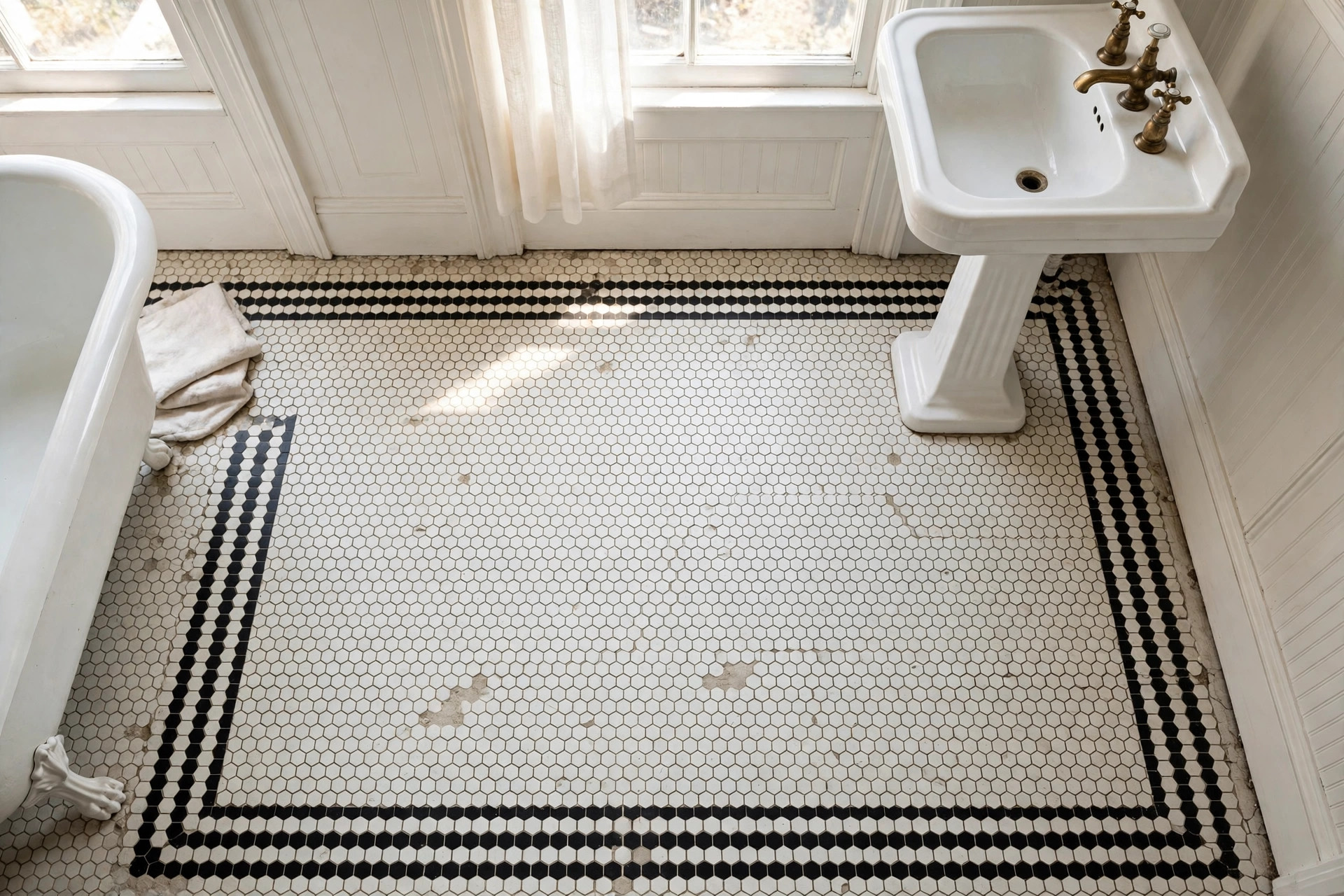
Learning how to identify real 1920s hex tiles matters the moment you start restoring a period bathroom, because original tile and modern reproduction tile behave very differently. Originals are worth preserving, matching, and repairing. Reproductions are easier to replace and far less precious. The good news is that genuine 1920s hex tile leaves a trail of clues: in its size, its glaze, its grout, and the way a century of feet has worn it down. Work through the seven checks below, and you will usually have a confident answer within ten minutes.
Size, Glaze and Grout
Check the Size First
The single most reliable clue is size. Genuine 1920s hex tiles are almost always 1 inch across, measured flat to flat, and they were sold mounted on mesh sheets in a 12-by-12-inch format. Some larger bathrooms used 2-inch hex tiles, but the 1-inch tile is the classic 1920s bathroom floor. Modern reproductions are frequently made in larger sizes, often 2 inches or more, because bigger tiles are cheaper to install. Measure several tiles in different parts of the floor with a ruler or a set of callipers. If they measure a neat 1 inch and sit in a tight, even grid, you are very likely looking at an original installation.
Look at the Glaze and the Colour
Original 1920s hex tiles were made from porcelain or vitreous ceramic with a glaze that has a particular depth to it. Hold a torch at a low angle across the floor. Genuine tiles show tiny variations in the glaze: faint ripples, slight differences in gloss from tile to tile, and colours that are warm rather than stark. Classic 1920s palettes were white, black, pale blue, soft green, and a warm cream, often combined in a white field with a black border or a simple pattern. Modern reproductions tend to be perfectly uniform, with a bright, almost plastic white and identical gloss on every tile. That factory-perfect uniformity is itself a clue that the tile is new.
Examine the Grout Lines
Grout tells the age of a floor almost as honestly as the tile does. In a 1920s installation, the grout lines are narrow, usually 1 to 2 millimetres wide, and the grout itself was a sanded cement mix that has hardened over decades. Look for grout that is slightly uneven, with small pits and a grey or off-white colour that has darkened with age. Modern installations use wider grout lines and polymer-modified grout that stays bright and even. Also look for repairs: a patch of brighter, whiter grout in one corner often marks where a later owner replaced a damaged section, which itself suggests the rest of the floor is original.
Wear, Edges and Patterns
Study the Wear Pattern
A century of use leaves marks that no factory can fake convincingly. In a genuine 1920s bathroom, the tiles in front of the sink, the bath, and the doorway are very slightly worn: the glaze is a little thinner, the edges a touch softer, and the surface has a gentle sheen where feet have passed thousands of times. The tiles under the bath or behind the toilet, where feet never reach, still look sharper. This contrast between high-traffic and hidden areas is one of the strongest signs of age. A reproduction floor, even one that has been in place for twenty years, rarely shows this pattern so clearly, because modern glazes are harder and more wear-resistant.
Look Underneath and Around the Edges
If you can lift a loose tile, or peek under a floor vent, a radiator, or the edge of a threshold, look at the back of the tile and the bed it sits in. Original 1920s tiles were set in a thick bed of cement mortar, often 20 to 25 millimetres deep, and the backs of the tiles show a rough, unglazed ceramic body, sometimes with a maker’s mark or a faint grid pattern from the mould. Modern tiles sit on a thin layer of adhesive, usually 3 to 6 millimetres, over cement board or plywood. A thick mortar bed is strong evidence of an original floor. Also check the edges where the tile meets the wall: original floors often run slightly under the skirting or the bath, while a reproduction usually stops neatly at a modern trim.
Check the Pattern and the Border
1920s bathroom floors were rarely plain. The most common design was a white hex field with a black border, a Greek key pattern, or a simple basketweave motif, sometimes with a contrasting flower or star in the centre of the room. The pattern was laid out by hand, so look for small human touches: a border that is one tile wider on one side, a motif that is slightly off-centre, or a colour change where the tiler ran out of one batch. Modern reproductions copy the look from a catalogue and lay it out with perfect symmetry. A small imperfection in the pattern is not a flaw; it is a signature.
Tools That Help You Decide
You do not need specialist equipment, but three simple tools make the job easier. A jeweller’s loupe or a phone camera on macro mode reveals glaze texture and tiny chips. A ruler or digital callipers confirm the 1-inch measurement. A torch held at a low angle across the floor exposes wear patterns and uneven grout that overhead light hides. If you are still unsure after these checks, photograph the floor, including a ruler for scale, and show it to a tile restoration specialist or a local architectural salvage dealer. Most will give an opinion for free, and they have handled enough original floors to recognise one at a glance.
What to Do Once You Know
If your floor is original, treat it as the most valuable surface in the room. Clean it gently with a pH-neutral cleaner, avoid acidic products that attack old grout, and repair rather than replace damaged tiles. Salvage yards and specialist suppliers stock reclaimed 1-inch hex tiles, and a good tiler can blend a repair so well that it disappears. If the floor turns out to be a reproduction, you have more freedom: you can replace damaged sections with matching modern tile, change the grout colour, or even lift the floor without guilt. Either way, knowing how to identify real 1920s hex tiles means every decision you make next is based on fact, not guesswork, and that is exactly how a period bathroom deserves to be treated.

GIPHY App Key not set. Please check settings