

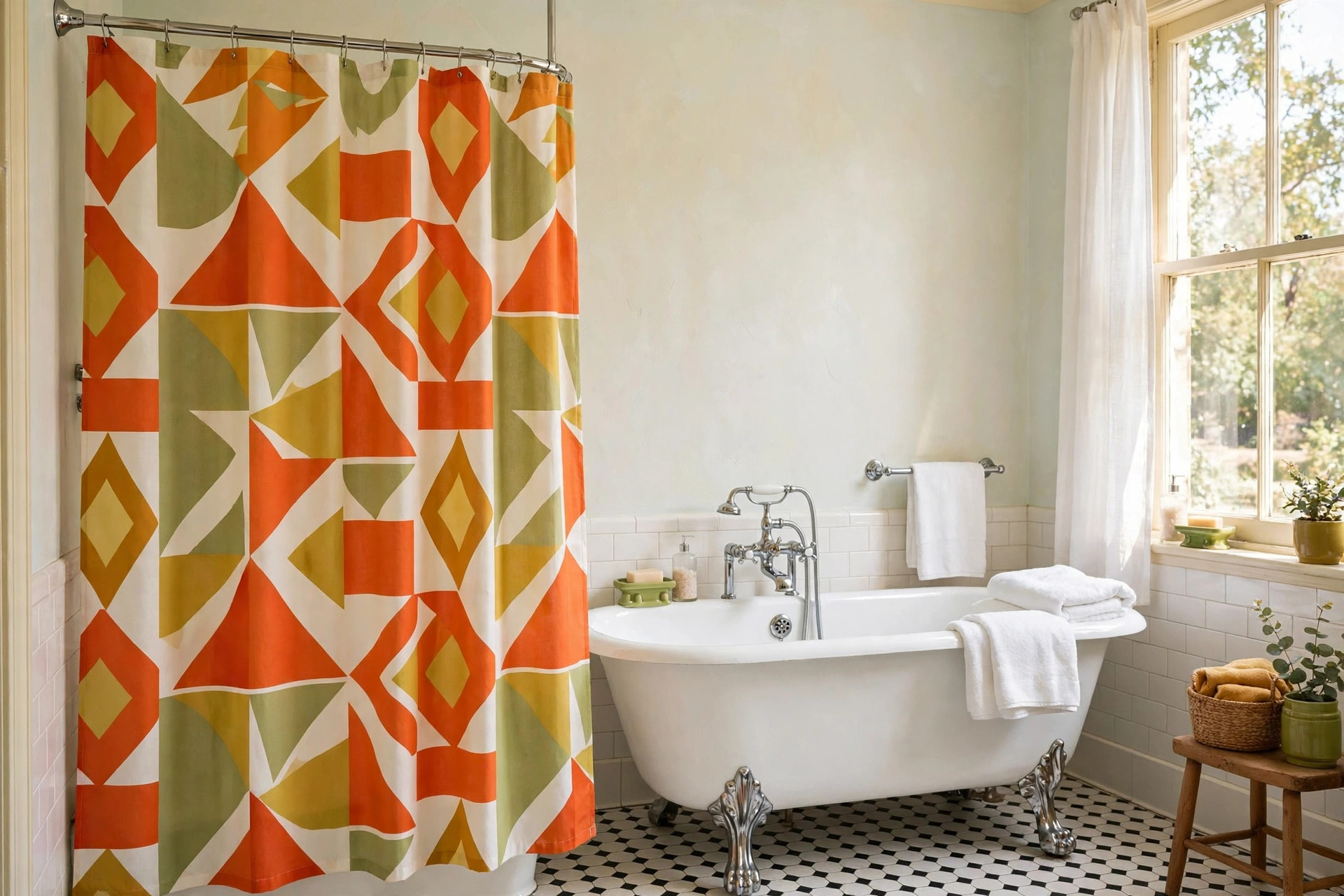
There is a particular pleasure in a genuine 1960s shower curtain: the bold geometry, the saturated colour, the slightly stiff vinyl that snaps back into place. In a retro bathroom it does more work than almost any other single item — it sets the colour palette, it sets the mood, and it costs a fraction of a tile job. But buying one takes care, because the market mixes genuine vintage pieces, honest reproductions, and cheap copies that fade in a month. This 1960s shower curtain for sale buyer shortlist will help you tell them apart and buy with confidence.
First, a word on what “1960s” actually means here. The decade’s shower curtains fall into a few clear styles: bold geometric prints in orange, avocado, and mustard; large-scale florals in pink and turquoise; and the space-age look — atomic shapes, starbursts, and op-art patterns in black and white. Knowing which style you want narrows the search enormously, and it stops you buying a 1970s curtain by mistake.
Where to Find One for Sale
Vintage sellers and antique malls. The most reliable source for a genuine piece, and the first stop on any 1960s shower curtain for sale buyer shortlist. Established vintage sellers usually describe condition honestly and will answer questions about measurements and materials. Expect to pay $40 to $120 for a good original, more for a rare print in excellent condition.
Online auction and marketplace listings. The widest selection lives here, and prices range from $15 for a faded example to over $150 for a mint one. Search for “vintage 1960s shower curtain”, “retro vinyl shower curtain”, and “mid-century shower curtain”, and save your searches so new listings reach you first.
Estate sales and house clearances. The best bargains come from estate sales, where a curtain still hanging in a 1960s bathroom can sell for $10 to $30. Go early, bring cash, and check the curtain in daylight before you buy — bathroom lighting hides fading.
Reproduction specialists. If you want the look without the fragility of sixty-year-old vinyl, reproduction makers sell new curtains in faithful 1960s prints for $25 to $60. These are washable, mould-resistant, and cut to modern standard sizes, which makes them the practical choice for a daily-use shower.
Craft sellers and small makers. Independent sellers on craft marketplaces often print 1960s-inspired designs on modern waterproof fabric. Prices run $30 to $70, and you can sometimes request a custom size or a matching window curtain for a coordinated room.
How to Spot a Genuine 1960s Curtain
Genuine 1960s shower curtains were usually made from vinyl or early PVC, and they feel different from modern fabric curtains: stiffer, slightly glossy, and heavier than you expect. Look for metal eyelets rather than plastic ones — brass or chrome grommets are a good sign of age — and check the header reinforcement, which on a genuine piece is often a doubled band of the same vinyl rather than a separate fabric strip.
The print is the biggest clue. 1960s prints are screen-printed, so the colours sit on the surface and you can sometimes see a faint registration edge where one colour meets another. Modern digital prints are perfectly flat and uniform. Fading is also telling: a genuine curtain fades unevenly, usually more at the top where light hits it, while a reproduction fades evenly or not at all.
Measure before you buy. A standard 1960s curtain is usually 180 cm wide by 180 cm long, but many were cut to 183 cm square, and some are shorter — 170 cm — for use over a low bath. If your rail is a standard 180 cm, a 183 cm curtain will hang with a gentle gather; a 170 cm curtain will leave a gap at the bottom and splash water on the floor.
Condition Checks That Matter
Vinyl ages, and not always gracefully. Hold the curtain up to the light and look for pinholes, which leak from day one. Flex the material gently: if it crackles or feels brittle, it will split at the fold lines within months. Smell it too — a strong chemical or musty smell that survives airing usually means the vinyl is breaking down or has been stored damp, and neither improves with washing.
Check the bottom hem for mould staining, which is the hardest flaw to remove, and check the top eyelets for rust or tearing. A curtain with a few small flaws at the very bottom can still be worth buying if the price reflects it, because you can trim 5 cm off the hem — but never buy a curtain with damage in the middle of the print, where it will catch the eye every day.
Our Top Picks
The genuine geometric vinyl original. A bold orange-and-avocado geometric print in good condition is the centrepiece this shortlist is built around. It is the real thing, it carries the patina of the decade, and nothing else in the room will need to work as hard. Hang it on a brass rail with matching rings for the full effect.
The faithful reproduction in modern fabric. For a family bathroom that gets used every day, a well-made reproduction is the sensible choice. It washes, it resists mould, and the print is crisp. Choose one printed on a weighted polyester that hangs straight rather than billowing into the shower.
The small-maker custom print. If your bathroom has an unusual size or a specific colour scheme, a small maker who prints to order is worth the small premium. You get the exact width you need, a print matched to your tile, and a curtain nobody else has.
Hanging and Care
Hang your curtain so the bottom edge sits 2 to 3 cm inside the bath or shower tray, never on the floor outside it. Use twelve rings for a standard 180 cm curtain — fewer and the fabric sags between them. For a genuine vinyl original, never machine-wash it: wipe it down with warm soapy water, rinse, and let it dry fully extended. A monthly wipe with a diluted white vinegar solution keeps mould at bay without bleaching the print. With that care, and this 1960s shower curtain for sale buyer shortlist in hand, a good 1960s curtain — original or reproduction — will set the tone of your retro bathroom for years, and it will cost less than a single tin of period paint.

GIPHY App Key not set. Please check settings