

The 1960s were a brilliant decade for bathroom mirrors. Designers threw out the plain rectangular medicine cabinet and embraced bold geometry, warm metals, tinted glass, and frames with real personality. A 1960s mirror does more than show your reflection: it sets the tone for the whole room, bouncing light around small spaces and giving even a modest bathroom a sense of occasion. These 7 1960s bathroom mirror ideas work whether you are restoring a true mid-century home or simply borrowing the decade’s confidence for a modern bathroom with retro leanings.
The Classics: Round, Oval, and Arched
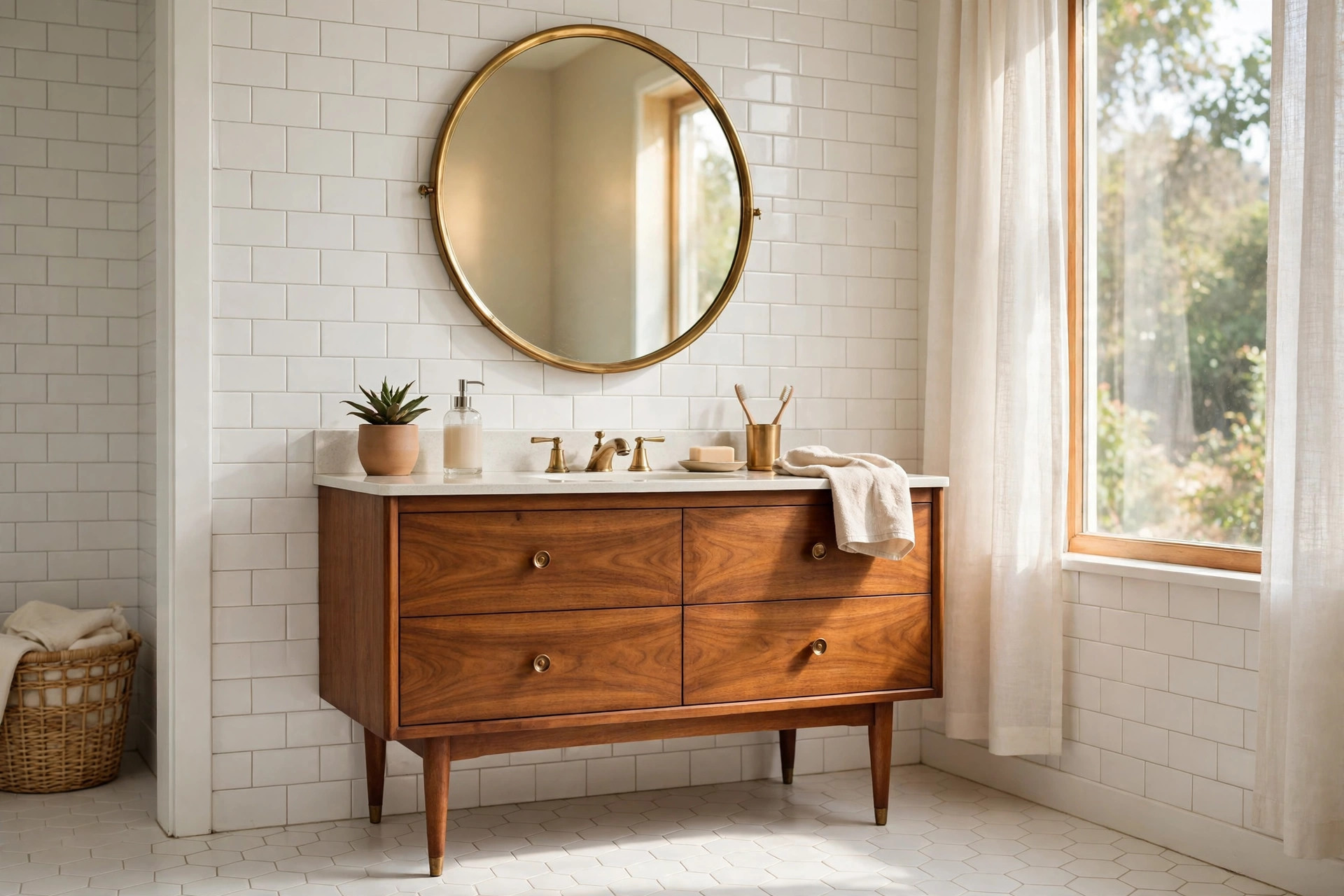
1. The round brass mirror. Nothing says 1960s quite like a large round mirror in a slim brass frame, hung above a floating vanity or a pedestal sink. A 24 to 30 inch diameter suits most vanities, and the circle softens the hard lines of tile and cabinetry. Hang it so its centre sits at eye level, around 60 inches from the floor, and pair it with a pair of globe sconces for a warm, flattering glow.
2. The oval mirror with a walnut frame. Oval mirrors bring the same softness as round ones with a little more height, which suits narrow bathrooms and tall, slim vanities. A walnut or teak frame warms up white tile beautifully, and the wood grain adds texture that chrome and porcelain cannot. Look for frames with a gentle bevel rather than a heavy, ornate profile.
3. The arched mirror. Arched-top mirrors, with their gentle curve rising from a straight base, echo the architecture of 1960s ranch homes and split-levels. A single arch over a double vanity looks generous and calm, while two smaller arches over two sinks feel tailored and symmetrical. Black or brass frames keep the look crisp; painted frames in cream or sage soften it.
Bold Shapes and Statement Pieces
4. The sunburst mirror. A sunburst mirror, with slim brass or teak rays radiating from a round centre, is the most joyful of these 7 1960s bathroom mirror ideas, and it works best as a piece of wall art as much as a mirror. Keep the mirror itself modest, around 18 to 24 inches across, and let the rays do the talking. It suits powder rooms especially well, where one bold gesture is all the room needs.
5. The geometric starburst or hexagon mirror. For a stronger, more architectural look, try a hexagonal or starburst mirror with a thin metal frame. Hexagons were everywhere in 1960s design, from tile to light fixtures, and a hex mirror ties those threads together. Hang one above the sink and echo the shape in a small way elsewhere, perhaps in a soap dish or a tiled niche, so the geometry feels deliberate rather than random.
6. The smoked glass mirror. Smoked or bronze-tinted mirrors were a glamorous 1960s touch, adding warmth and a soft, flattering reflection. A full smoked-glass panel behind a vanity makes a small bathroom feel deeper and more expensive, though it reflects slightly less light than a clear mirror. Use smoked glass as an accent, a framed panel or a medicine cabinet door, rather than the only mirror in the room, so the space stays bright enough for shaving and makeup.
Finishing the Look
7. The backlit floating mirror. The most forward-looking of these 7 1960s bathroom mirror ideas is the backlit mirror: a frameless rectangle or oval with a soft halo of light glowing from behind it. The 1960s loved indirect lighting, and a backlit mirror delivers it beautifully, washing the wall with warmth and eliminating harsh shadows on your face. Modern LED versions are energy efficient and dimmable, and a warm white temperature around 2700K keeps the retro glow without the yellow cast of old incandescent bulbs. Budget $150 to $400 for a good-quality backlit mirror in a standard vanity size.
How to Hang and Style a 1960s Mirror
Whichever idea you choose, a few practical rules keep the result looking intentional. First, match the mirror’s scale to the vanity: a mirror should be roughly two-thirds to three-quarters as wide as the vanity below it, never wider than the vanity itself. Second, mind the height. In a bathroom with an 8 foot ceiling, a mirror that is 30 to 36 inches tall usually feels right, with the bottom edge 5 to 10 inches above the backsplash.
Third, think about lighting before you hang anything. A mirror with a sconce on each side, or a backlit mirror, flatters far more than a single overhead light, which casts shadows downward. If your bathroom has only one overhead fixture, consider adding a pair of small wall sconces beside the mirror; even battery-operated picture lights can help in a rental where wiring is off limits. The goal is even, warm light on your face from both sides, which is exactly how 1960s bathrooms were lit.
Finally, keep the frame in conversation with the rest of the room. Brass mirrors love brass faucets and warm wood; black-framed mirrors suit chrome and graphic black-and-white tile; walnut frames pair beautifully with cream and avocado-era fixtures if you are lucky enough to have originals. And do not forget the wall itself: a mirror hung on plain white tile can look lost, so a painted wall in warm cream, pale sage, or soft mustard behind it gives the frame something to stand against. A 1960s mirror is one of the easiest retro upgrades you can make. No plumbing, no tiling, just one confident shape on the wall, and suddenly the whole bathroom feels like it has a story to tell. Pick the idea that makes you smile, hang it straight, and enjoy the reflection.

GIPHY App Key not set. Please check settings