


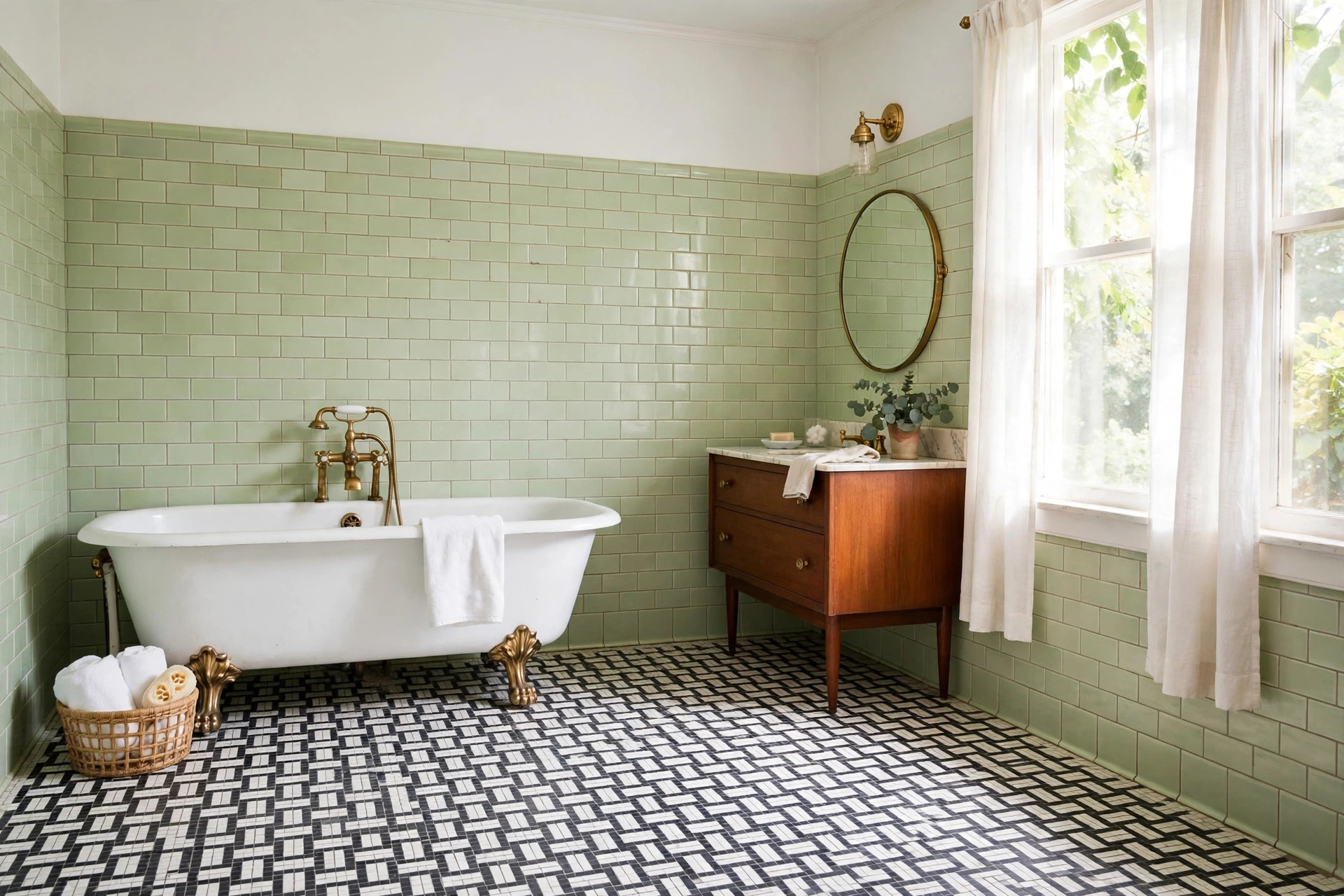
Learning how to spot a real mid-century modern basketweave tile is a useful skill for anyone restoring a 1940s or 1950s bathroom. The basketweave pattern — small rectangular tiles woven over and under each other like a basket — is one of the most charming mosaic designs of the mid-century era, and it is also one of the most copied. Modern manufacturers reproduce it in porcelain, ceramic, and even peel-and-stick vinyl, so a floor that looks vintage at first glance may be only a few years old. Here is how to tell the difference.
Know the Pattern First
A true basketweave tile is made from small rectangular tiles, usually about 1 by 2 inches, arranged in pairs that alternate direction — one pair vertical, the next horizontal — to create the woven effect. In the classic mid-century version, the “weave” is picked out in two colours: the rectangular tiles in white or cream, and a small square “dot” tile, usually black, set at each intersection. That black-and-white combination is the most iconic, but originals also came in soft blue and white, pale green and white, and pink and white.
Measure the tiles. Genuine mid-century basketweave tiles are small — the rectangles are typically 1 inch by 2 inches, sometimes 3/4 inch by 1 1/2 inches in earlier examples — and they arrive mounted on a mesh or paper sheet in 12-by-12-inch squares.
The grout lines matter, too. Original basketweave installations used narrow grout joints, about 1/16 to 1/8 inch, and the grout was usually white or very light grey.
Check the Glaze and the Clay Body
Glaze is one of the best clues when learning how to spot a real mid-century modern basketweave tile. Original tiles were glazed in a way that modern production rarely replicates: the glaze has a soft, slightly uneven surface with tiny variations in colour from tile to tile. Hold a tile up to the light and look across its surface — a genuine mid-century glaze shows gentle ripples and occasional pinholes, while a modern glaze is usually glassy-smooth and perfectly uniform.
The clay body underneath tells a story as well. If you can see the edge of a loose tile, look at the unglazed back or side. Mid-century tiles were typically made from a warm, reddish or buff-coloured clay, and the back often shows the marks of the mould or the mesh it was mounted on. Modern porcelain reproductions have a dense, pale, almost white body with a very fine grain, and their backs are often stamped with a maker’s mark or a modern grid pattern.
Colour is another giveaway. The whites of the 1940s and 1950s were warm — a soft cream or ivory rather than a stark, blue-white. The blacks were deep and slightly soft, not the hard, glossy black of modern porcelain. If the white tiles look brilliant and cold under daylight, they are probably modern.
Look at the Edges and the Wear
The edges of a tile reveal how it was made. Genuine mid-century basketweave tiles usually have a slightly rounded or “cushion” edge, a result of the pressing and firing process of the time. Run your fingertip along the edge: an original feels soft and slightly irregular, with tiny variations in the curve. Modern tiles, especially rectified porcelain, have sharp, machine-cut edges that feel crisp and uniform.
Wear is the most honest evidence of age. A basketweave floor that has been walked on for seventy years shows soft, even wear in the traffic paths — the glaze thins slightly in the centre of the room, the grout darkens in the most-used areas, and a few tiles may be chipped at the corners or around the door threshold. This wear is gradual and natural. Reproductions sometimes fake it with acid washes or sandblasting, but faked wear tends to be too uniform, affecting every tile equally, or too dramatic, with deep pits that no amount of foot traffic would create.
Check the corners and edges of the room, too. Original installations often show small imperfections where the tiler cut tiles to fit around the tub or the door frame — a slightly uneven cut, a tile trimmed by hand. Modern installations are usually cut with a wet saw and fit with machine precision.
Read the Installation and the Substrate
How the tile is installed can confirm its age. Mid-century basketweave tile was set in a thick bed of mortar, often over a concrete or wood subfloor, and the sheets were laid with the mesh facing down or the paper facing up, depending on the manufacturer. If you can lift a loose tile or look under a floor register, check the thickness: original mosaic tile is usually 1/4 to 5/16 inch thick, set in a mortar bed that may be an inch or more deep. Modern thin-set installations are much shallower, typically 1/8 to 1/4 inch of adhesive over a cement backer board.
The pattern alignment is also revealing. Original tilers worked by hand, so the weave may drift very slightly over a long run — a pair of tiles a fraction out of line, a dot that sits a hair off centre. These tiny imperfections are the signature of hand work. A perfectly aligned, mathematically exact weave across an entire floor suggests a modern sheet, cut and laid by machine.
Finally, look at what is underneath. If the floor has been lifted during a renovation, the old mortar bed and any remnants of the original mesh are strong evidence of age. Modern mesh is usually a synthetic fibreglass grid; mid-century mesh was often cotton or a simple paper backing, and fragments of it may still be visible in the mortar.
Our Top Picks
If you are choosing basketweave tile for a retro bathroom, these are the options worth considering:
- Salvaged black-and-white basketweave. The classic combination, perfect for a 1940s or 1950s floor, and the most forgiving choice if your bathroom is small — the pattern adds texture without overwhelming the room.
- Soft blue-and-white basketweave. A quieter, period-correct alternative that pairs beautifully with pale blue wall tile and chrome fixtures.
- Modern porcelain basketweave in a vintage size. If salvaged tile is out of budget, a good-quality reproduction in the original 1-by-2-inch size gives you the look with modern durability — just do not pay vintage prices for it.
A Quick Checklist Before You Buy
Before you commit to a basketweave tile, run through these checks: measure the rectangles (1 by 2 inches is the classic size), inspect the glaze for soft ripples and slight colour variation, look at the clay body and the tile edges, and ask about the installation and the source. Bring a sample home and compare it in daylight against a known modern tile — the difference in warmth and texture is usually obvious once you see them side by side. A real mid-century basketweave tile has a quiet, handmade quality that no machine has quite matched, and once you have learned to see it, you will spot it every time.

GIPHY App Key not set. Please check settings