

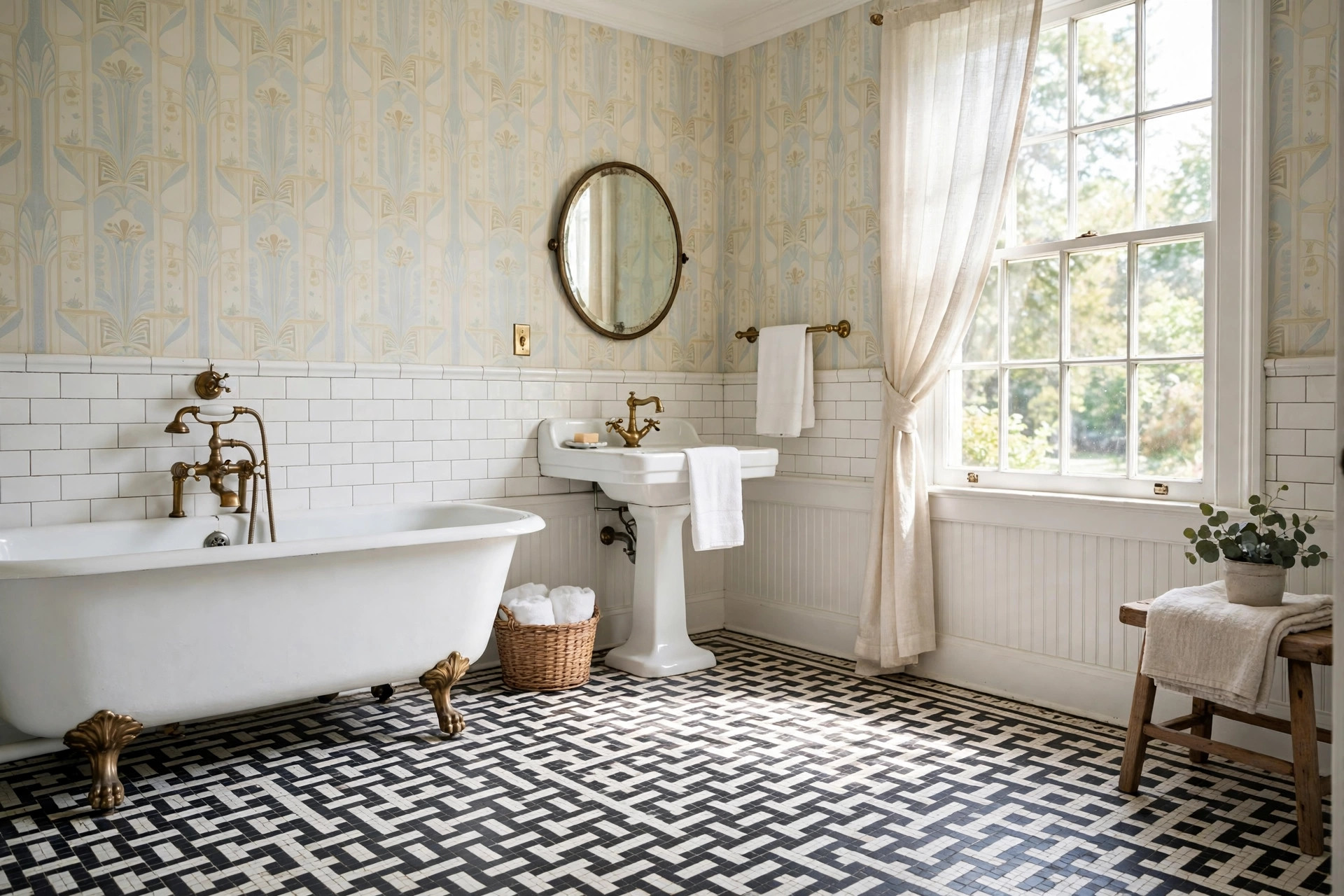
Few details say “1920s bathroom” quite like a basketweave tile floor. That crisp grid of small white rectangles woven around tiny black squares turned ordinary washrooms into miniature works of geometry, and it still stops people in their tracks a century later. If you are restoring a period home or simply borrowing the look, knowing where to find 1920s basketweave tile reproductions is the difference between a floor that whispers Jazz Age and one that just looks like a checkerboard. The good news is that reproductions are widely available today, from artisan tile studios to the big home improvement chains, and the quality range is enormous. This guide walks you through the best sources, what separates a convincing reproduction from a cheap imitation, and the practical details to check before you order a single sheet.
What Makes Basketweave Tile So 1920s
The classic basketweave pattern is a mosaic of small rectangular tiles, usually 1 by 2 inches, laid in alternating horizontal and vertical pairs with a small square dot tucked into each intersection. In the 1920s the field tiles were almost always glazed white ceramic, and the dots were glossy black, though soft grey and pale blue dots appeared in some homes. Floors were typically laid over a mortar bed, and the tiles themselves were unglazed or lightly glazed porcelain and ceramic with a matte or satin finish rather than a high shine.
A convincing reproduction keeps those proportions. Watch out for patterns where the rectangles are too long or the dots are oversized, because the weave reads as stretched and modern. When you are comparing where to find 1920s basketweave tile reproductions, ask for a sample sheet first. A sample costs little, and it tells you more about glaze colour, tile thickness, and dot alignment than any product photo ever will.
Specialty Tile Makers Worth Knowing
The most faithful reproductions come from companies that specialise in historic tile. These makers study original installations, match the old glaze colours, and often produce their basketweave on the same 12 by 12 inch mesh sheets the originals used. Expect to pay roughly $18 to $35 per square foot for artisan-made basketweave, with hand-glazed options at the higher end. Lead times run two to six weeks, since many of these tiles are made to order, so build that into your renovation schedule.
Specialty makers also shine when you need matching pieces. A 1920s floor rarely stood alone: the same basketweave often ran up a shower wall, wrapped a tub surround, or met a black pencil liner at the baseboard. Ordering field tile, dots, liners, and cove base from one maker keeps the whites consistent, which is harder than it sounds. Whites vary noticeably between manufacturers, and a floor from one brand beside a liner from another can look mismatched in daylight. If your bathroom is small, say 40 to 60 square feet of floor, order 10 to 15 percent extra for cuts and breakage, and keep a spare sheet or two for future repairs.
Big-Box Stores and Online Retailers
If your budget is tighter or your timeline is short, the big home improvement chains and large online tile retailers are a practical answer to where to find 1920s basketweave tile reproductions. Mass-market basketweave sheets typically cost $8 to $15 per square foot, and many are stocked in stores, so you can see the tile in person before committing. The pattern is usually correct at a glance, though the glaze may be brighter and the dots a touch larger than the 1920s originals.
Online-only tile shops sit between the two worlds, with prices around $12 to $22 per square foot and a much wider range of dot colours, including soft grey, sage, and dusty blue. Read the reviews carefully and check the sheet size and tile thickness in the specifications. Thinner tiles, around 6 millimetres, are fine for floors but can look flimsy on a shower wall next to thicker original-style pieces. Also confirm the return policy before ordering in bulk: some retailers charge restocking fees on tile, and shipping a heavy box of mosaic back is never cheap.
Salvage Yards and Architectural Antiques
For purists, nothing beats genuine salvaged tile, and architectural salvage yards are the most romantic answer to where to find 1920s basketweave tile reproductions, or rather the real thing. Salvaged basketweave turns up when old apartment buildings and hotels are demolished, and dealers sell it by the sheet or by the square foot, usually for $25 to $50 per square foot depending on condition. The patina is unbeatable, but there are trade-offs. Salvaged sheets may have chipped edges, mismatched whites, or old mortar stuck to the backs, and you will rarely find enough of one lot to cover a whole floor.
A smart compromise is to use salvaged tile as an accent, perhaps a border strip or a small powder room floor, and fill the main floor with a close reproduction. Another option is reproduction tile made from reclaimed moulds, which several historic tile studios offer. These pieces carry the slight irregularities of the originals without the gamble of salvage quantities. Either way, bring a sample of your reproduction tile when you visit a salvage yard so you can compare whites side by side in natural light.
Our Top Picks
The artisan classic: A hand-glazed basketweave sheet from a historic tile specialist, with true 1 by 2 inch white rectangles and glossy black dots on a 12 by 12 inch mesh sheet. Best for full restorations where authenticity matters most, and for bathrooms where the floor is the star of the room.
The budget-friendly workhorse: A mass-market porcelain basketweave in matte white with black dots, sold by the sheet at home improvement stores. Best for rental renovations, laundry rooms, and anyone who wants the 1920s look without the artisan price tag or the wait.
The colour twist: A reproduction basketweave with soft grey or pale blue dots instead of black, from an online tile retailer. Best for bathrooms where you want the period pattern with a gentler, more modern feel, especially alongside painted cabinetry in sage or dusty blue.
What to Check Before You Order
Before you buy, confirm four things. First, the dot colour: true black dots should be a deep, glossy black, not charcoal grey, or the pattern loses its snap. Second, the grout recommendation: white or very light grey grout keeps the weave crisp, while dark grout muddies it. Third, the slip rating: basketweave’s many grout lines already give good grip, but check the tile is rated for floor use, especially in a shower. Fourth, the batch: order everything at once, because glaze whites drift between production runs.
Measure twice, too. Basketweave sheets are 12 inches square, so a 5 by 8 foot bathroom floor needs about 40 square feet, plus your waste allowance. And talk to your tiler before ordering: some prefer mesh-mounted sheets, others prefer paper-faced, and that preference can save you hours of labour. With the right source and a little patience, your 1920s basketweave floor will look like it has been there for a hundred years.

GIPHY App Key not set. Please check settings