

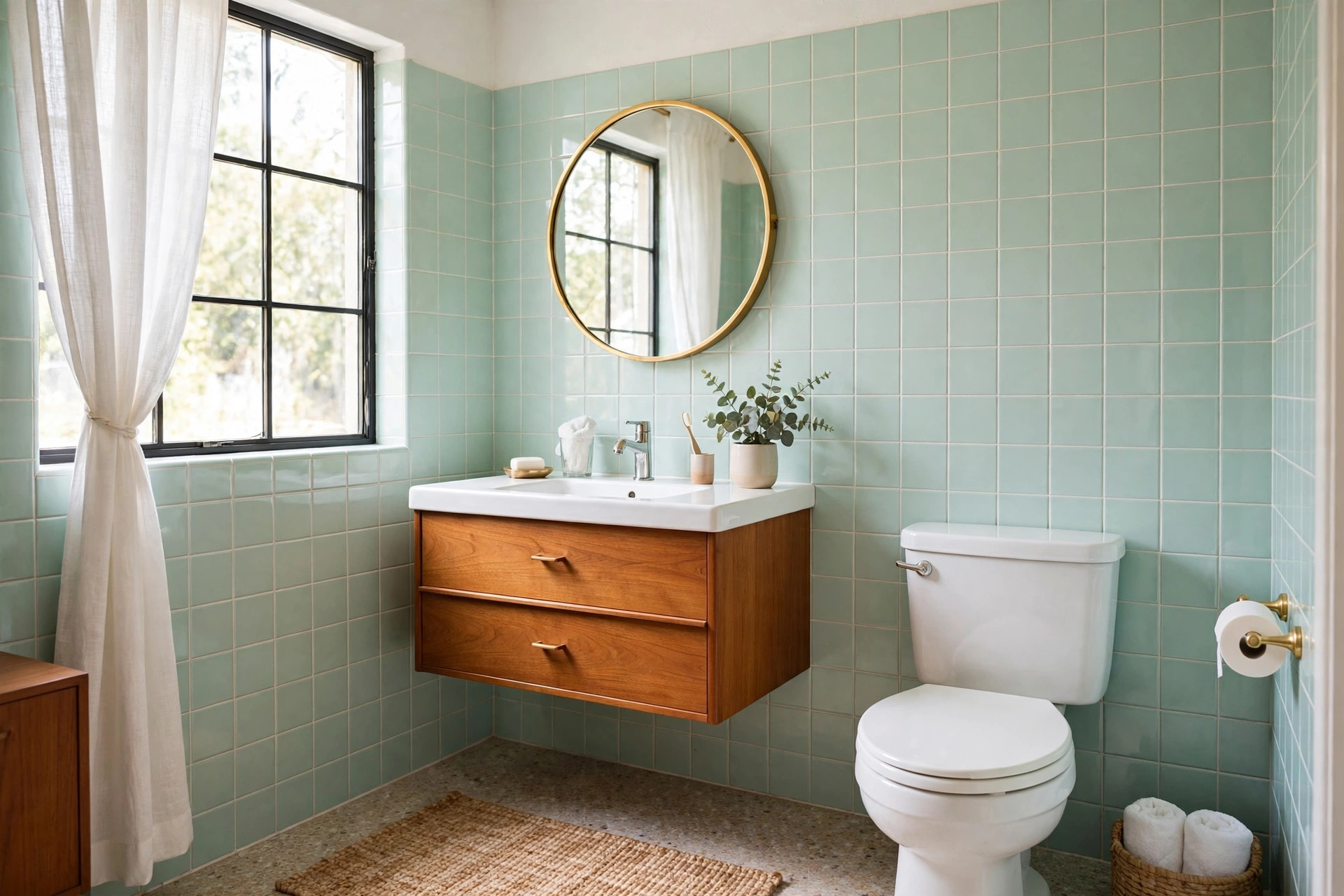
Mid-century modern bathroom ideas for small spaces are having a well-deserved moment. The style was practically invented for compact living — the 1950s ranch house bathroom was rarely larger than 5 x 8 feet, and designers of the era became masters of making small rooms feel intentional rather than cramped. Clean lines, honest materials, and clever storage are the whole philosophy, and every one of those principles flatters a tiny footprint.
Here is how to bring authentic mid-century style into a small bathroom without knocking down a single wall.
Start With the Signature Palette
The mid-century bathroom palette is unmistakable: pastel wall tile in mint, powder pink, butter yellow, or powder blue, paired with white fixtures and warm wood. If your bathroom still has its original pastel tile — many 1950s homes do — you are halfway there before spending a penny. Work with it, not against it.
If you are starting from scratch, 4×4 square wall tiles in a period pastel are the most authentic choice. Carry the tile to a standard wainscot height (about 120 cm) or full height in the shower, and paint the walls above in a soft complementary shade. Keep the ceiling bright white to preserve every centimetre of perceived height.
The Floating Vanity Trick
Nothing makes a small bathroom feel larger than visible floor. A wall-hung or floating vanity — the mid-century standard was often a simple teak or walnut cabinet on slim legs — opens up the floor visually and makes cleaning easier. For a truly tiny room, a floating vanity just 45–50 cm deep provides storage without swallowing the floor plan.
Pair it with a simple rectangular or gently curved basin in white porcelain. Vessel sinks look dramatic but eat counter space; in a small mid-century bathroom, an undermount or drop-in basin keeps the clean lines the style demands.
Tile Choices That Add Space
Small-format tiles are your friends. Penny rounds, 1-inch hexagons, and 4×4 squares all read as period-correct and their small scale makes a compact room feel finely detailed rather than poky. A classic move: white or pale hex tile on the floor with a coloured border, and pastel square tile on the walls.
Grout matters more than people expect. A grout colour close to the tile colour creates a calm, continuous surface that visually expands the room; high-contrast grout chops it into a grid and can make small spaces feel busy. In my opinion, matching grout is one of the cheapest space-enhancing decisions you can make.
Lighting: The Atomic-Age Glow
Mid-century bathrooms loved good lighting, and small ones need it. A pair of sconces flanking the mirror at eye level gives the most flattering light and the most period-correct look — the classic globe or cone sconce in brass or white is the signature. If space is too tight for two sconces, a single overhead fixture with a frosted globe shade plus the mirror sconces covers both ambient and task lighting.
Keep the colour temperature warm (2700–3000K). Cool white light fights the warmth of teak, brass, and pastel tile, and makes the whole room feel like a laboratory instead of 1959.
Storage Without the Clutter
Mid-century design hates clutter, which is a challenge in a small bathroom full of daily essentials. The period solutions still work beautifully:
- A mirrored medicine cabinet recessed into the wall — storage that takes zero floor or counter space and looks completely authentic.
- A slim teak wall cabinet above the toilet for towels and spares; the warm wood is the style’s signature material.
- Open shelving in one short run — a single teak shelf with neatly folded towels and a plant reads as styled rather than messy, provided you edit ruthlessly.
- Drawer organisers in the vanity so the counter stays clear; the mid-century look depends on clean surfaces.
Fixtures and Hardware Details
Taps should be simple: single-lever or two-handle sets in polished chrome were the 1950s–60s standard, and they remain the most practical choice. Brushed brass works if you are leaning toward the warmer, late-mid-century look, but keep all metals in the room consistent — mixing chrome, brass, and nickel in a small space reads as chaos rather than character.
Cabinet pulls in slim brass or chrome bar shapes, a simple round mirror (60–75 cm suits most small vanities), and a shower curtain in a period geometric print rather than a glass screen all reinforce the era. Glass screens are practical, but in a truly tiny bathroom a curtain on a curved rod actually gives you more elbow room.
Colour and Pattern: Restraint Wins
In a small space, let one element carry the pattern — the shower curtain, the floor tile border, or a single wallpapered wall — and keep everything else quiet. Mid-century pattern classics include boomerang shapes, atomic starbursts, and simple geometric repeats. One confident pattern choice feels designed; three feels like a jumble sale.
Plants are the finishing touch the era loved and small bathrooms welcome: a pothos on the shelf or a small fern by the window adds life without taking floor space, and the humidity is a genuine bonus for tropical plants.
A Realistic Budget Breakdown
A small mid-century bathroom refresh need not cost a fortune. As a rough guide in USD: paint and supplies $100–$200; a floating vanity $300–$800; taps $120–$300; mirror $80–$250; lighting $100–$300; tile (if retiling) $500–$1,500 depending on area; accessories and textiles $100–$200. A cosmetic refresh keeping existing tile and layout can land under $1,500; a full re-tile pushes toward $3,000–$5,000. The style’s simplicity is a budget ally — fewer ornate details means fewer expensive ones.
Closing Thoughts
The best mid-century modern bathroom ideas for small spaces all follow the same logic the original designers used: honest materials, clean lines, light colours, and storage that disappears. You do not need a big room to get the look — you need discipline about what goes in it. Keep the palette tight, the floor visible, and the surfaces clear, and even the smallest 1950s footprint can feel like the best room in the house.

GIPHY App Key not set. Please check settings