


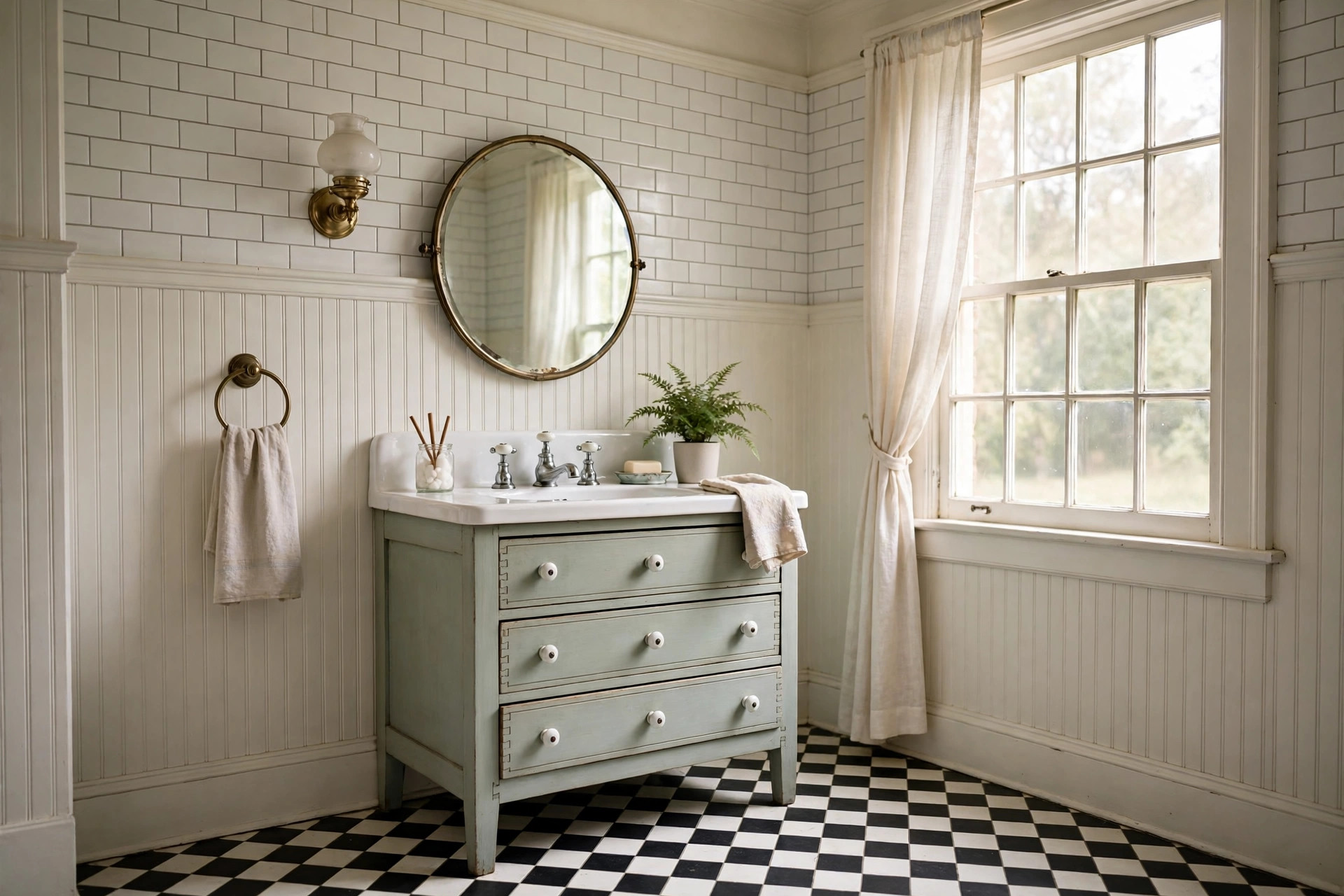
Learning how to identify real 1940s bathroom vanities is the difference between bringing home a piece of wartime-era history and paying antique prices for a modern copy. The 1940s produced some of the most charming bathroom furniture ever made — compact, sturdy, and full of quiet detail — but eight decades of reproductions, refinishes, and “vintage-style” pieces have made the market tricky to navigate. Here is how to read them.
Start With the Proportions
A real 1940s vanity is smaller than you expect. Wartime bathrooms were modest — most measured just 5 by 7 feet or 5 by 8 feet — so vanities were built to fit tight corners. Expect a width of 18 to 30 inches, a depth of 16 to 20 inches, and a height of 30 to 32 inches, noticeably lower than today’s standard 34 to 36 inches. If a “1940s” vanity stands 36 inches tall with a 24-inch-deep countertop, it is almost certainly a later piece or a reproduction sized for modern comfort.
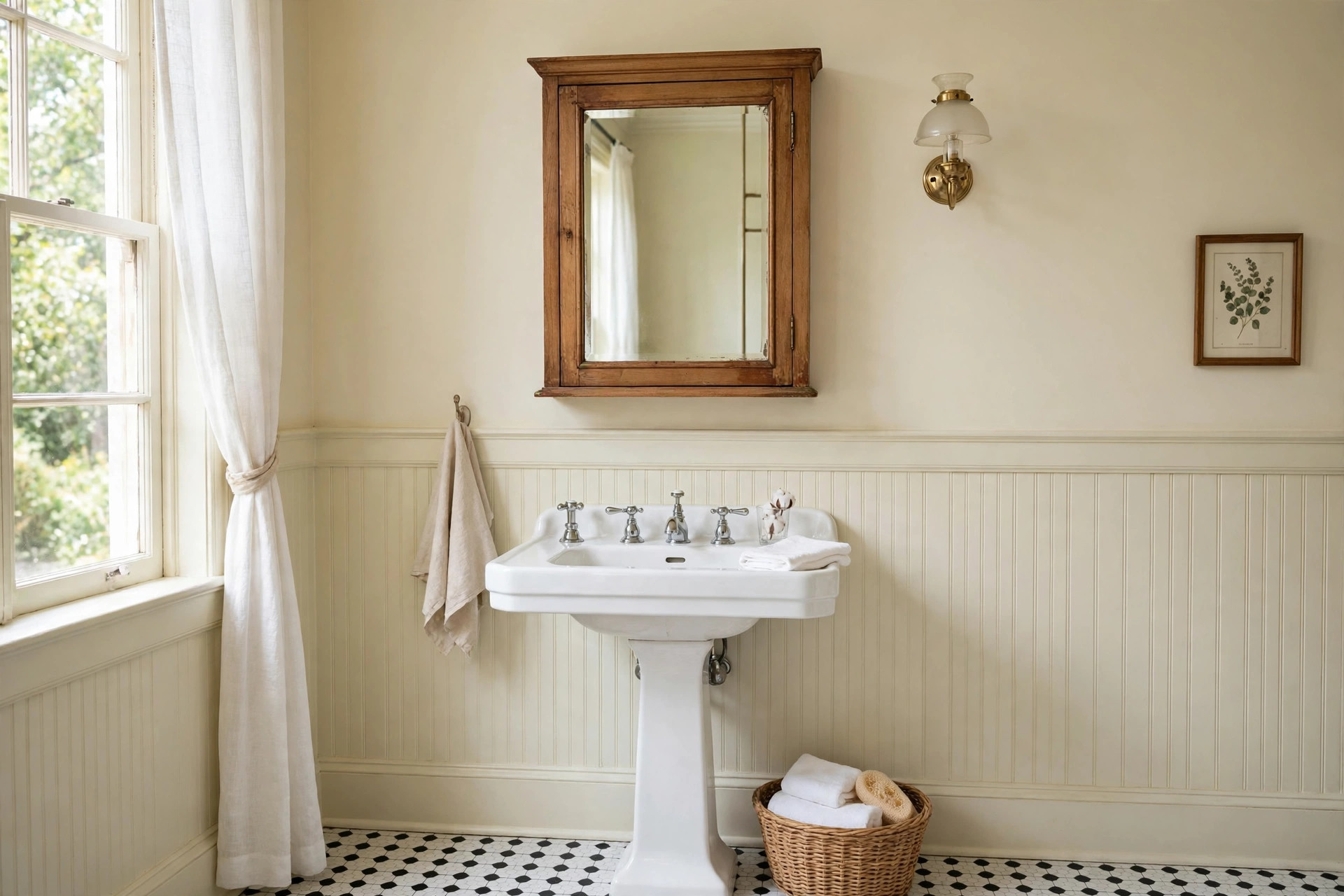
Look at the basin, too. Originals typically carried a small wall-hung or inset porcelain sink, often a Vitreous china model from American Standard, Kohler, or Crane, with a narrow backsplash of 4 to 6 inches. The sink’s overflow hole and the faucet spread are telling: 1940s faucets usually sat on 4-inch centers, while many modern reproductions use an 8-inch widespread layout.
Read the Joinery Like a Birth Certificate
Joinery is the single most reliable clue when learning how to identify real 1940s bathroom vanities. Open a drawer and look at the corners. Genuine 1940s drawers were usually built with dovetail joints — often machine-cut dovetails that are neat but slightly irregular, with pins that vary a fraction of a millimetre from one to the next. Perfectly uniform, laser-clean dovetails can suggest modern CNC work, while stapled or nailed drawer boxes with visible staples are a sure sign of a later piece.
Check the drawer bottoms as well. Originals used solid wood panels, often pine or poplar, set into grooves, and they slide on wooden runners rather than metal ball-bearing slides. If you see full-extension metal drawer slides, the piece has been rebuilt or was never old at all. Similarly, look under the vanity: a real 1940s cabinet will show a simple plank or framed base, sometimes with small turned feet, and the underside will be unfinished or roughly finished — never sprayed with modern polyurethane.
The carcass construction matters, too. In the 1940s, vanities were commonly made from solid hardwoods such as oak, birch, and maple, with plywood used sparingly for panels. Medium-density fibreboard (MDF) did not exist in American furniture production until much later, so any MDF — recognisable by its smooth, grain-free cut edges — rules out a 1940s origin immediately.
Examine the Wood, Finish, and Patina
Authentic 1940s vanities carry their age in the finish. Most were painted rather than stained: soft whites, pale greens, powder blues, and butter yellows were the colours of the decade, often in a satin or semi-gloss enamel. Over eighty years, that paint develops a fine craquelure — a network of tiny cracks — and yellows slightly, especially around the edges. A finish that is perfectly smooth, uniformly glossy, and free of wear is either a recent repaint or a reproduction.
If the vanity is wood-toned, look for the species. Oak with a golden or honey stain was common, and the grain should be clearly visible under a thin shellac or lacquer finish, not buried under thick modern varnish.
Wear patterns tell the truth as well. Genuine use leaves soft, rounded wear on drawer pulls, a slightly darkened ring where hands gripped the edges, and faint water marks near the basin. Reproductions sometimes fake this wear with sandpaper and stain, but faked distressing tends to be too even — every edge worn to exactly the same degree — while real wear concentrates where hands actually touched the piece.
Check the Hardware and Hinges
Hardware is where many reproductions give themselves away. A 1940s vanity typically wears simple, functional hardware: small round porcelain knobs, stamped brass or nickel bin pulls, or slim chrome bar pulls. Porcelain knobs from the era were made by companies like Keeler Brass, and their glaze has a soft, slightly uneven quality with tiny bubbles or pinholes visible up close. Modern porcelain knobs are glassy-smooth and perfectly uniform.
Unscrew a knob and look at the screw. Originals used slotted screws — the kind with a single straight groove — throughout. Phillips-head screws did not become common in American furniture until the late 1940s and 1950s, so a vanity full of Phillips screws was assembled later, even if the cabinet itself is old. Hinges are equally revealing: 1940s vanities used surface-mounted butt hinges or simple inset hinges, often in brass or steel with a dull, aged finish. Concealed European-style cup hinges are a modern invention and do not belong on a genuine piece.
Do not forget the faucet holes and plumbing. Original 1940s vanities were built around cast-iron or porcelain sinks with chrome-plated brass faucets, and the cabinet interior often shows old plumbing marks — a circular stain where a trap once sat, or patched holes where pipes were rerouted. A pristine interior with no plumbing history is suspicious.
Look for Maker’s Marks and Wartime Clues
The 1940s were shaped by the Second World War, and that history is written into bathroom furniture. Between 1942 and 1945, metal was rationed, so manufacturers used less chrome and brass, substituted wooden or Bakelite knobs, and sometimes built vanities with simpler, plainer designs. A vanity with Bakelite pulls or minimal metal trim may well date from the war years, while one loaded with heavy chrome hardware is more likely from the late 1940s or later.
Maker’s marks help, too. Check the back panel, the underside of drawers, and the inside of the cabinet doors for stamps, stencils, or paper labels from manufacturers such as American Standard, Crane, Kohler, or the many regional cabinet shops of the era. These marks are often faded or partially worn away, which is itself a good sign — crisp, perfectly legible labels on an “80-year-old” piece deserve a second look. Measure the sink as well: many 1940s porcelain sinks carry a date stamp or model number moulded into the underside, and a quick search of that number can confirm the decade.
Our Top Picks
If you are shopping for a vanity to anchor a retro bathroom, these are the pieces worth hunting for:
- A compact painted vanity with its original porcelain basin. The 24-inch width suits small bathrooms, and the original sink and backsplash are worth more together than apart.
- A solid oak vanity with dovetailed drawers. The warm honey stain pairs beautifully with black-and-white floor tile, and the joinery confirms its age at a glance.
- A wartime-era vanity with Bakelite knobs. Scarcer than the standard models, these carry a genuine piece of 1940s history and suit a restoration purist’s bathroom.

GIPHY App Key not set. Please check settings