


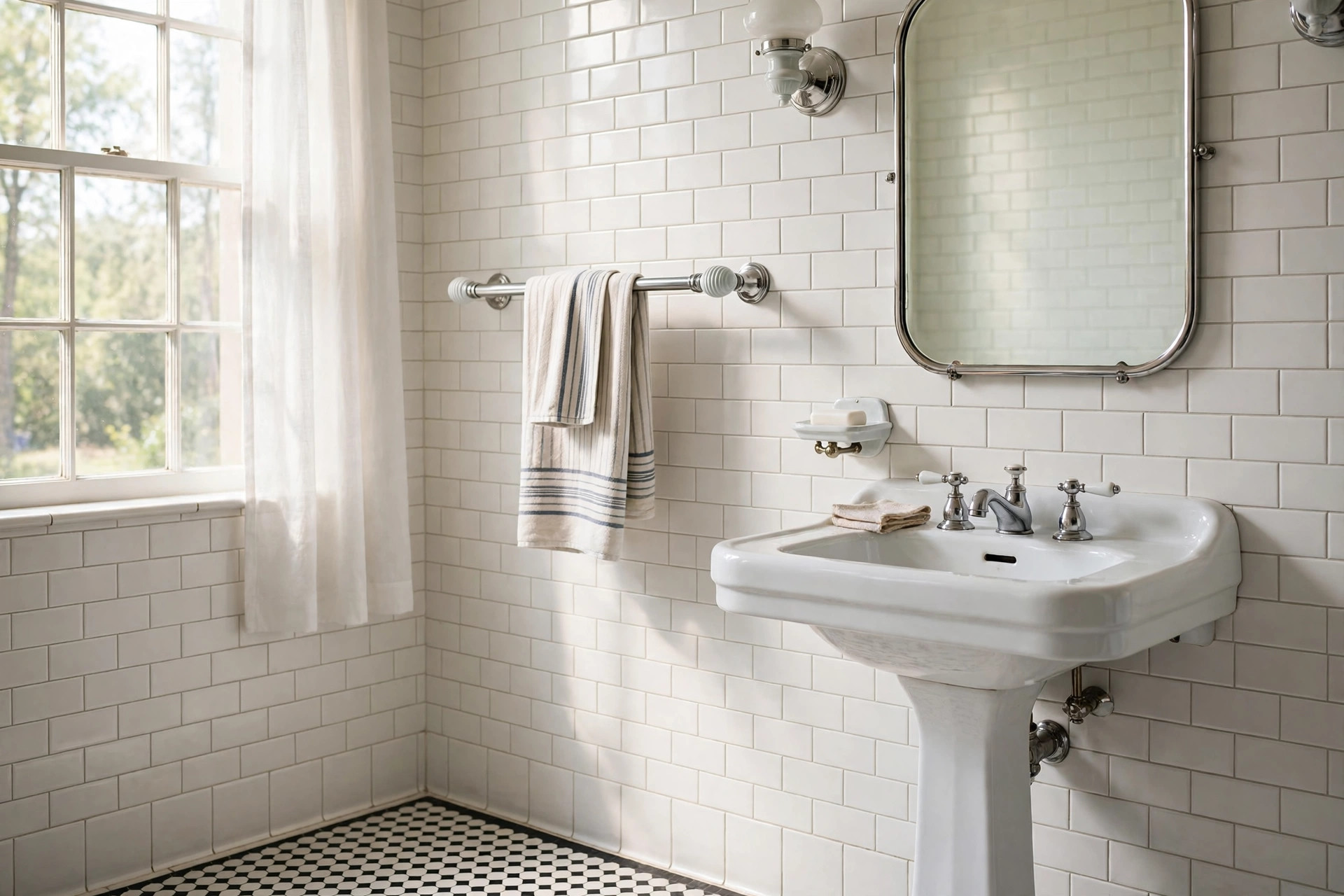
A 1940s bathroom was a study in neat, gleaming order, and the towel bar set was one of its hardest-working details. Typically a matching group, a towel bar, a towel ring, a robe hook or two, and often a glass shelf or a soap dish, all in the same polished chrome or nickel, mounted on small ceramic or metal brackets. Get the set right and the whole bathroom feels finished; get it wrong and even a beautiful tile job looks slightly off. Knowing where to find 1940s towel bar set reproductions saves you from that mismatch, and the good news is that several specialist makers still produce them faithfully, alongside a healthy salvage market for the real thing.
What a 1940s Towel Bar Set Looked Like
Before you shop, it helps to know what you are looking for. A typical 1940s set centred on a towel bar 18 or 24 inches long, made from a slim chrome tube held by two small wall brackets. The brackets were often ceramic, in white or black, or die-cast metal with a stepped, streamlined shape that nodded to the Art Deco era just ending. Towel rings were usually 6 to 8 inches across, and the matching glass shelf, if the set included one, sat above the towel bar on two small brackets with a frosted or clear glass plate.
Finishes were almost always polished chrome, with polished nickel a close second in higher-end homes. Brass was rare in 1940s bathrooms, and matte black or oil-rubbed bronze are modern inventions that will look out of place in a period restoration. The chrome of the era was bright and mirror-like, and the best reproductions match that shine rather than the softer, brushed chrome common today. When you are weighing where to find 1940s towel bar set reproductions, hold that image in mind: slim, gleaming, streamlined, and always matching.
Specialty Reproduction Hardware Makers
The most reliable source is a specialist in vintage reproduction hardware. These companies cast or machine their brackets from solid brass, plate them in chrome or nickel, and sell complete matched sets so every piece shares the same finish and profile. A full reproduction set, towel bar, towel ring, robe hook, and glass shelf, typically costs $120 to $250, with individual towel bars around $40 to $80. That is more than a modern big-box set, but the weight and finish are noticeably better: a solid brass bracket feels substantial in the hand, while a hollow zinc one feels light and can pit over time.
Specialist makers also offer the details that matter for a convincing 1940s look. Porcelain-tipped mounting screws, ceramic bracket bases in white or black, and period-correct glass shelves cut to the right depth, usually 5 to 6 inches, are all worth asking about. Lead times are usually short, one to two weeks, since most sets are stocked rather than made to order. If you are restoring a whole bathroom, order the matching toilet paper holder and soap dish from the same maker at the same time, because chrome varies slightly between manufacturers and even between batches.
Online Marketplaces and Retailers
Online marketplaces are the next best answer to where to find 1940s towel bar set reproductions, especially if you are hunting for a bargain or a discontinued design. Large home retailers carry vintage-style sets in polished chrome for $60 to $120, and the quality is generally solid for the price, though the brackets tend to be simpler and the chrome a little less mirror-bright than specialist pieces. Read the reviews and look closely at the product photos: brackets with visible plastic parts or oversized mounting plates are a sign to keep looking.
Auction sites and vintage marketplaces are a mixed bag. You will find genuine 1940s sets there, sometimes still in their original boxes, for $50 to $150, but also modern sets mislabelled as vintage. Check the seller’s photos for signs of age, like light wear on the chrome and old-style screws, and ask about the mounting hardware before you bid. Missing wall brackets are the most common problem with second-hand sets, and a towel bar without its brackets is just a shiny tube.
Salvage Yards and Antique Shops
For the real thing, nothing beats an architectural salvage yard. Towel bar sets were often removed carefully during demolitions, and dealers sell them for $40 to $120 per set depending on completeness and condition. The charm is genuine: original chrome has a depth that modern plating struggles to match, and ceramic brackets carry the small imperfections of hand-finished pieces. Bring a tape measure and a list of what you need when you visit a salvage yard, and check every piece in person. A towel bar that looks straight on a shelf may have a subtle bow, and chrome that looks bright in a dim warehouse can reveal pitting in daylight. A good salvage dealer will let you test the brackets against a wall and will often have a box of spare screws and mounting plates behind the counter, so ask. If you find a set you love but it is missing one piece, a specialist reproduction maker can often supply a close match to complete it.
Our Top Picks
The specialist matched set: A complete reproduction set from a vintage hardware maker, with a 24 inch towel bar, towel ring, robe hook, and glass shelf, all in polished chrome on solid brass brackets. Best for a full 1940s restoration where every piece must match and the finish must last.
The budget chrome set: A vintage-style towel bar set from a large home retailer, with a towel bar, ring, and robe hook in polished chrome. Best for a guest bathroom or a rental refresh where the look matters more than heirloom quality.
The salvaged original: A genuine 1940s set from an architectural salvage yard, with ceramic brackets and original chrome. Best for a bathroom where authenticity is the point, and where you are happy to hunt for the right set and clean it up yourself.
What to Check Before You Order
Before you buy, measure your wall space. A 24 inch towel bar needs at least 26 inches of clear wall, and it should sit 48 inches from the floor for bath towels, with hand towel rings at 48 to 52 inches. Check the mounting system too: 1940s sets were often screwed into wooden blocking or tile anchors, and modern drywall needs proper anchors or a stud, especially for a bar that will hold wet, heavy towels.
Confirm the bar diameter as well. Most 1940s bars are 5/8 inch in diameter, and a thicker modern bar can look clumsy beside period brackets. Finally, check the finish against your faucet and other fittings. Polished chrome should match polished chrome, but chrome from different makers can vary from cool blue-white to warm grey, so compare samples in daylight before you drill a single hole. With the right source and a little care, your 1940s towel bar set will look like it has been holding towels in your bathroom since the decade itself.

GIPHY App Key not set. Please check settings