


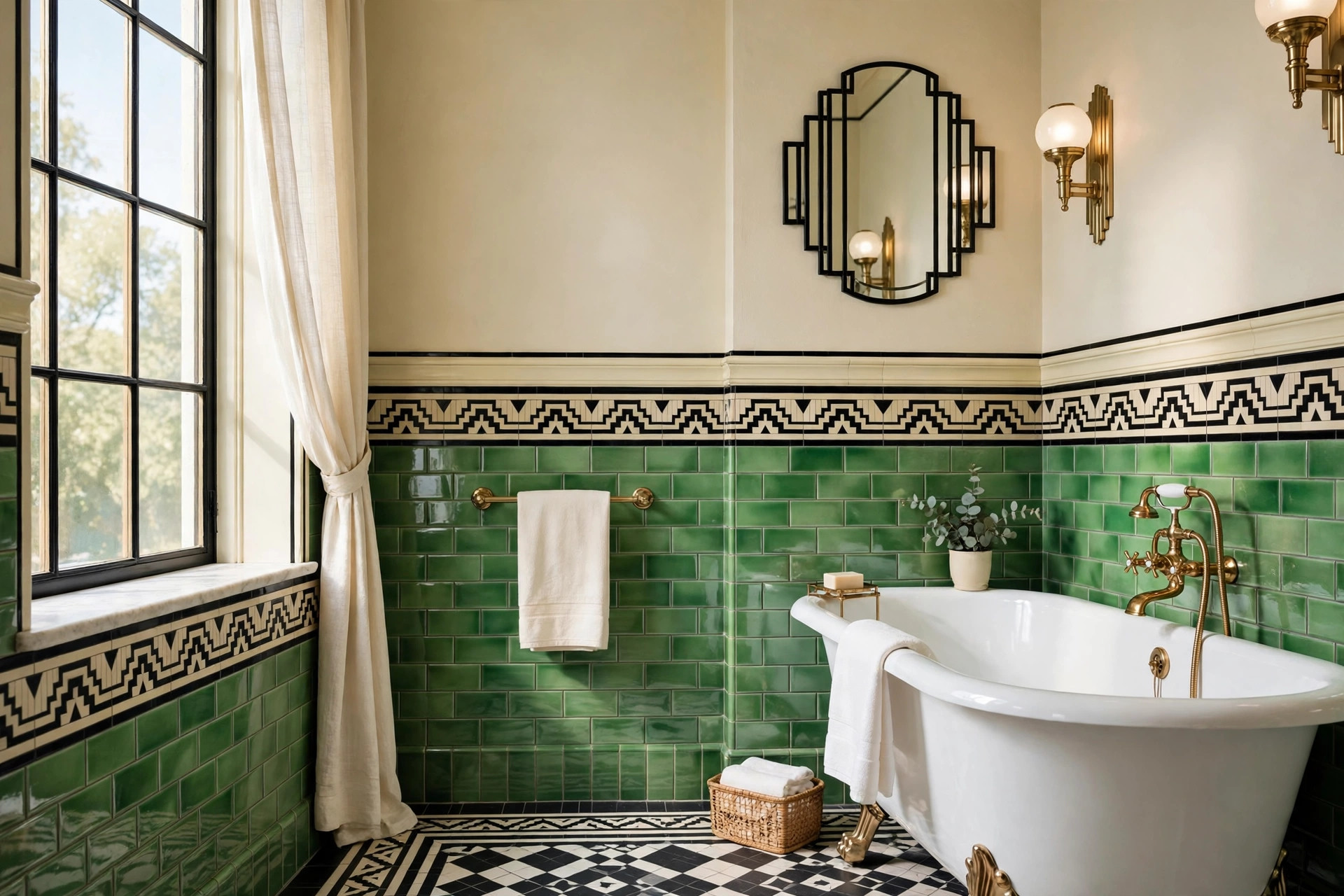
Knowing how to spot a real art deco subway tile matters because the style has never really gone away. The classic 3-by-6-inch brick tile, glazed in deep jade, glossy black or warm cream, has been made continuously since the 1920s — which means the market is full of handsome modern copies sitting next to genuine period pieces. A real Art Deco tile carries the marks of its making: a hand-dipped glaze, a slightly uneven edge, a crackle that took decades to develop and a back that still shows the mortar of the wall it came from. This guide shows you how to read those clues, so you can tell an original from a reproduction before you spend money or start tiling.
What Makes a Subway Tile Art Deco
First, a little history helps. Subway tile takes its name from the New York City subway stations of 1904, where white 3-by-6-inch tiles were chosen because they were easy to clean and reflected light in the tunnels. By the 1920s and 1930s, the Art Deco movement had adopted the format and given it glamour: deep jewel colours, glossy black with cream trim, stepped and chevron borders, and fan or sunburst accent tiles. A genuine Art Deco subway tile is therefore not just any 3-by-6 tile — it is a tile made during the Deco period, roughly 1920 to 1940, in a Deco colour or with a Deco profile. The classic field tile measures 3 by 6 inches, though 2-by-6 and 4-by-8 sizes exist, and the thickness is usually around a quarter of an inch. Bevelled edges became popular in the late 1920s, catching the light and giving the wall a quilted look, while flat tiles with a high gloss were used for a sleeker, more modern effect. Trim pieces are a big part of the story: bullnose edges, cove bases, chair rails and decorative liners in contrasting colours were all part of a Deco installation.
Glaze, Colour and Surface Clues
The glaze is your best evidence. Genuine Art Deco tiles were glazed by dipping or spraying, and the glaze pools slightly at the edges and in the corners, creating a deeper colour where it gathers. Hold a tile at an angle to the light and look for that pooling, along with tiny pinholes, faint ripples and the occasional small bubble — all normal in period glazing and almost absent from modern factory tiles, which are sprayed to a perfectly even coat. Colour is the next clue. The Deco palette is rich and saturated: jade green, cobalt blue, glossy black, butter yellow, peach, burgundy and warm cream, often used in bold combinations such as black with cream, or jade with black trim. Modern reproductions often use softer, muted versions of these colours, so a tile that looks a little too pale or too grey is worth questioning. Crackle, or crazing, is the fine network of hairline cracks that develops in the glaze over decades as the tile and its glaze expand and contract at different rates. A genuine period tile often shows this crackle, especially on white and cream tiles, while a new tile is usually flawless. Be aware, though, that crackle can be faked with a chemical treatment — real crackle is irregular and follows the shape of the tile, while faked crackle often looks too uniform. Finally, run your finger over the face: a period tile feels smooth but not slippery, with a slight texture from the hand finishing, whereas a modern tile can feel almost glassy.
Size, Shape and Edge Details
Measure the tile. A genuine Art Deco subway tile is 3 by 6 inches, and period manufacturing tolerances were generous — a real tile may measure 2 and 7/8 inches by 5 and 7/8 inches, or vary slightly from tile to tile in the same batch. Modern tiles are cut to exact, consistent dimensions, so a box of perfectly identical tiles is a sign of modern production. Look at the edges too. Period tiles have slightly rounded, soft edges from the moulding and firing process, and bevelled tiles show a gentle, hand-finished slope rather than a sharp, machine-cut angle. The corners may be very slightly uneven, and the face may bow almost imperceptibly — all signs of a tile made before modern precision pressing. Decorative tiles deserve a close look as well. Deco accent tiles with fan, sunburst, stepped or chevron patterns were usually made by applying a contrasting glaze by hand or with a simple stencil, so the pattern edges are slightly soft and the colours may overlap a fraction. A laser-sharp, perfectly registered pattern is a modern giveaway. If you are buying reclaimed tiles, expect variation: no two original tiles are exactly alike, and that variation is part of their charm on the wall.
Backs, Marks and Installation Evidence
Turn the tile over — the back often tells you more than the front. Genuine Art Deco tiles have an unglazed back with a slightly rough, sandy texture, often with ridges, grooves or a mesh pattern pressed in to help the mortar grip. Many period tiles show traces of old mortar, plaster or adhesive still clinging to the back, which is strong evidence that the tile was actually installed in a building decades ago. Some makers stamped their name or a pattern number into the back of the tile, and these marks — often faint and slightly uneven — are worth researching, as they can identify the factory and the date range. American makers of the period included the American Encaustic Tiling Company, the Cambridge Tile Manufacturing Company and the Mosaic Tile Company. A back that is perfectly clean, smooth and white, with a modern printed logo, is almost certainly a new tile. Also check for installation evidence on the face: faint grout lines or a thin line of old paint are signs of a tile that lived on a real wall.
Our Top Picks
If you love the Deco look but cannot find enough genuine tiles for a whole wall, these three options capture the era beautifully. A glossy jade green 3-by-6 bevelled tile with a cream chair rail and black liner gives you the classic Deco bathroom in a single, confident colour scheme. A black-and-cream combination — black field tiles with a cream bullnose and a stepped border — is the most dramatic Deco look and suits a small bathroom. And a warm cream subway tile with a single row of cobalt or burgundy accent tiles adds a touch of Deco colour without overwhelming a neutral room. Whichever route you choose, use a period-appropriate grout colour and keep the grout lines narrow, around 1/16 inch, as they would have been in a Deco installation.
Learning how to spot a real art deco subway tile comes down to reading the glaze, the colour, the size and the back together, and trusting the small imperfections that only time and hand-making can produce. A genuine tile is a small piece of design history, and once you know what to look for, you will recognise it at a glance — and you will never pay antique prices for a modern copy again.

GIPHY App Key not set. Please check settings