


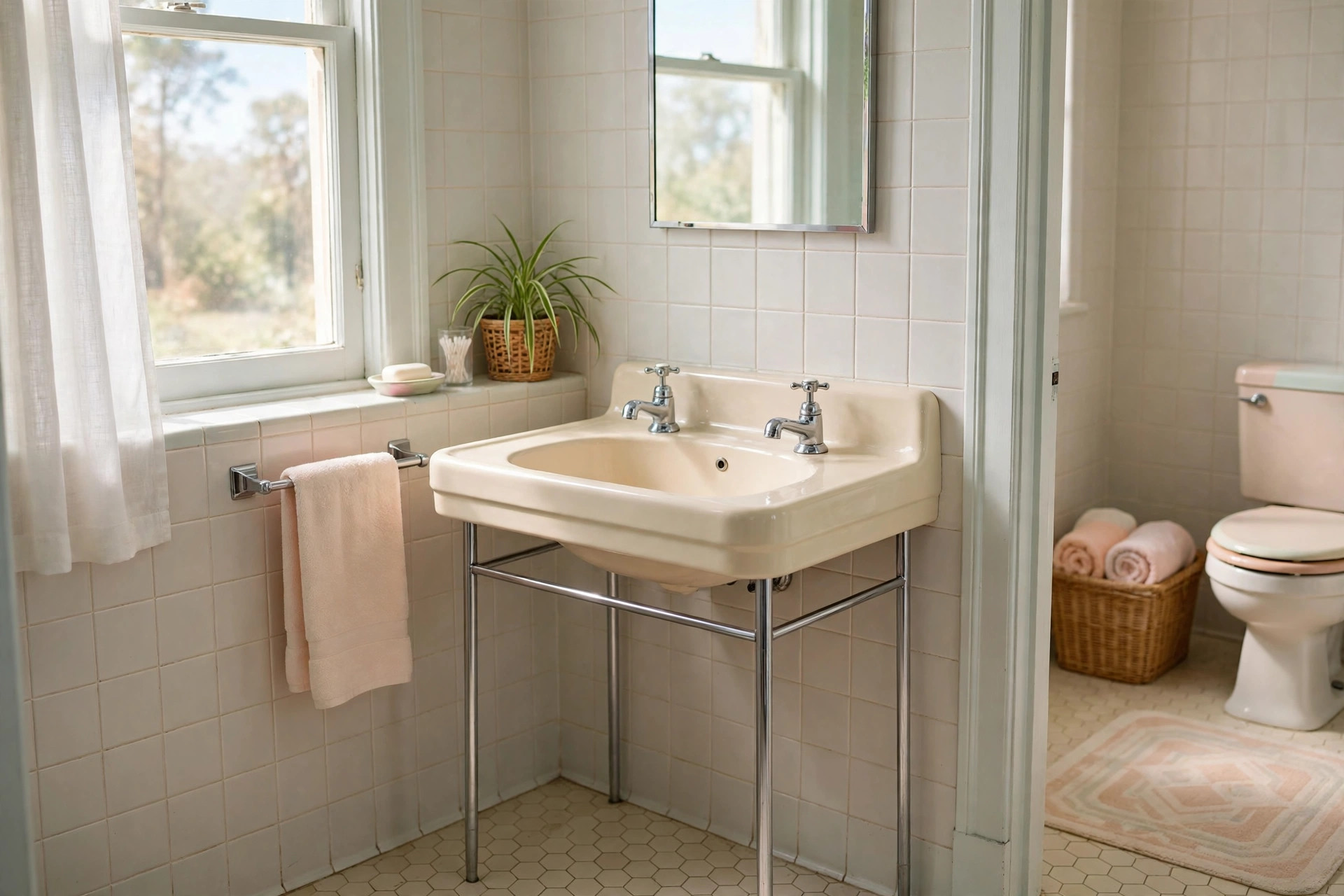
A console sink — a wall-hung basin carried on two slim front legs — is one of the defining fixtures of the 1980s bathroom, and it is also one of the most widely reproduced. Knowing how to identify real 1980s console sinks can save you from paying antique prices for a new basin with vintage styling, and it can help you find a genuine piece that will suit a period restoration perfectly. The clues are in the porcelain, the colour, the legs, the fittings and the marks stamped underneath the basin. This guide takes you through each one, so you can judge a sink with confidence whether you find it in a salvage yard, an estate sale or an online listing.
What a 1980s Console Sink Looked Like
The 1980s console sink was a revival of an earlier idea, dressed in the decade’s colours. Basins were typically 20 to 24 inches wide and 18 to 20 inches front to back, with a shallow, rounded-rectangle bowl and a generous flat deck around it for soap and toothbrushes. The defining feature is the pair of front legs: slim, straight chrome or brass legs, usually round or square in section, that support the front of the basin while the back is bolted to the wall. Some models had a lower shelf or a towel bar between the legs, and a few had a small backsplash of 4 inches. Faucet holes were drilled for either a 4-inch centre-set tap or an 8-inch widespread tap. Console sinks were popular in the decade’s smaller bathrooms and powder rooms because they took up less visual space than a vanity cabinet, and they fitted the 1980s taste for open, airy bathrooms with tiled walls and plenty of chrome.
Porcelain, Colours and Glazing
The porcelain is where a genuine 1980s sink gives itself away. Real period basins were made from vitreous china — a dense, glassy ceramic that rings with a clear tone when tapped lightly with a knuckle and feels cool and smooth to the touch. Reproductions are often made from fireclay or a lighter ceramic that sounds duller and feels slightly rougher. Weight is a useful guide: a genuine 1980s console basin typically weighs 40 to 60 pounds on its own, before the legs, while a modern copy can be noticeably lighter. Colour is the next clue, and the 1980s palette is unmistakable. Alongside classic white, the decade’s bathrooms came in almond, bone, dusty rose, peach, seafoam green, Wedgwood blue and pale grey. These colours were baked into the glaze, so a genuine coloured basin is the same shade all the way through the glaze layer — if you look at a chip and see white underneath the colour, the basin has been painted or refinished. The glaze itself should show the signs of age: fine crazing, a network of hairline cracks in the glaze that develops over decades, is normal and even desirable on a period piece, while a perfectly flawless glaze on a supposedly forty-year-old basin should make you suspicious. Small chips around the rim and the drain are also normal; a basin that has survived four decades without a single mark is rare.
Legs, Brackets and Fittings
The legs and hardware tell their own story. Genuine 1980s console legs were made from solid chrome-plated brass or steel, and they are heavy and rigid, with a smooth, mirror-bright finish that has dulled slightly at the joints. Modern reproduction legs are often hollow, lighter and coated in a thinner chrome that peels or bubbles at the edges. Look at the way the legs meet the basin: period sinks used a cast metal bracket or a socket fitting, secured with slotted screws and showing a little wear where the leg has been adjusted over the years. Wall brackets from the 1980s were heavy steel, bolted through the tile into a stud, and they often carry a maker’s stamp. Check the taps and the waste fitting too. Original 1980s taps were usually chrome-plated brass with ceramic disc or compression valves, and they have a satisfying weight and a smooth, firm action. Plastic taps, push-button wastes and quick-release fittings are all modern. If the sink is being sold with its original taps, check that the tap spread matches the holes — 4-inch or 8-inch — because mismatched taps are a sign that parts have been swapped. Finally, look underneath the basin for the wall-hung mounting: genuine 1980s basins have thick, reinforced mounting points cast into the porcelain, while reproductions sometimes rely on thinner sections that can crack under load.
Marks and Measurements That Confirm the Decade
Turn the basin over — or ask the seller for a photograph of the underside — and look for the maker’s mark. The main American makers of the period were Kohler, American Standard and Eljer, and their marks were stamped or fired into the underside of the basin, often alongside a model number and a date code. A fired-in mark, slightly uneven and part of the glaze itself, is a strong sign of authenticity; a printed sticker or a laser-etched mark is not. Measure the basin carefully and compare it with the maker’s catalogue dimensions for the model you think it is — genuine period basins follow standard sizes of the era, such as 22 by 18 inches or 24 by 20 inches, while reproductions are often a fraction of an inch off. Check the drain hole as well: 1980s basins used a standard 1.5-inch drain with a metal strainer, and the drain area should show a little wear and mineral staining from decades of use. If every detail lines up, you have a genuine 1980s console sink.
Our Top Picks
If you are shopping for the look rather than a certified antique, these three options give you the 1980s console sink style with modern reliability. A white vitreous china console basin on slim chrome legs is the most versatile choice and suits almost any retro bathroom, from a small powder room to a full family bathroom. A pastel basin in almond or seafoam green on brass legs captures the decade’s colour perfectly and pairs beautifully with matching pastel tiles and a chrome tap. And a compact 20-inch console sink with a lower towel bar is ideal for a small cloakroom, where a full vanity would crowd the room. Whichever you choose, make sure the wall behind it is solid — a console sink needs proper blocking in the wall to carry its weight safely — and fit a modern trap and supply lines even if you keep the period basin and legs. A genuine 1980s console sink is a practical, elegant fixture, and with the right installation it will serve for decades more.
Learning how to identify real 1980s console sinks is a matter of checking the porcelain, the colour, the legs and the marks together, rather than trusting any single clue. Take your time, lift the basin, look underneath and measure twice — and you will bring home a genuine piece of 1980s bathroom history rather than a modern copy in vintage clothing.

GIPHY App Key not set. Please check settings