

Figuring out how to identify real 1980s shower curtains is trickier than it sounds, because the decade’s most popular looks — pastel florals, country geese and bold geometrics — are back in production today. The difference lies in the details: the weight of the vinyl, the style of the print, the metal of the grommets and the wording on the label. A genuine 1980s curtain has spent forty years in bathrooms, linen cupboards and thrift shops, and that history leaves traces a new curtain cannot fake. Whether you are hunting for an authentic piece for a period bathroom or simply want to avoid paying vintage prices for a reproduction, this guide shows you exactly what to check before you buy.
What Defined a 1980s Shower Curtain
The 1980s shower curtain was a statement piece in a decade when bathrooms were anything but neutral. Standard sizes were 70 by 72 inches for a tub and 70 by 72 inches for most stall showers, with 12 buttonholes along the top — the same basic dimensions used today, so size alone proves nothing. What changed was the material and the mood. Most 1980s curtains were vinyl, sold as PVC, and noticeably heavier and stiffer than the soft PEVA curtains that dominate shops now. Fabric curtains existed too, usually cotton or a cotton blend, and they were generally used as a decorative outer curtain over a plain vinyl liner. The decade’s bathrooms were often pastel — peach, mint, dusty blue and mauve — and the curtain was expected to carry the room’s colour scheme. Country style was huge in the early 1980s, with geese, ducks and gingham checks everywhere, while the later part of the decade leaned towards chintz florals, Laura Ashley-style prints and bold Memphis-inspired geometrics in black, white and primary colours. If a curtain’s print looks like a modern boho pattern or a photographic image, it is almost certainly new: 1980s printing was flat, graphic and screen-printed rather than photographic.
Fabrics, Prints and Colours of the Decade
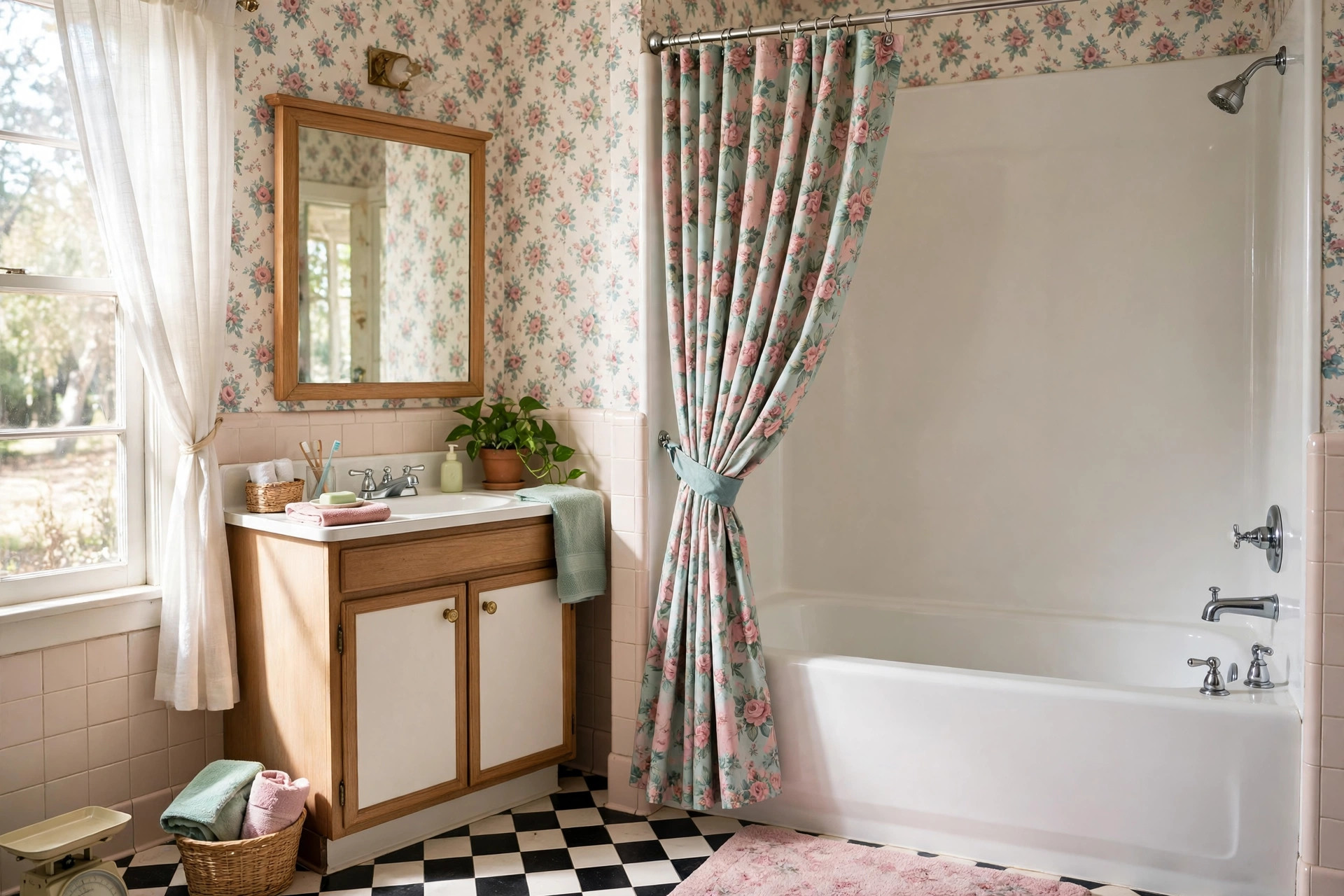
Start with the print itself. Genuine 1980s vinyl curtains were usually screen-printed, so look closely at the edges of the design: the colours should sit slightly imperfectly, with tiny registration wobbles where one colour overlaps another. Modern digital printing is pin-sharp by comparison. The colour palette is another strong clue. Early 1980s prints favour dusty, muted tones — peach, seafoam green, dusty rose and Wedgwood blue — while late 1980s prints go bolder, with teal, burgundy, hunter green and black-and-white contrasts. Country motifs are a hallmark of the first half of the decade: geese in bonnets, ducks, hearts, gingham and calico florals. By 1987 or so, chintz florals and oversized cabbage roses had taken over, often paired with a matching valance or window curtain. Vinyl from the period also has a distinctive feel: it is smooth but slightly tacky to the touch, with a faint chemical smell that lingers even after years of airing. Modern PEVA and polyester curtains feel softer, lighter and almost odourless. Fabric curtains from the 1980s were usually a medium-weight cotton with a slightly coarse weave; if the fabric feels silky, stretchy or very lightweight, it is probably a modern reproduction.
Labels, Grommets and Construction Details
The label is your best friend. Genuine 1980s curtains usually carry a woven or printed label sewn into a side seam or the top hem, often reading “Made in USA” or naming a department store brand, and the care instructions use older wording — “wipe clean with damp cloth” on vinyl, or “machine wash warm” on fabric. Modern reproduction labels tend to be flimsy paper tags or printed care labels with current symbols and web addresses. Check the grommets next: 1980s curtains almost always have metal grommets, usually brass or chrome-plated steel, and after forty years they show rust spots, tarnish or greenish corrosion around the rim. Plastic grommets or snap-in plastic rings are a modern feature and a clear warning sign. Look at the stitching and the hem. Period curtains have a weighted hem — a heavier folded edge at the bottom, sometimes with a sewn-in cord or small magnets added later — and the stitching is a simple straight lockstitch in matching thread. Overlocked or serged edges in contrasting thread, heat-sealed hems and built-in suction cups all point to a newer curtain. Finally, count the buttonholes: twelve evenly spaced holes are standard, but on a genuine 1980s curtain they are often slightly uneven, with hand-finished reinforcement stitching around each one.
Condition Clues and the Smell Test
A real 1980s curtain should show its age, and honest wear is a good sign. Look for gentle yellowing along the folds, faint water marks near the bottom hem and slight stiffness in the vinyl where it has hung folded for years. Small rust spots around the grommets and a little fading on the side that faced the window are exactly what you would expect from forty years of use. What you should not see is a curtain that looks brand new in every respect — perfectly white, perfectly flexible and smelling of nothing — being sold as vintage. That said, be wary of heavy mildew staining or a strong musty smell, which can mean the curtain was stored damp and may never fully clean up. Vinyl curtains can be washed gently in a bath with warm water and a little white vinegar, then air-dried; never put a 1980s vinyl curtain in a tumble dryer, as the heat can warp or melt it. Fabric curtains can usually be machine washed on a gentle cycle, but check for weak seams first, as old cotton can tear at the fold lines. If you are buying online, ask the seller for close-up photos of the label, the grommets and the bottom hem — a seller with a genuine piece will be happy to provide them.
Our Top Picks
If you want the 1980s look without the hunt, these three styles capture the decade’s spirit. A pastel chintz floral vinyl curtain in dusty rose and seafoam brings the late 1980s bathroom to life and pairs beautifully with a white suite and chrome fittings. A country-style curtain with a geese or gingham print is the classic early 1980s choice and suits a cottage-style bathroom with wooden accessories. And a bold black-and-white geometric curtain with Memphis-style shapes gives you the decade’s graphic energy without committing to a busy floral. For any of these, use a plain white vinyl liner behind the decorative curtain — it protects the print from constant water exposure and keeps a vintage original in good condition for years longer. Keep the rest of the room simple so the curtain stays the star, as it was designed to be.
Learning how to identify real 1980s shower curtains comes down to trusting your hands and your eyes: feel the weight of the vinyl, check the metal grommets, read the label and look for the soft, uneven wear of forty years. A genuine curtain is a small, cheerful piece of design history — and once you know the clues, you will never mistake a new copy for the real thing again.

GIPHY App Key not set. Please check settings