


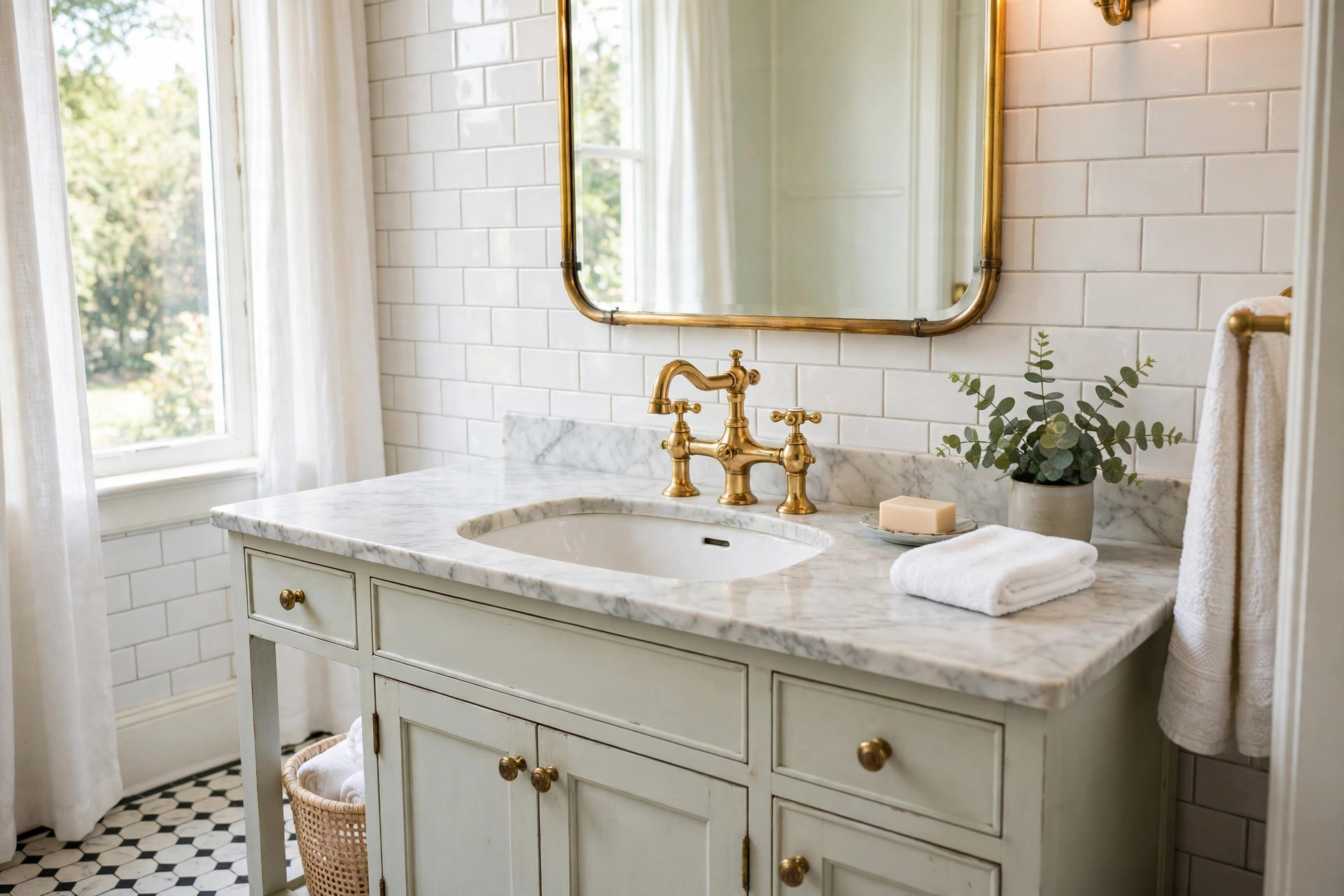
So how much does it cost to restore a brass faucet? The honest answer is that it depends on what you mean by “restore” — a gentle clean and polish might cost less than $20, while a full professional rebuild with replating can run $300 or more. A vintage brass faucet is one of the most rewarding pieces to bring back to life in a retro bathroom, but the costs add up quickly once you factor in parts, plating, and labour. Here is a clear breakdown of what to expect at every level.
What “Restoring” Actually Means
Before pricing anything, it helps to define the job. A brass faucet restoration usually falls into one of three categories. The first is cosmetic restoration: cleaning, polishing, and relacquering the surface so the brass looks bright and new again. The second is functional restoration: replacing washers, seals, valve seats, and cartridges so the faucet works properly without dripping or sticking. The third is full restoration: stripping the old finish, replating the metal, rebuilding the internal mechanism, and replacing every worn part. Each level costs a different amount, and most faucets need a combination of the first two, with the third reserved for high-value or sentimental pieces.
Start by assessing your faucet. Turn the handles: do they move smoothly, or do they stick and grind? Run the water: does it drip when the faucet is off? Look at the finish: is the brass bright under a layer of tarnish, or is the plating worn through to the base metal in patches?
The DIY Route: $15 to $100
The cheapest way to restore a brass faucet is to do it yourself, and for many faucets that is all they need. A basic cleaning kit — a soft cloth, a gentle brass cleaner such as Brasso or Bar Keepers Friend, and a can of clear lacquer spray — costs about $15 to $30. The process is simple: remove the faucet from the sink, clean off the tarnish with the brass cleaner, polish with a soft cloth, and seal the finish with a thin coat of lacquer to slow future tarnishing. Allow a couple of hours for a single faucet, and work in a ventilated area.
If the faucet drips or the handles are stiff, you will need parts. A washer and O-ring kit for a standard compression faucet costs $5 to $15, and a replacement valve seat — the small brass ring the washer presses against — runs $3 to $10. A faucet seat wrench, the tool that removes the old seat, costs about $10 to $20 and is reusable for future projects. For a cartridge-style faucet, a replacement cartridge typically costs $20 to $60 depending on the brand, with Kohler and American Standard cartridges at the higher end of that range.
All told, a straightforward DIY restoration usually lands between $15 and $100, and it is a very satisfying weekend project.
Professional Cleaning and Polishing: $75 to $200
If you would rather hand the job to a professional, a plumber or metal restoration specialist can clean, polish, and relacquer a brass faucet for roughly $75 to $200, depending on size, condition, and location. This usually includes ultrasonic cleaning to remove mineral deposits, hand polishing, and a fresh coat of lacquer. Professional polishing is worth considering for a valuable or unusual piece, or when tarnish is heavy and the brass is pitted. Get a quote in writing first, and ask whether removal and reinstallation — often $50 to $100 extra — is included.
Replating: $150 to $400 and Up
When the original plating is worn through to the base metal, cleaning will not fix it — the faucet needs replating. The old finish is stripped, the base metal polished, and a new layer of chrome, nickel, or brass applied, followed by a protective lacquer. Replating a single bathroom faucet typically costs $150 to $400, and a full three-piece set — spout and two handles — can cost $250 to $500, with turnaround usually two to four weeks. Polished chrome is usually cheapest; polished nickel and unlacquered brass cost more. If the faucet is a common model still in production, a new reproduction may be cheaper than replating — but for a rare or sentimental piece, replating preserves the original metal and its history.
Full Professional Restoration: $250 to $600
A full professional restoration combines everything: stripping and replating, rebuilding the valve mechanism, replacing all washers, seals, and cartridges, and reassembling and testing the faucet. Expect $250 to $600 for a standard bathroom faucet, with larger or more complex pieces at the higher end. Ask for an itemised quote — stripping, plating, parts, labour, and testing — and ask about the warranty; reputable shops usually guarantee plating for one to five years depending on the finish.
Hidden Costs to Watch For
A few costs catch people by surprise. Removal and reinstallation by a plumber usually runs $100 to $200 per visit. Parts for a 1940s or 1950s faucet may need to come from a specialist supplier, costing $30 to $80 with shipping. And if the faucet has leaked for years, the porcelain around the faucet holes may be stained or damaged. Old supply lines are often corroded too; replacing them with flexible braided stainless steel lines costs $10 to $25 per line, a sensible job to do while the faucet is out.
Our Top Picks
If you are planning a brass faucet restoration, these are the supplies and services worth investing in:
- A quality brass cleaner and soft polishing cloths. A gentle, non-abrasive cleaner protects the finish, and soft cotton cloths prevent the fine scratches that a scouring pad would leave.
- A washer and O-ring kit matched to your faucet brand. Buying the kit for your specific brand — Kohler, American Standard, or Crane — saves a second trip to the store and ensures the parts actually fit.
- A reputable local replating shop. Ask for references, look at examples of their work, and get the quote in writing. A good plater is the difference between a faucet that looks new and one that looks merely shiny.
Is It Worth It?
Whether restoring a brass faucet is worth the cost depends on the faucet. A common, mass-produced faucet in poor condition is rarely worth a $400 replating job — a new reproduction in solid brass costs $150 to $300 and will last for decades. But a rare, well-made, or sentimental faucet is a different story: a full restoration at $250 to $600 gives you a piece that is genuinely old, genuinely beautiful, and built to a standard that modern mass-market faucets rarely match. The rule of thumb is simple: if the faucet is worth more to you than the cost of the restoration — in money, in history, or in the look of your bathroom — then restore it. If it is not, a good clean and a new set of washers will often be enough, and you will have spent less than $100 for a faucet that works and looks far better than it did.

GIPHY App Key not set. Please check settings