


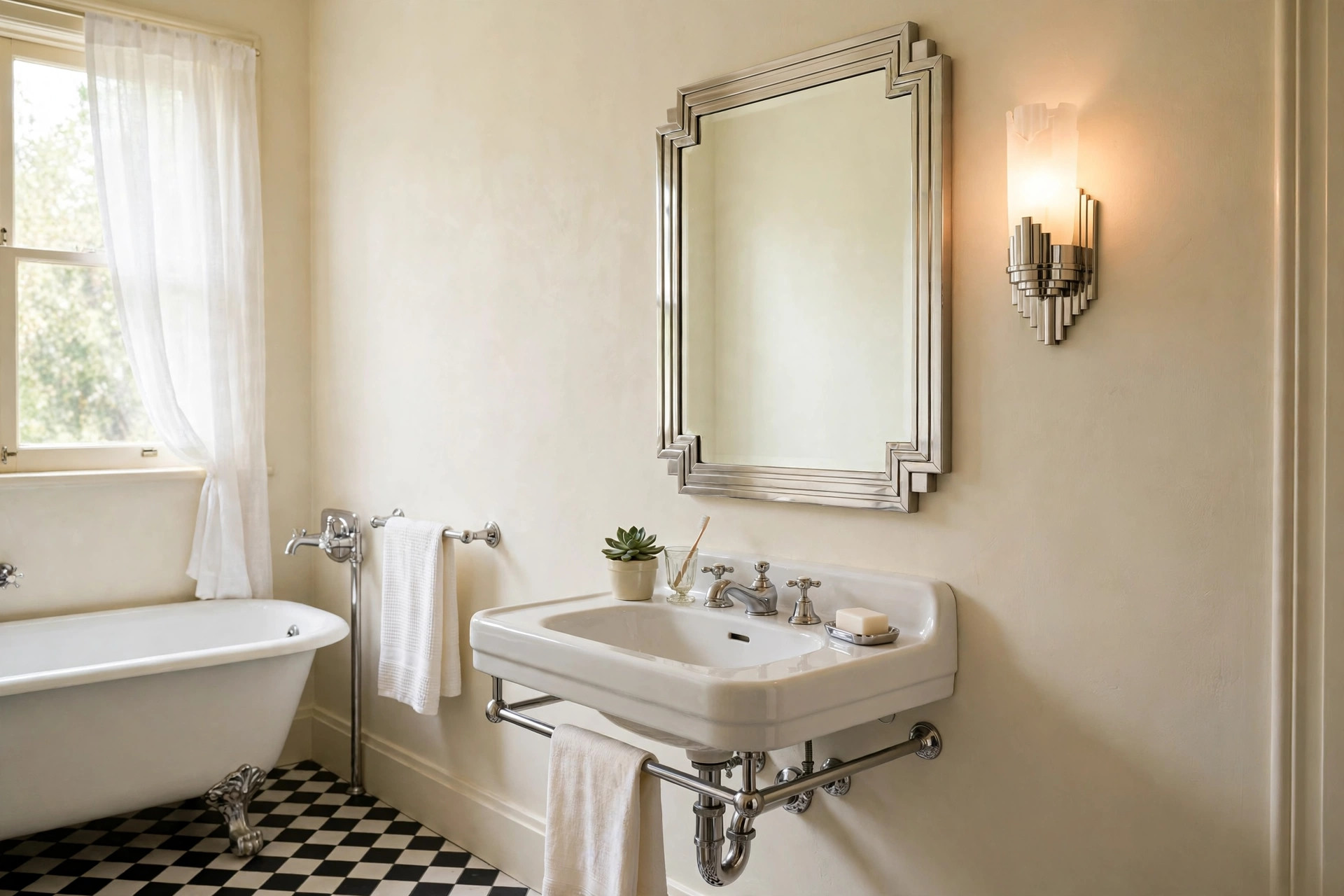
Few lights flatter a vintage bathroom like a 1930s wall sconce. The decade gave us stepped geometric shades, frosted glass, chrome and nickel fittings, and soft, even light that makes a mirror genuinely useful. Whether you want one sconce beside a mirror or a matching pair flanking a vanity, this 1930s wall sconce for sale buyer shortlist will help you tell an original from a reproduction, budget for rewiring, and pay a fair price.
What a 1930s Sconce Looks Like
The 1930s sits between Art Nouveau’s flowing curves and the streamlined look of the 1940s, and its lighting reflects that. Expect geometric shapes — stepped tiers, fan motifs, chevrons, and frosted glass shades in opal, amber, or pale green. Metalwork is usually chrome, nickel, or polished brass, often with bakelite details. Shades are commonly slipper-shaped, shell-shaped, or simple frosted glass panels that wash light up and down the wall.
A genuine 1930s sconce was made to use incandescent bulbs, so it may have a small Edison screw or bayonet socket. That is fine — modern LED bulbs in the same fitting give the same warm glow for a fraction of the running cost. Look for a warm white LED, around 2700K, to keep the period feel, and keep this 1930s wall sconce for sale buyer shortlist in mind when you check the socket type.
Original, Vintage, or Reproduction?
An original 1930s sconce — one actually made in the decade — is a collector’s piece. Prices vary widely: a simple single-light chrome sconce might sell for $80–$200, while a rare pair with original glass shades can reach $300–$800 or more. Condition is everything. Original glass shades are fragile and hard to replace, so a sconce with its original shade intact is worth a premium.
A vintage sconce, made later but in a 1930s style, is often the best value. Mid-century reproductions from the 1950s to the 1970s, and good modern reproductions, capture the look for $60–$250. For a bathroom you use every day, a modern reproduction is often the smartest buy: it arrives wired to current standards, takes standard bulbs, and comes with a warranty.
The tricky middle ground is a seller calling a modern reproduction an “original.” Check for maker’s marks and compare the price with similar pieces. This 1930s wall sconce for sale buyer shortlist is built around that caution: if the price seems too good for an original, it probably is not one.
The Shortlist: What to Check Before You Buy
1. The glass shade. Hold the shade up to the light and check for chips, cracks, and repairs. Frosted glass hides small flaws well, but a crack near the fitting can spread with heat. Ask whether the shade is original — a replacement shade changes the value and the look.
2. The metalwork. Chrome and nickel should be bright with no pitting or flaking. Light tarnish on brass can be polished out, but pitting and corrosion cannot. Check the backplate too: it sits against the wall, so damage there is easy to miss.
3. The wiring. This is the most important check. Original 1930s wiring is not safe to use as it stands — the insulation degrades and the fittings predate modern safety standards. Budget $40–$100 per sconce for professional rewiring with new cable, a modern lampholder, and an earth connection where required. If a seller claims an original is “ready to install” without rewiring, be sceptical.
4. Bathroom safety rating. Lights in a bathroom must suit their zone. A sconce beside a mirror, away from direct water spray, usually needs an IP44 rating or better — protected against splashing water. Check the rating before you buy, especially for originals, which may have none at all. A qualified electrician can advise whether a fitting suits your bathroom’s zones.
5. Size and placement. A single sconce beside a mirror should sit at about eye level, roughly 1,600–1,700mm from the floor. This is an easy detail to get wrong, so keep this 1930s wall sconce for sale buyer shortlist beside you while you measure: a pair flanking a vanity should be spaced about 750–900mm apart, depending on the mirror width. Measure your wall before you buy — a sconce that is too large will crowd the mirror, and one that is too small will look lost.
6. The bulb fitting. Check the socket type and whether it takes a standard bulb. Some originals use obsolete fittings that need an adapter or a specialist bulb. A standard E14 or E27 socket, or a bayonet fitting, is the easiest to live with.
7. Matching pairs. Sconces look best in pairs, and a genuine matched pair is worth more than two similar singles. If you can only find one, check whether the seller or maker has a second — or be prepared to hunt. Buying a pair together is usually cheaper than assembling one over months.
Where to Find One
Architectural salvage yards and antique fairs are the best hunting grounds for originals — go in person, handle the piece, and check the glass and metalwork yourself. Online marketplaces list plenty of 1930s sconces, but ask for photographs of the shade, the backplate, and the wiring before you commit, exactly as this 1930s wall sconce for sale buyer shortlist recommends. Specialist lighting retailers that stock period reproductions are the safest route for a matching pair with a warranty.
Estate sales and auction houses sometimes offer the best prices of all, especially for pairs, but you will usually be buying as seen, with no returns. Set a maximum bid before you go, and stick to it.
Budgeting the Whole Job
A reproduction sconce at $60–$250, or an original at $80–$800, is only the start — and a good 1930s wall sconce for sale buyer shortlist always counts the fitting costs too. Add rewiring at $40–$100 per fitting if it is an original, plus an electrician’s time to install it — typically $100–$250 for a pair, more if new wiring needs to be run through the wall. A realistic all-in budget for a pair of reproduction sconces, fitted and working, is $250–$700. A pair of rewired originals, installed, can reach $500–$1,500.
Our Top Picks
Three choices that fit this 1930s wall sconce for sale buyer shortlist:
- A modern reproduction pair in chrome with frosted glass shades — the safest, simplest route to a 1930s look, with a warranty and standard fittings.
- A salvage-yard original with an intact shade — for a feature wall or powder room where one beautiful light is enough.
- A single slipper-shade sconce in nickel — a classic 1930s shape that works beside a mirror in a small bathroom.
A 1930s wall sconce is a small purchase that changes how a bathroom feels every single morning. Work through this 1930s wall sconce for sale buyer shortlist, check the glass, the metalwork, and the wiring before you pay, and budget for a professional rewire on any original. Buy the pair if you can, fit them at eye level, and enjoy the warm, Deco-era glow they were made to give.

GIPHY App Key not set. Please check settings