


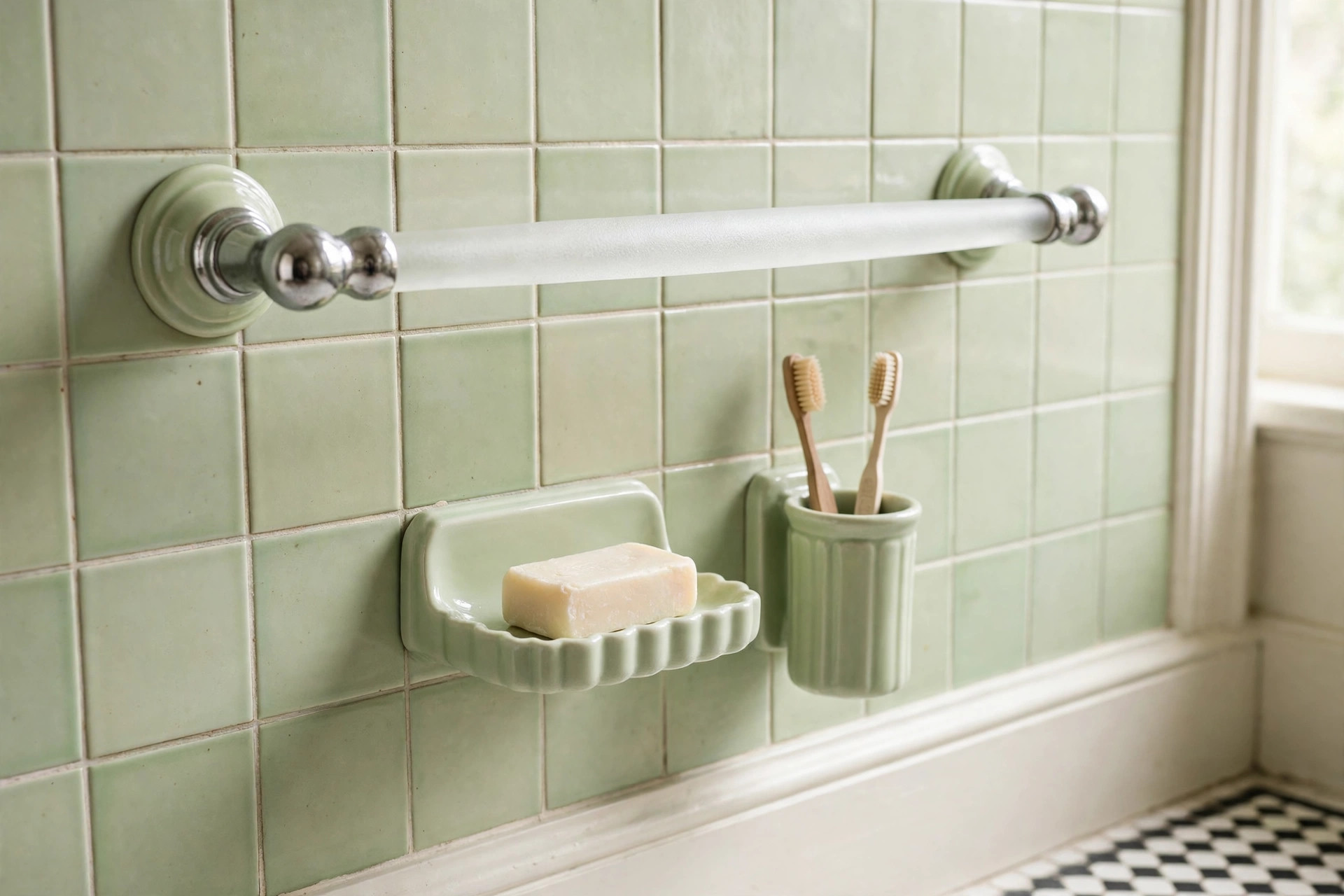
Learning how to spot a real 1940s towel bar set saves you from the most common mistake in vintage bathroom collecting: paying antique prices for a modern reproduction. The 1940s produced some of the most elegant bathroom hardware ever made — slim chrome bars, glass towel rods, and ceramic holders with soft pastel glazes — and modern makers copy the look very convincingly. The differences are in the details: the weight, the metal, the glass, and the way the pieces were made. Work through the eight checks below before you buy.
Know What a 1940s Set Actually Looked Like
A complete 1940s towel bar set usually included a 24-inch towel bar, a smaller 18-inch bar or a towel ring, a soap dish, a toothbrush holder, and sometimes a toilet-paper holder, all in matching metal and ceramic. The dominant style was Streamline Moderne: smooth curves, rounded edges, little ornament. Chrome was the most common finish, with nickel as the quieter alternative. Ceramic holders came in white, pale green, soft pink, pale blue, and ivory, made to match the coloured bathroom suites that were fashionable in the late 1930s and 1940s. Ornate Victorian scrollwork sold as 1940s should raise suspicion — that style belongs to an earlier era.
Weight, Chrome and Glass
Feel the Weight
Pick the piece up. Genuine 1940s bathroom hardware is noticeably heavier than modern reproductions. The towel bar itself was usually solid brass with a chrome plating, and the ceramic holders were thick-walled porcelain or vitreous china. A real 24-inch bar with its two wall mounts weighs roughly 700 to 900 grams. A modern copy, often made from hollow aluminium or thin zinc alloy, weighs half as much and feels tinny in the hand. Weight alone is not proof, but it is the fastest first test and very hard for a reproduction to fake.
Examine the Chrome
Chrome plating in the 1940s was applied thickly over brass or nickel, and after eighty years it shows a particular kind of ageing. Look for a warm, slightly yellow tone in the reflections, tiny pinprick pits in sheltered spots, and a soft patina where hands touched the bar for decades. The plating may be worn thin on the top of the bar but should still be smooth, not flaking. Modern chrome is brighter, colder, and almost blue-white by comparison, and when it fails it peels in sheets rather than wearing gradually. A bar that looks brand new and mirror-bright is either a reproduction or a piece that has been re-plated, which is fine for use but not worth antique prices.
Look at the Glass Rod
Many 1940s towel bars used a glass rod instead of a metal one, usually in a frosted or opalescent finish. Genuine period glass has a soft, slightly milky appearance with tiny bubbles and faint ripples visible when you hold it to the light. The ends of the rod are smoothly finished, and the diameter is usually 16 to 19 millimetres. Modern glass rods are clearer, more uniform, and often slightly thinner. If the glass is perfectly clear and flawless, it is almost certainly new. Also check how the rod sits in its mounts: original mounts grip the glass with a small set screw or a spring clip, while reproductions often use a visible plastic insert.
Ceramic, Mounts and Measurements
Check the Ceramic Holders
The ceramic parts of a 1940s set — the wall mounts, soap dish, and toothbrush holder — were made from vitreous china with a thick, glossy glaze. Turn a holder over and look at the unglazed base: genuine pieces show a fine, off-white ceramic body, sometimes with a maker’s mark stamped in blue or black. Common makers include Crane, American Standard, and Kohler, and their marks are well documented. The glaze on an original has depth, with slight pooling in the curves and tiny variations in colour. Modern ceramic copies often have a thinner glaze, a stark white body, and no maker’s mark at all — or a mark that looks printed rather than stamped.
Inspect the Mounting Hardware
Turn the wall mounts over and study the screws and fixings. Original 1940s sets used slotted brass screws, often with a slightly domed head, and the mounting plates were cast or stamped from solid brass. The screw holes show honest wear, and the plates may have a faint maker’s stamp on the back. Reproductions usually come with modern Phillips-head screws in zinc-plated steel, and the mounting plates are thinner and lighter. If a set arrives with shiny new Phillips screws in the box, the hardware has almost certainly been replaced, which is not a deal-breaker for a bathroom you plan to use, but it should lower the price.
Compare the Measurements
Period hardware followed standard sizes, and those standards are a useful check. A full-size 1940s towel bar is 24 inches between the centres of its mounts, with an 18-inch version for smaller bathrooms. The bar sits 70 to 80 millimetres out from the wall, and the mounts are 50 to 60 millimetres across. Reproductions often drift from these measurements by a few millimetres, because they are scaled from photographs rather than from original patterns. Measure the piece and compare it with the standard sizes. A bar measuring 60 centimetres instead of 61 is a strong hint that the piece is new.
Watch for the Classic Reproduction Tells
A few details give reproductions away almost every time. Mould lines or seams on the ceramic that were never polished smooth. A chrome finish that is identical and flawless on every surface, including the hidden backs of the mounts. A maker’s mark that is spelled slightly wrong or placed where no original maker put one. A set where every piece is in perfect condition, with no wear at all, yet is sold as eighty years old. Genuine antique hardware has lived a life, and that life leaves traces. A set that looks untouched after eight decades in a damp bathroom is the most suspicious set of all.
Our top picks
- A jeweller’s loupe or a phone macro lens: reveals glaze texture, maker’s marks, and chrome pitting that the naked eye misses.
- A small digital scale: weighing a bar takes ten seconds and is one of the most reliable authenticity checks you can do.
- A set of brass slotted screws: if you buy a genuine set with replaced fixings, period-correct screws restore the look for a few dollars.
Buying With Confidence
Buy from sellers who photograph the backs of the mounts, the unglazed bases, and the maker’s marks. Ask for the weight and the measurements before you pay, and compare them with the standards above. Expect to pay $40 to $90 for a genuine 1940s towel bar in good condition, and more for a complete matching set with ceramic holders. Knowing how to spot a real 1940s towel bar set means you can buy with confidence, pay a fair price, and hang a piece of genuine history on your bathroom wall instead of a clever copy.

GIPHY App Key not set. Please check settings