


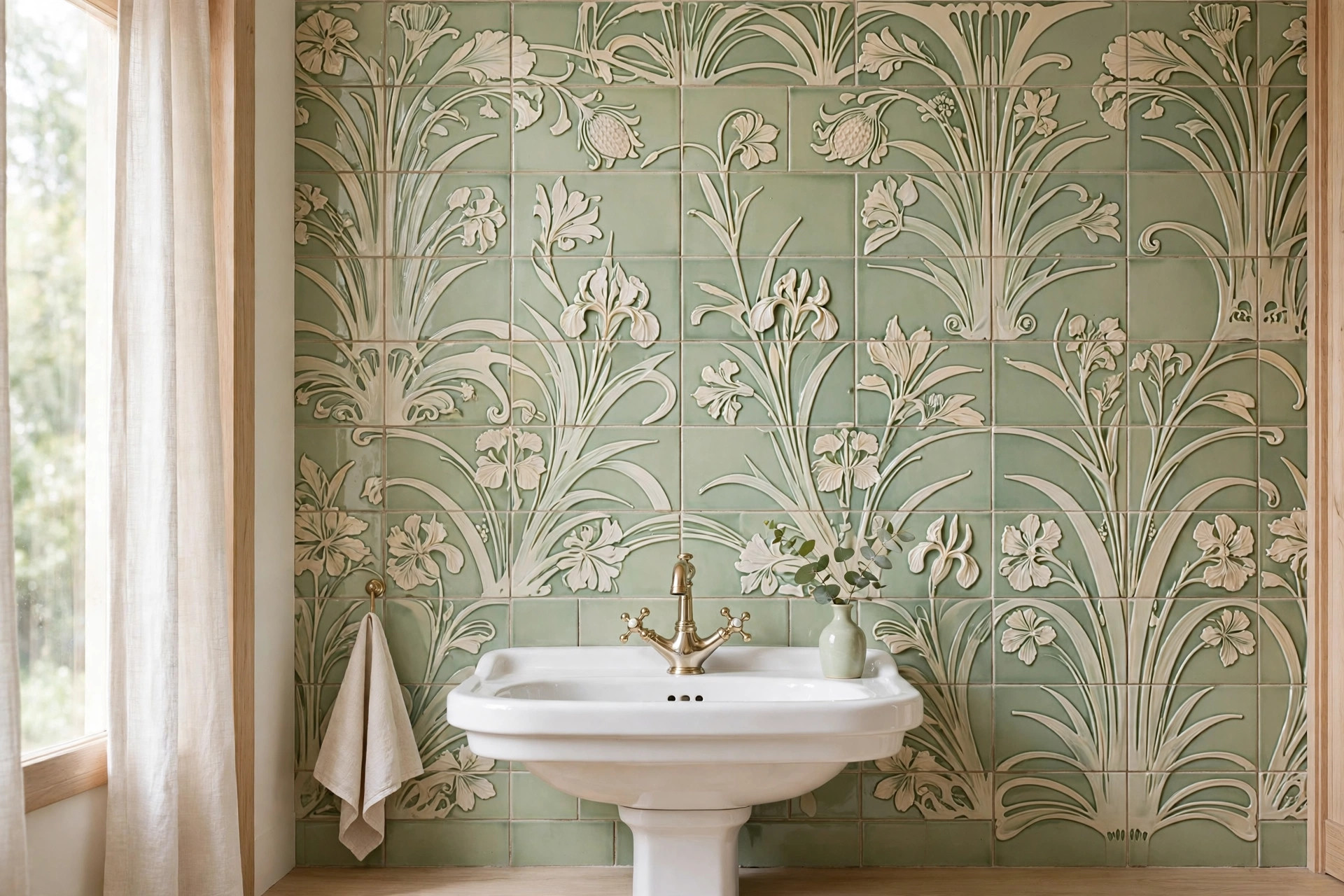
Few tiles capture the romance of the early 1900s like Art Nouveau subway tile. With its whiplash curves, stylised flowers and softly rippled glazes, it turns an ordinary bathroom wall into something closer to a work of art. The trouble is that genuine antique tiles are scarce, fragile and often sold in incomplete lots. So where to find Art Nouveau subway tile reproductions that look right, last well and suit a real bathroom? This guide walks through the best sources, what to ask before you buy, and how to spot a quality reproduction.
What Counts as an Art Nouveau Reproduction
True Art Nouveau tile flourished roughly between 1890 and 1910, and its hallmarks are easy to recognise: asymmetrical, flowing lines inspired by stems and vines; relief patterns you can feel under your fingers; and glazes in muted greens, ochres, blues and creams, often with a hand-finished variation from tile to tile. A good reproduction captures at least two of those three qualities. Be wary of flat printed tiles that borrow a Nouveau motif but have no relief and no glaze depth — from across the room they can look convincing, but up close they read as a photograph of a tile rather than a tile.
Standard subway tile dimensions apply: the classic format is 7.5 by 15 centimetres, though many Nouveau reproductions also come in 10 by 20 centimetres. Relief tiles are usually thicker — around 10 to 12 millimetres — so check that your tiler allows for the extra depth at edges and trims.
Specialist Tile Makers and Studios
Your first stop should be specialist ceramic studios and heritage tile makers. These are the workshops that press or hand-form tiles in small batches, glaze them by hand and fire them in kilns, much as the original makers did. Because each batch is small, expect shade variation between tiles — that is a feature, not a flaw, and it is what gives a Nouveau wall its living, handmade surface.
Search for studios that describe their work as hand-glazed, relief or moulded, and ask whether they can supply matching border tiles, pencil trims and corner pieces. A good maker will offer samples, usually for a small fee, and will tell you the lead time honestly — four to eight weeks is normal for a made-to-order run. Prices vary widely with the maker and the complexity of the relief, so request a per-square-metre quote for your exact quantity rather than comparing headline tile prices.
Salvage Yards, Marketplaces and Tile Retailers
If you want genuine antique tiles, salvage yards and reclamation dealers are the place to look. Tiles surface when old houses, hotels and bathhouses are renovated, and dealers often sort them into usable lots. The charm is real — a century of patina cannot be faked — but so are the risks. Antique tiles may be chipped, crazed or slightly different sizes, and you may need to buy more than you need to cover breakages and cuts. Always inspect a lot in person or request detailed photographs of every tile, and ask whether the dealer can supply the quantity you need plus 10 to 15 per cent extra for wastage.
Large online tile retailers and handmade marketplaces are the most convenient source, and the range is enormous. Use them for standard-format relief subway tiles and for decorative feature tiles to mix with plainer field tiles. Read reviews that mention glaze quality and colour accuracy, and order a sample box before committing to a full order — screen colours are notoriously unreliable for green and ochre glazes. Check the returns policy too: many retailers will not accept returns on cut or special-order tiles, so confirm quantities with your tiler first.
Our Top Picks
These three routes suit different budgets and projects. None of them is a single product, because the right choice depends on your bathroom, but each represents a reliable way to buy.
A hand-glazed studio reproduction. Best for a feature wall or a splashback where the tile is the star. Look for a studio that fires small batches, offers samples and can supply matching trims. Expect the richest glaze variation and the highest price, and plan for a longer lead time.
A heritage tile maker’s standard relief range. Best for a full bathroom, where you need consistent sizing and a dependable supply. These ranges usually include field tiles, borders and corners in the same glaze family, so the whole room coordinates without guesswork.
Salvage tiles for a single accent panel. Best for a small, high-impact detail such as a niche surround or the wall behind a basin. Buying a modest quantity keeps the cost manageable, and the genuine patina of antique tiles is unbeatable at close range.
Before You Order: A Quick Checklist
Measure twice and order 10 to 15 per cent extra for cuts and breakages. Ask for the tile’s water absorption rating — bathroom wall tiles should be well under 10 per cent — and confirm the tiles are suitable for wet areas. Check the thickness of relief tiles against your trims and edge profiles, and ask your tiler whether they have worked with handmade tiles before, since uneven edges need a wider grout joint, typically 3 millimetres, to look intentional.
Finally, live with your samples for a few days. Tape them to the wall, look at them in morning light and evening light, and hold them next to your paint and fittings. Art Nouveau tile changes dramatically with the light, and the glaze you love at noon may look quite different by lamplight.
Knowing where to find Art Nouveau subway tile reproductions is half the battle; the other half is choosing patiently. Order samples, compare makers, and let the tile’s flowing lines do what they have done for more than a century — make an ordinary bathroom feel quietly extraordinary.

GIPHY App Key not set. Please check settings