


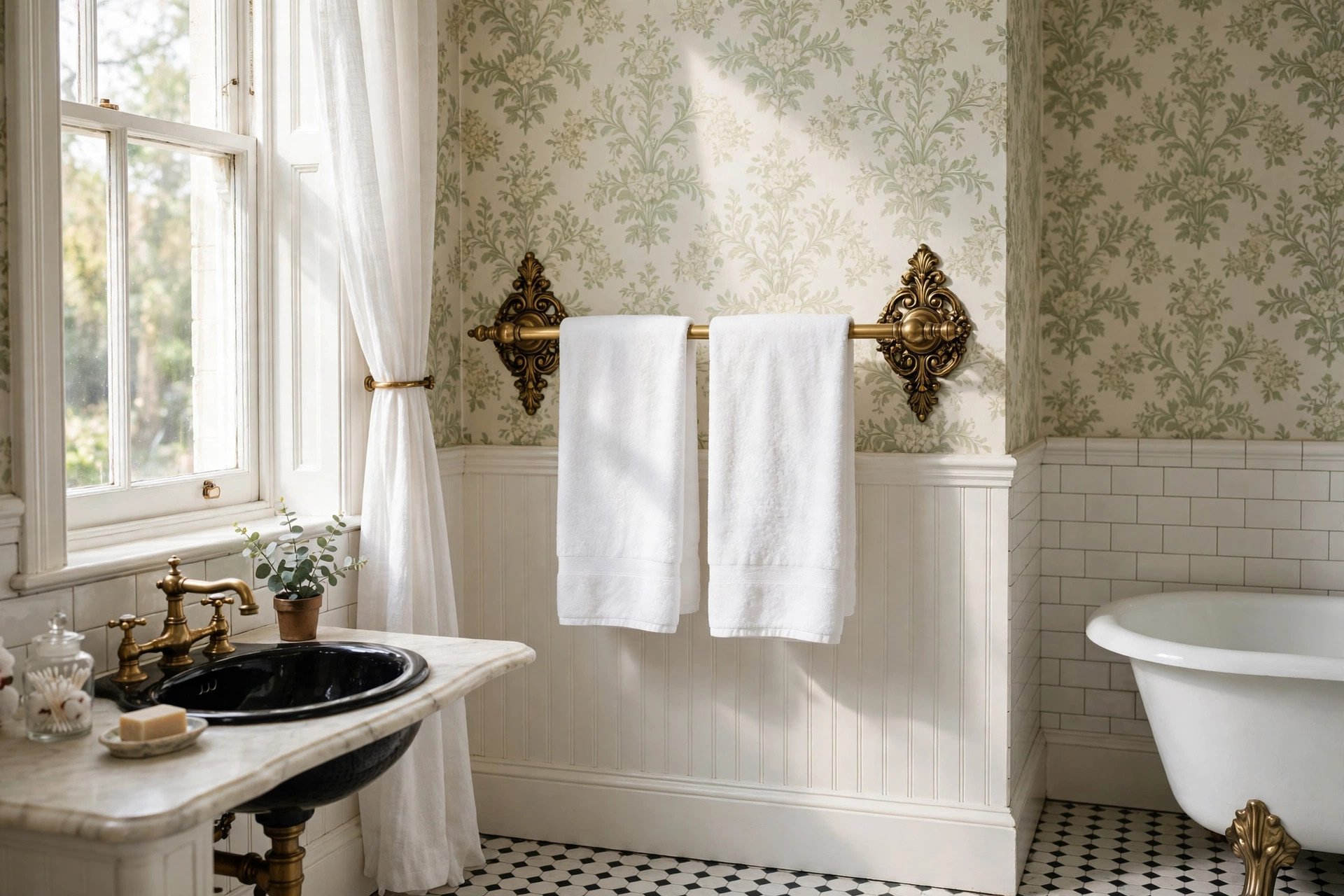
Victorian towel bar sets are among the most collected pieces of bathroom hardware, and they are also among the most copied. Reproductions range from honest modern pieces in a period style to deliberate fakes aged to look a century old. Knowing how to spot a real Victorian towel bar set will save you from paying antique prices for a modern copy — and help you recognise a genuine bargain when you find one. The clues are in the materials, the construction, the wear and the fixings, and most of them can be checked in a few minutes with nothing more than your eyes and your hands.
What a Victorian Towel Bar Set Actually Is
First, a quick definition. A Victorian towel bar set usually consists of a horizontal bar — round in section, between 45 and 60 centimetres long for a single bar — held between two decorative wall mounts, sometimes with a matching towel ring or robe hook in the set. Victorian bars were made for the era’s bathrooms, which often had a washstand rather than a modern basin, so the sets tend to be smaller and more ornate than their Edwardian successors.
The materials are the first clue. Genuine Victorian pieces are almost always solid brass, often nickel-plated, or occasionally porcelain-mounted. Cast iron appears in cheaper sets, but solid brass with a nickel or chrome plate is the classic combination. The bar itself may be brass, wood — usually mahogany or rosewood, turned on a lathe — or porcelain. Plastic, aluminium and hollow thin-walled tubing are modern giveaways: if the bar feels suspiciously light, it is almost certainly a reproduction.
Check the Construction and the Fixings
Victorian hardware was made before standardised mass production, and that shows in the details. Look at the back of the wall mounts first. Genuine pieces usually have slotted screws, not Phillips or cross-head screws, which were not in common use until the 1930s. The screw heads may show signs of hand filing, and the mounts themselves often have a slightly irregular casting — tiny bumps, seams or file marks that modern die-casting eliminates.
Check how the bar is held. On a genuine Victorian set, the bar is typically held by a small set screw or a threaded socket in each mount, and the bar can be removed. The ends of a wooden bar often show a turned tenon that fits into the mount. On many reproductions, the bar is glued, welded or crimped in place — a construction method a Victorian maker would not have used.
Look at the wall plate fixings too. Victorian mounts were usually fixed with two screws through a small backplate, and the plate often has a maker’s mark, a patent number or a registration diamond stamped into the reverse. Marks to look for include names like J. L. Mott, Thomas Crapper, or the Birmingham makers — but be aware that marks can be faked, so treat them as supporting evidence, never proof on their own.
Read the Wear and the Patina
Age leaves evidence that is very hard to fake convincingly. On a genuine Victorian piece, the wear follows the pattern of a century of use: the plating is thinnest on the raised parts of the mounts and on the centre of the bar where towels have rubbed, while recesses and crevices keep more of their finish. The exposed brass underneath often has a warm, slightly mottled patina — not a uniform colour.
Artificial ageing, by contrast, tends to be too even. A reproduction that has been chemically darkened or tumble-aged usually shows the same tone everywhere, including in places that would never have been touched. Look for darkening in the crevices combined with bright, shiny high spots — that is the pattern of genuine use, where hands and towels polished the raised surfaces over decades.
Also check the underside of the bar and the back of the mounts, places a faker rarely bothers to age. A genuine piece shows consistent ageing in these hidden spots; a fake often looks brand new underneath while the visible surfaces are artificially worn.
The Finish and the Details
Victorian nickel plating has a distinctive quality: it is slightly warm and soft in tone, with a depth that modern chrome lacks. Modern chrome is colder, bluer and more mirror-like. If a piece gleams like a new car bumper, it is either a reproduction or a genuine piece that has been re-plated — which reduces its value as an antique but does not necessarily make it a bad buy if the price reflects it.
The decorative details matter too. Victorian mounts often feature crisp, detailed casting: acanthus leaves, beading, rosettes or classical scrollwork. On genuine pieces the detail is sharp, because it was cut into the original mould by hand. On many reproductions the detail is soft and blurred, a sign that the mould was taken from an existing antique rather than cut fresh. Run your fingertip over the ornament — if the edges feel mushy and rounded, be suspicious.
What to Pay, and Where to Buy
Prices for genuine Victorian towel bar sets vary widely with condition, maker and material. A modest solid brass set in good original condition typically sells for $80 to $250 at auction or from a reputable architectural salvage dealer. Rare makers, porcelain-mounted sets or complete matching sets with rings and hooks can reach $400 or more. If a seller is asking antique prices for a piece with no signs of age, hollow tubing or Phillips screws, walk away.
Buy from sources that let you inspect the piece in person — salvage yards, antique fairs and specialist dealers — rather than from photographs alone. A reputable dealer will accept a return if a piece proves to be a reproduction, and many will provide a written description of the piece’s age and origin. Online, look for sellers with detailed photographs of the back of the mounts and the fixings, and be wary of listings that show only the front.
Our Top Picks
- A solid brass towel bar set with nickel plate and visible slotted-screw fixings, the most reliable starting point for a genuine Victorian look.
- A matching porcelain-mounted towel ring in the same finish, to complete a set without mixing modern and period pieces.
- A gentle brass cleaner and a soft cloth for maintaining the patina without stripping the finish that gives an antique its character.
A Final Word of Caution
The best defence against buying a fake is knowledge, not suspicion. Handle as many genuine pieces as you can — in salvage yards, antique shops and friends’ bathrooms — and you will develop a feel for the weight, the finish and the construction that no photograph can teach. A real Victorian towel bar set feels substantial in the hand, shows its age honestly, and rewards a close look. Once you know what to look for, spotting the difference becomes second nature.

GIPHY App Key not set. Please check settings