


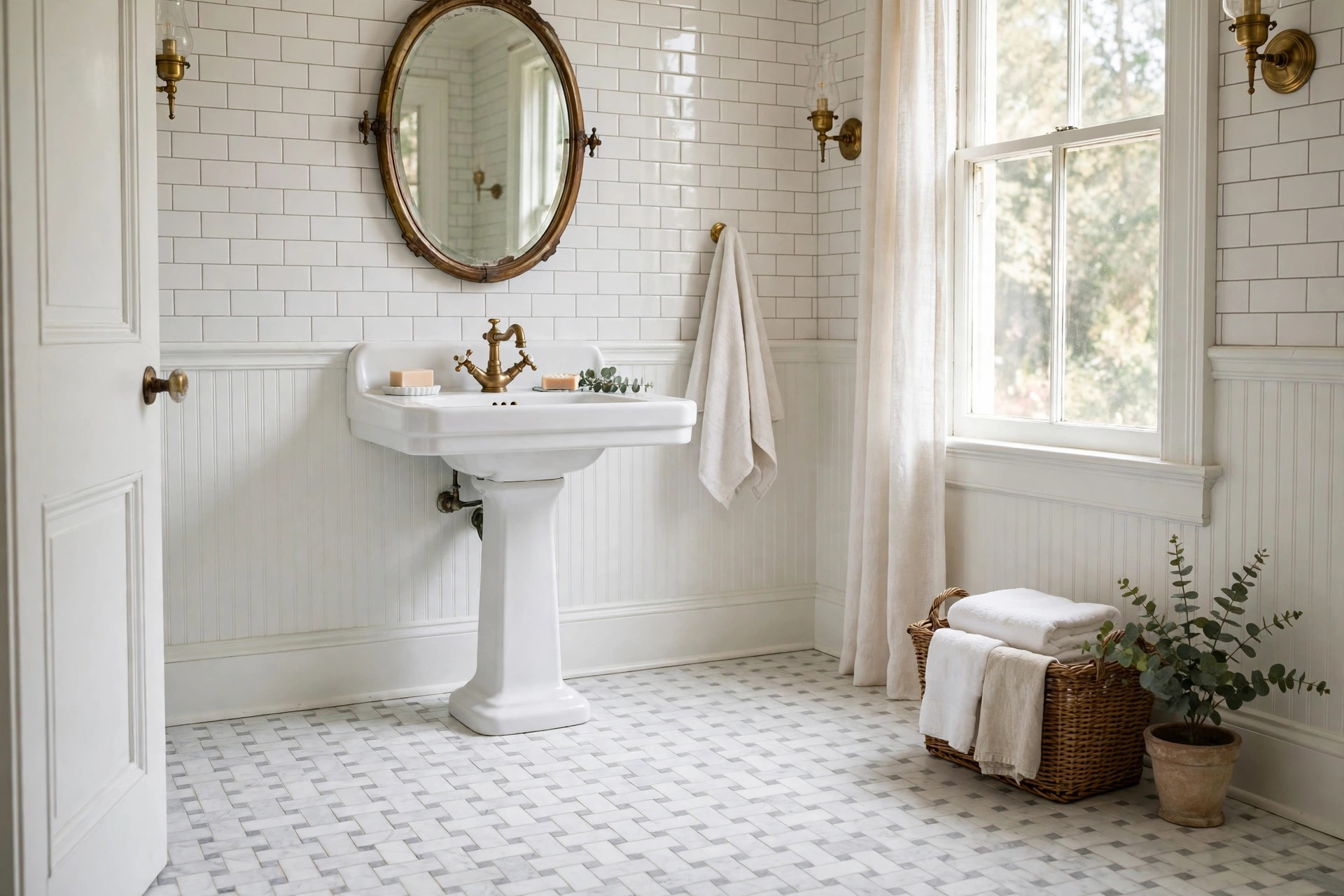
If you’ve ever stepped into an older home and noticed a bathroom floor that looks like finely woven cloth – tiny tiles interlaced in a steady over-under rhythm – you’ve met basketweave tile. It’s one of the most recognisable patterns in vintage bathroom design, and after decades of quiet, it’s firmly back in favour.
But what exactly is it, what does it cost, and is it a nightmare to install? This guide answers all of it in plain English.
What Basketweave Tile Actually Is
Basketweave is a mosaic pattern, not a type of tile. The classic layout pairs small square tiles – usually about 1 inch (2.5 cm) across – with rectangular “bar” tiles roughly twice as long. Each square is framed by bars that alternate direction: horizontal bars above and below it, vertical bars to its left and right. Stand back, and the grid reads exactly like a woven basket.
You don’t lay hundreds of tiny pieces by hand. Basketweave is sold on mesh-backed sheets, usually 12 by 12 inches, so fitting it is a matter of setting full sheets in thinset and cutting the edges to fit the room. The mesh disappears into the adhesive; all you ever see is the pattern.
A short history
Basketweave is a fixture of American and British bathrooms from the late Victorian era through the early 1930s. Tour a restored brownstone, a 1920s bungalow or an early Art Deco flat and there’s a good chance the original bathroom floor is basketweave. It was prized for two very practical reasons: the small mosaic format coped beautifully with the slightly uneven floors of older homes, and the busy pattern hid wear and water marks far better than plain tile. Both qualities still matter today, which is part of why the pattern has survived a century of trends.
Materials, Colours and Finishes
The version most people picture is white marble – usually Carrara or a similar white stone – with a small dark “dot” (often black Nero Marquina marble) set at each intersection where the bars meet. That white-with-black-dots combination is the period-correct classic.
But the pattern is far more flexible than its reputation suggests:
- Porcelain and ceramic mosaics convincingly mimic the marble look at a lower price, and they shrug off stains and moisture without any sealing.
- Reversed colourways – black squares with white dots, charcoal with pale grey – suit moodier, more dramatic takes on vintage style.
- Honed vs polished finishes: polished marble reads formal and bright and bounces light around a small bathroom; honed or tumbled finishes feel softer, show fewer smudges, and are less slippery underfoot – worth considering in a family bathroom.
- Dot-free versions exist too, where the woven grid is formed purely by the two tile shapes in a single colour. The effect is subtler and very elegant in an all-white scheme.
Where to Use It: Floors, Walls and Accents
The bathroom floor is basketweave’s natural home – it’s where the pattern does its hardest work, visually anchoring the room. But don’t stop there:
- Shower floors: the small mosaic format follows the slope to the drain better than large tiles, and all those grout lines add welcome grip. Just confirm your chosen tile is rated for wet areas.
- Feature walls: a single basketweave wall behind a pedestal sink or inside a shower niche gives you the vintage hit without committing the whole room.
- Wainscot borders: a horizontal band of basketweave running at dado height, capped with a chair rail, is a very 1920s detail.
- Small cloakrooms: in a tiny powder room, basketweave on the floor plus one mirrored wall can make the space feel twice its size – the pattern’s fine scale flatters small rooms rather than overwhelming them.
One caution: because the pattern is busy, it pairs best with calm surroundings. Plain wall tiles, a simple pedestal basin and quiet paint colours let the floor be the star.
What Does Basketweave Tile Cost?
Prices vary by region and supplier, but as a rough guide in USD:
- Ceramic or porcelain basketweave mosaics: roughly $8–$15 per square foot
- Natural marble basketweave: roughly $12–$25+ per square foot, more for rare stones
- Professional installation: roughly $10–$20 per square foot of labour – mosaic work is slower and fussier than laying large-format tile, so expect to pay for the patience
- Penetrating stone sealer: $20–$40 a bottle, enough for an average bathroom floor
For a typical 40-square-foot bathroom floor, a porcelain basketweave project might land around $700–$1,400 fitted; the marble equivalent more like $900–$1,800. Marble costs more up front and asks a little more of you in maintenance, but for a period-correct restoration it’s difficult to beat.
Installation and Grout Tips
A few things worth knowing before you commit:
- Grout colour changes everything. White grout keeps the woven pattern crisp and classic; light grey is more forgiving of everyday dirt and soap residue. Dark grout can blur the basket effect into a muddy grid – use it only if you’re deliberately after a bolder, graphic look.
- Use unsanded grout with polished marble. Sanded grout can scratch a polished stone surface as it’s worked in. Porcelain and ceramic are tougher and take either.
- Seal natural stone. Marble is porous. A penetrating sealer applied after grouting – and topped up every year or two – guards against stains from cosmetics, hard water and cleaning products.
- Clean gently. A pH-neutral stone cleaner keeps marble happy. Skip bleach, vinegar and anything acidic, which etch the surface and dull the polish over time.
- Centre the pattern. Dry-lay your first sheets and centre the design on the room’s focal point – usually the doorway or the bath – so that cut tiles land in the least visible corners.
- Order 10–15% extra. Mosaics generate more offcuts than you’d expect, and dye lots vary; having spare sheets from the same batch saves heartache if a tile cracks later.
The bottom line: basketweave tile is one of those rare design elements that is both historically accurate and genuinely practical: it copes with imperfect old floors, hides wear, flatters small rooms and signals “vintage bathroom” instantly, without a single reproduction fixture. Whether you choose classic white marble or a budget-friendly porcelain lookalike, you’re picking a pattern that has already outlived a century of trends — a fairly safe bet it’ll outlive your renovation too.

GIPHY App Key not set. Please check settings