


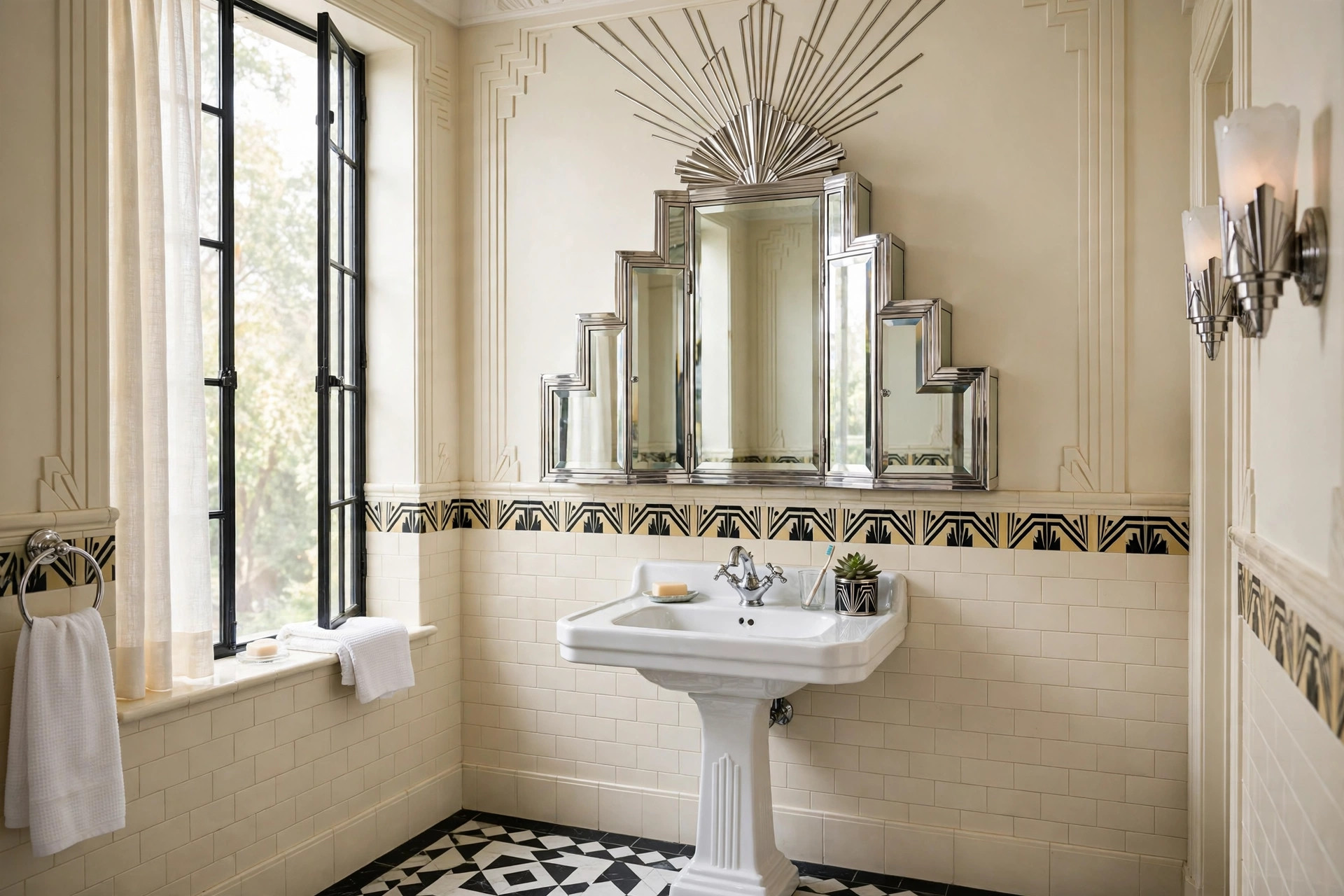
Knowing how to spot a real art deco medicine cabinet can save you from paying antique prices for a reproduction — or, just as happily, help you recognise a genuine 1930s treasure hiding in a flea market for a fraction of its worth. Art Deco bathroom cabinets were made in huge numbers between roughly 1925 and 1940, and they share a design language of stepped profiles, mirrored doors, chrome trim and geometric ornament. The fakes borrow the look, but they almost always betray themselves in the materials, the mirror, the hinges or the back. Here is what to check before you buy.
The Shape and the Stepped Profile
Start with the silhouette. Genuine Deco cabinets love geometry: stepped or ziggurat tops, sunburst motifs, chevrons and fan shapes pressed into the metal or wood surround. The door is usually a single large mirror, sometimes with a bevelled edge, set into a frame that steps outward in two or three tiers. Reproductions tend to flatten these details — the steps become shallow, the sunburst becomes a printed decal rather than a pressed relief, and the whole piece looks a little too crisp and symmetrical.
Check the proportions too. Period cabinets were typically 16 to 24 inches wide and 20 to 30 inches tall, sized to fit between wall studs in houses of the era, with a depth of about 4 to 5 inches. A cabinet that is oddly deep or suspiciously large may be a modern vanity piece dressed in Deco styling. If you are learning how to spot a real art deco medicine cabinet at an antique fair, run your fingers along the stepped edges: originals often show tiny irregularities from hand finishing, while reproductions feel uniformly machine-perfect.
Materials: Steel, Glass and Bakelite
The materials tell the real story. Most authentic Deco medicine cabinets were made from sheet steel with a baked enamel or chrome-plated finish, or from wood — often oak or walnut — with a mirrored door. The steel on a genuine piece is noticeably heavy for its size and may show faint rust freckling at the seams after ninety years. Bakelite, the early plastic, appears on handles and knobs; it feels warm and dense, unlike modern plastic, which feels light and hollow.
Open the door and look at the interior. Period cabinets usually have two or three glass shelves, often with a slightly green tint from the iron content in old glass, and a painted or enamelled interior in white, cream or pale mint green. Modern reproductions frequently use clear modern glass, particleboard backs and bright white plastic interiors. A magnet test helps as well: it will stick firmly to a steel original but not to an aluminium or plastic copy. When you know how to spot a real art deco medicine cabinet, the weight and the cold feel of the metal in your hands are often the first clue.
The Mirror: Silvering, Bevel and Age
The mirror is the cabinet’s face, and it is also its fingerprint. Mirrors from the 1920s and 1930s were silvered by hand, and after decades they develop a distinctive patina: small dark spots, a faint foxing around the edges and sometimes a soft, slightly wavy reflection. A mirror that is flawlessly clear and flat is almost certainly a modern replacement — though note that a replaced mirror does not automatically mean the cabinet itself is fake, since many owners re-mirrored their cabinets over the years.
Look at the bevel. Period mirrors often have a hand-ground bevel, usually about half an inch wide, with tiny unevennesses you can feel with a fingertip. Machine-cut modern bevels are dead even. Also check how the mirror is held in the door: originals typically use small metal clips, glazing points or a thin wooden bead, while reproductions often glue the mirror directly to the door panel. A cabinet with honest mirror wear and original fixings is a strong candidate for the real thing, and recognising that wear is a key part of how to spot a real art deco medicine cabinet.
Hinges, Hardware and Maker’s Marks
Hardware is where reproductions most often cut corners. Genuine Deco cabinets usually have solid brass or steel hinges, often with a simple geometric pattern, and screws with slotted heads — Phillips-head screws did not become common until the late 1930s, so a cabinet full of cross-head screws deserves suspicion. Handles are typically chrome-plated, stepped or streamlined, and they should feel substantial, not tinny.
Turn the cabinet around and examine the back. Many period makers stamped their name, a model number or a patent date on the steel back panel or on a paper label inside. Names to look for include Kohler, Crane, American Standard and smaller regional makers such as the F. H. Lawson Company. Even a partial stamp is encouraging. If the back is modern plywood or MDF with staple fixings, the piece is almost certainly a later copy. Learning how to spot a real art deco medicine cabinet means spending as much time on the back and the hinges as on the pretty mirrored front.
Price, Provenance and a Quick Checklist
Finally, use price and provenance as a sanity check — knowing how to spot a real art deco medicine cabinet also means knowing what a genuine one should cost. A genuine Deco medicine cabinet in good, original condition typically sells for $150 to $600 depending on size, rarity and condition, with particularly fine examples reaching $800 or more. If a seller is asking antique money for a cabinet with a flawless mirror, Phillips screws and a particleboard back, walk away. Conversely, a dusty cabinet at a house clearance with honest wear, steel construction and a stamped maker’s mark is often a genuine bargain.
Before you buy, run through this quick checklist: stepped or geometric profile, heavy steel or hardwood construction, foxed or wavy mirror with a hand-ground bevel, slotted screws and solid hinges, and a maker’s mark on the back. Four out of five is a strong buy. A genuine Deco cabinet is more than a storage box — it is a small piece of 1930s glamour, and once you know how to spot a real art deco medicine cabinet, you will never look at a mirrored door the same way again.

GIPHY App Key not set. Please check settings