


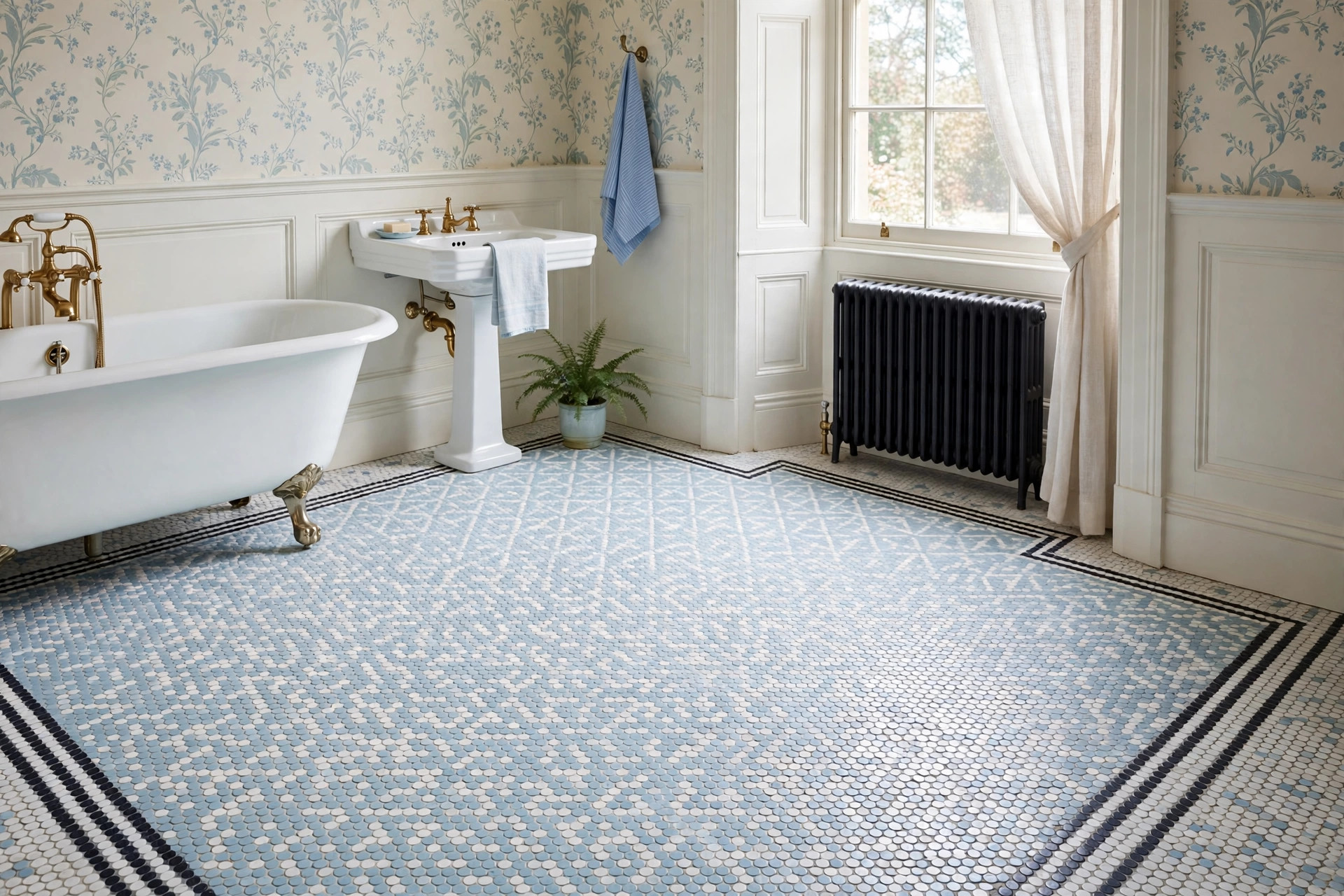
Penny tiles — those small, round mosaic tiles that look exactly like their name suggests — are one of the most recognisable features of an Edwardian bathroom. They covered the floors of countless homes built between 1901 and 1910, and they are still being made today, which is precisely the problem: modern reproductions look very convincing at first glance. Knowing how to spot a real edwardian penny tile matters whether you are restoring a period floor, buying salvage or simply trying to match a repair. The originals give themselves away in their size, their glaze, their backing and their wear.
Size, Shape and the Sheet They Came On
Start with the measurements. Genuine Edwardian penny rounds are typically about 19 mm (three-quarters of an inch) in diameter, though some makers produced them slightly larger or smaller. Modern reproductions often measure 20 to 23 mm and are noticeably more uniform. Lay a ruler across several tiles: originals vary by a fraction of a millimetre from tile to tile, because they were pressed and fired in small batches. Reproductions are almost perfectly identical.
The shape matters too. Original penny tiles are true circles with a gently domed or slightly uneven top surface, and their edges are soft rather than sharp. Modern tiles tend to be flatter, with crisper edges and a more mechanical finish. If you can lift a loose tile, look at the back: period tiles usually have a plain, slightly rough ceramic back, sometimes with a maker’s stamp or a faint mesh pattern from the paper or cloth sheets they were mounted on. Modern mosaic sheets use a fibreglass mesh backing and a much smoother tile reverse. Learning how to spot a real edwardian penny tile begins with your hands — pick one up, feel the weight and the slight irregularity, and the difference becomes obvious.
Glaze, Colour and a Century of Wear
The glaze is the next giveaway. Edwardian penny tiles were glazed in a limited palette: white, cream, pale blue, sage green, soft grey, black and the occasional dusty pink or mustard. The colours are muted and slightly variable, because the glazes were mixed by hand and fired in coal kilns where temperatures shifted from one end of the kiln to the other. A sheet of originals will show subtle tonal differences between individual tiles, while a modern sheet is usually dead even in colour.
Age leaves its own marks. A floor that has been walked on for a hundred years shows a soft, even wear on the highest points of the glaze, a faint crazing — a network of tiny cracks in the glaze surface — and grout that has darkened to cream or grey. Crazing is a good sign: it takes decades to develop and is very hard to fake convincingly. Be wary of tiles that claim to be Edwardian but have a flawless, glassy glaze and bright white grout — they are almost certainly new, and spotting that too-perfect finish is half of how to spot a real edwardian penny tile. Of course, a genuine tile that has spent its life in a cupboard may look fresher than one from a hallway, so wear is a clue, not a verdict on its own.
Patterns, Borders and Period Motifs
Edwardian penny tile floors were rarely plain. The classic designs include a white field with a black or coloured border, a Greek key pattern, a basketweave, or a simple scattered “confetti” of coloured rounds among white ones. Floral motifs and monograms were popular in entrance halls and grander bathrooms. If you are restoring a floor, photograph the surviving pattern carefully before you lift anything, and note the border width and the spacing of the motif.
Reproductions often get the patterns slightly wrong. The border may be too wide or too narrow, the Greek key may be simplified, or the colours may be too bright for the period. Compare the pattern against photographs of documented Edwardian interiors, or against the tile catalogues that makers such as Minton and Carter published at the time — many are now available in reprints and online archives. Knowing how to spot a real edwardian penny tile also means knowing what a real Edwardian floor was supposed to look like, and the pattern is often the fastest way to catch a copy.
Where to Buy, What to Pay and Matching a Repair
If you need originals, start with architectural salvage yards, which often sell penny tile by the sheet or by the box. Expect to pay $15 to $40 per square foot for genuine salvaged penny tile in good condition, depending on the colour and rarity, versus $8 to $15 per square foot for a quality modern reproduction. Online auction sites and specialist tile dealers are worth checking too, but always ask for close-up photographs and measurements before you buy, and confirm the return policy.
For a small repair, a high-quality reproduction in the right colour and size is often the sensible choice, and it is a perfectly respectable outcome once you know how to spot a real edwardian penny tile. — once it is grouted in, surrounded by originals and given a year or two of wear, even an expert will struggle to pick it out. The trick is matching the size and the glaze tone rather than chasing an exact period match. Buy a sample sheet first, lay it beside your existing floor in daylight, and check the colour when both are dry. If the tones clash, try a different supplier rather than forcing a poor match.
Our Top Picks
Three generic options suit most Edwardian restorations. First, a handmade-look porcelain penny round mosaic in matte white with a soft, slightly irregular glaze — the closest modern match for a plain field, at roughly $10 to $14 per square foot. Second, a classic white-and-black penny round sheet with a pre-formed border pattern, ideal for entrance halls and bathroom floors, at around $12 to $18 per square foot. Third, a glazed ceramic penny tile in a muted period colour such as pale sage or dusty blue, perfect for scattered accents or a full coloured field, at about $9 to $13 per square foot. Whichever you choose, order a sample first, and keep the grout joints tight — around 2 mm — to match the look of an original installation.
A genuine Edwardian penny tile floor is a small miracle of survival, and it deserves a careful eye. Check the size and the soft edges, read the glaze and the crazing, study the pattern, and buy from a source you trust. Once you know how to spot a real edwardian penny tile, you will start seeing them everywhere — in old houses, in salvage yards, and sometimes, wonderfully, under a layer of lino in a bathroom that has been waiting a century to be admired again.

GIPHY App Key not set. Please check settings