

Small details make a period bathroom, and few details repay attention like the towel bar. These 12 1940s towel bar set ideas show how a humble fixture became a design feature during the 1940s, when bathrooms grew simpler, cleaner and more practical — yet never lost their sense of style. Whether you are restoring a wartime home or adding retro warmth to a modern bathroom, the right towel bar set ties the whole room together.
What Made 1940s Towel Bars Distinctive
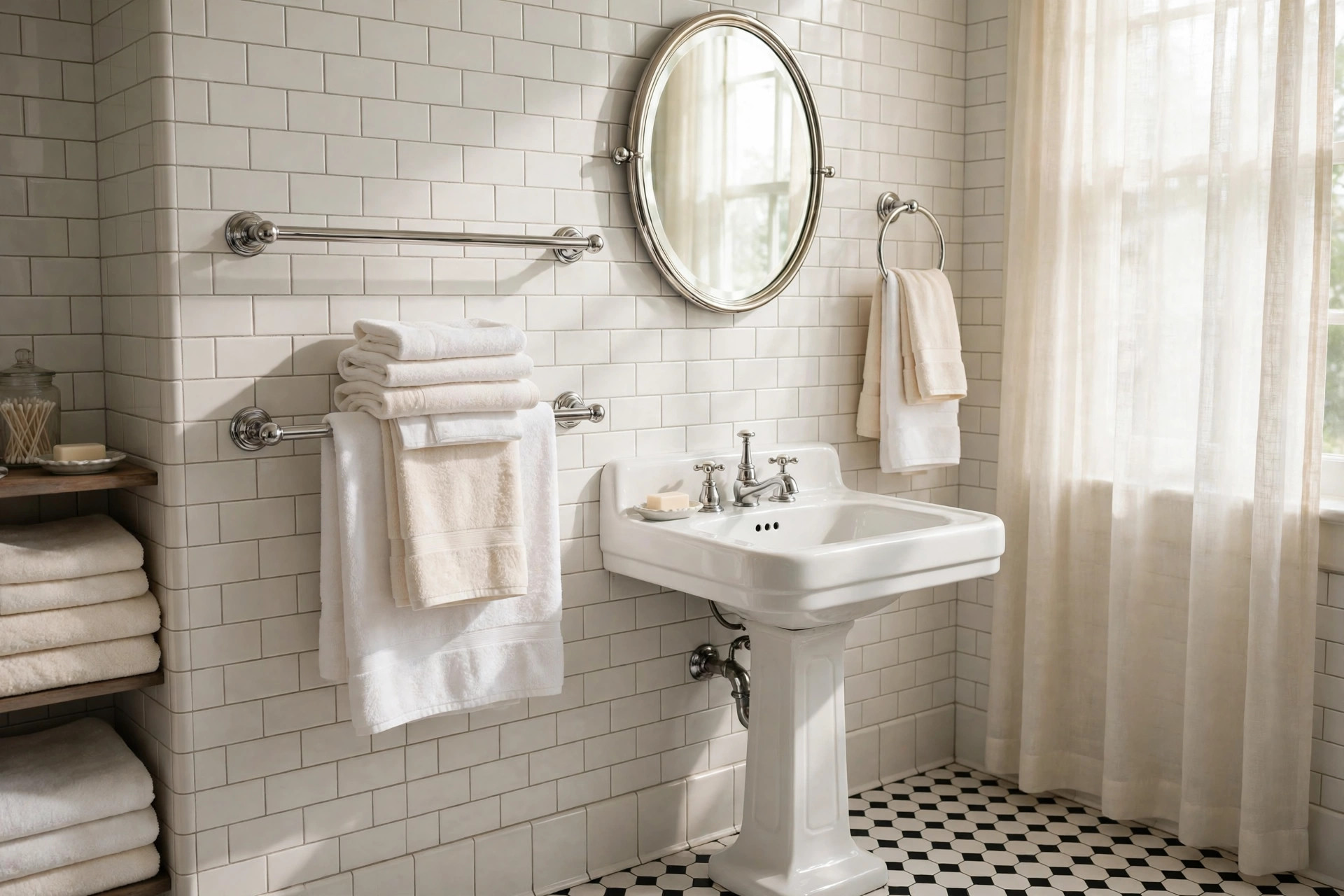
The 1940s bathroom was shaped by practicality. Wartime shortages meant less ornament and more honest materials: gleaming chrome, white porcelain, glass and the occasional touch of bakelite. Towel bars of the decade were slim and straight, usually wall-mounted on small round or square porcelain flanges, with bars of polished chrome about 45 to 60 centimetres long. Sets typically included a towel bar, a towel ring, a soap dish and a toothbrush holder, all in matching finishes — the coordinated set was the point.
That coordination is exactly what makes these sets so useful today. A matching set gives a bathroom instant visual order, and the restrained 1940s styling sits comfortably beside both vintage fixtures and clean-lined modern ones. Chrome remains the most authentic and forgiving finish, though nickel and porcelain-accented sets are lovely alternatives.
Twelve Ideas to Bring Home
- The classic three-piece chrome set. A 60-centimetre towel bar, a matching towel ring and a wall-mounted soap dish in polished chrome is the definitive 1940s combination. It suits any bathroom and costs surprisingly little.
- A porcelain-flange towel bar. Bars mounted on white ceramic rosettes echo the porcelain fixtures of the era. They look wonderful against coloured tile, where the white flanges pick up the grout lines.
- The double towel bar. Two parallel bars on a single set of brackets hold twice the towels in the same wall space — ideal for a family bathroom or a guest room.
- A towel bar with a glass shelf above. Many 1940s sets paired the bar with a frosted or clear glass shelf, giving you a perch for a folded towel, a small plant or a bottle of hand wash.
- The swing-arm towel bar. A hinged arm that folds flat against the wall when not in use is a clever period solution for narrow bathrooms, and it still feels ingenious today.
- A bakelite-accented set. Black or ivory bakelite end caps on a chrome bar add a warm, unmistakably 1940s note. Original bakelite pieces are collectable, but good reproductions capture the look without the fragility.
- The heated towel bar, 1940s style. Slim chrome rails with a gentle electric warmth bring period looks together with modern comfort. Expect to budget roughly $150 to $400 for a quality heated rail, plus installation by a qualified electrician.
- A towel ring by the basin. A 15-centimetre ring mounted beside the sink keeps a hand towel within easy reach. In the 1940s this was standard practice, and it remains the most practical placement.
- Matching robe hooks. Extend the set with two or three robe hooks in the same finish. Hooks mounted at 165 centimetres from the floor keep robes off the ground and the wall looking intentional.
- The ladder-style towel rack. A leaning ladder rail in chrome or painted timber holds several towels at once and suits larger bathrooms. It nods to the utilitarian spirit of the decade without feeling like a museum piece.
- A towel bar over the bath. Mounting a long bar on the wall above the bath gives wet towels a place to dry and fills an otherwise bare stretch of tile. Choose a bar at least 60 centimetres long so a bath towel hangs without bunching.
- The full five-piece set. For a complete restoration, choose the full suite: towel bar, towel ring, soap dish, toothbrush holder and toilet roll holder, all in one finish. The consistency is what sells the period look.
Sizing, Placement and Installation
Getting placement right matters more than the finish. Mount the main towel bar 110 to 120 centimetres from the floor, and leave at least 45 centimetres of clear wall on either side so a towel hangs flat. In a small bathroom, a 45-centimetre bar holds a hand towel beautifully, while a 60-centimetre bar is the minimum for a full bath towel folded in half.
Always fix bars into studs or use proper wall anchors — a towel bar takes real weight when wet towels are hung on it, and plasterboard fixings alone will work loose. If you are drilling into tile, use a diamond-tipped bit, mark the position with masking tape to stop the bit wandering, and drill slowly without the hammer action. A complete reproduction set typically costs between $40 and $180, with heated rails and solid brass versions at the higher end.
Styling Your Set the 1940s Way
Finish the look with thick cotton towels in white, cream or a soft pastel, folded neatly rather than draped carelessly. A small glass shelf, a ceramic soap dish and a simple round mirror complete the picture. Avoid mixing too many metal finishes in one room — if your taps are chrome, keep the towel set chrome too, and let the towels and tiles supply the colour.
These 12 1940s towel bar set ideas prove that the smallest fixtures can carry the most character. Choose a coordinated set, mount it with care, and your bathroom will gain a quiet touch of wartime-era elegance that works just as hard today as it did eighty years ago.

GIPHY App Key not set. Please check settings