

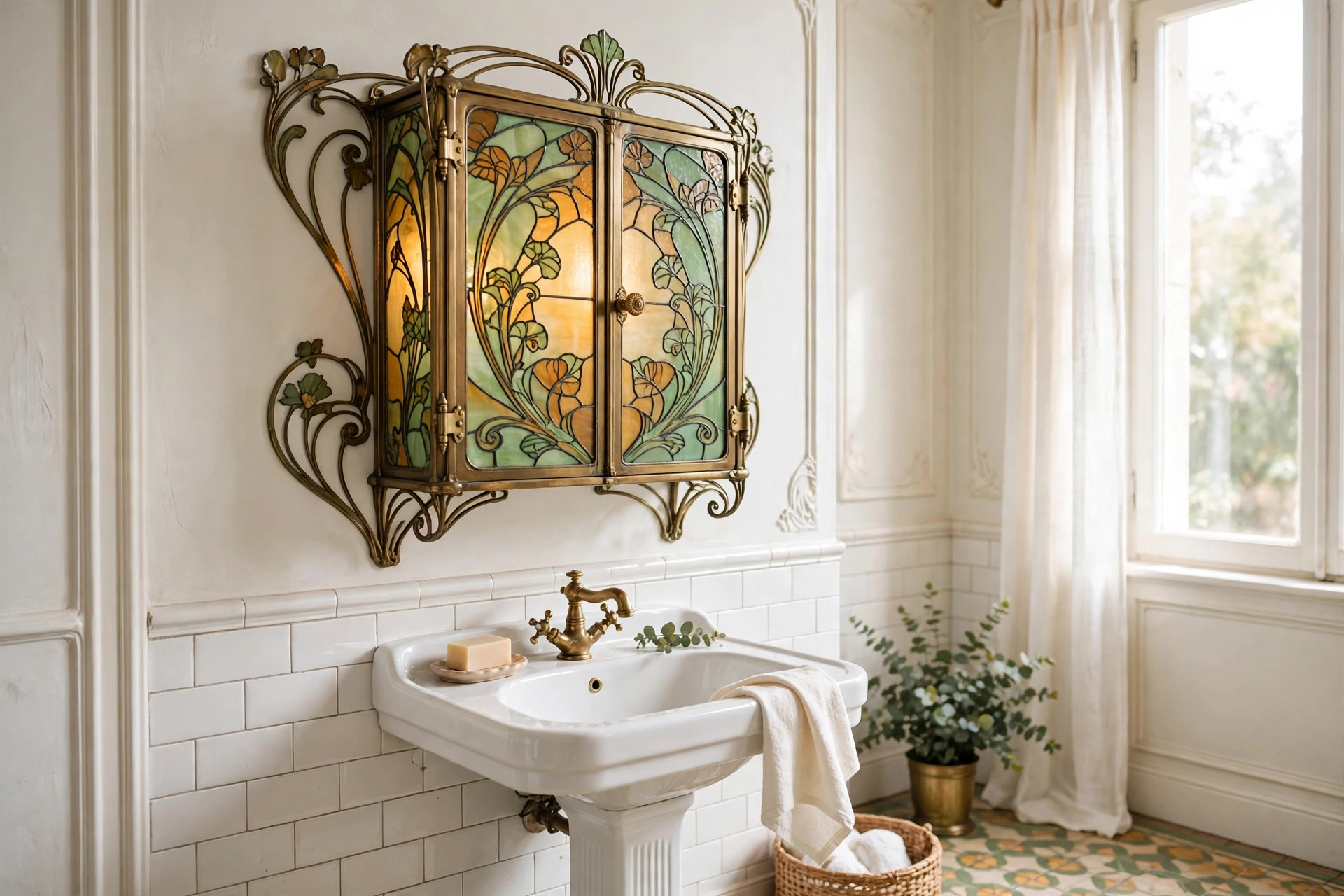
Learning how to identify real Art Nouveau medicine cabinets is essential before spending serious money on one. Art Nouveau was a short-lived movement — roughly 1890 to 1910 — and genuine pieces are rare, fragile, and frequently faked. A real cabinet can be worth $800–$3,000 or more; a reproduction with applied decoration is worth a fraction of that. The differences hide in the glass, the joinery, the mirror, and the way the decoration was made. Here is how to read them.
The Whiplash Line: Decoration That Grows, Not Sits on Top
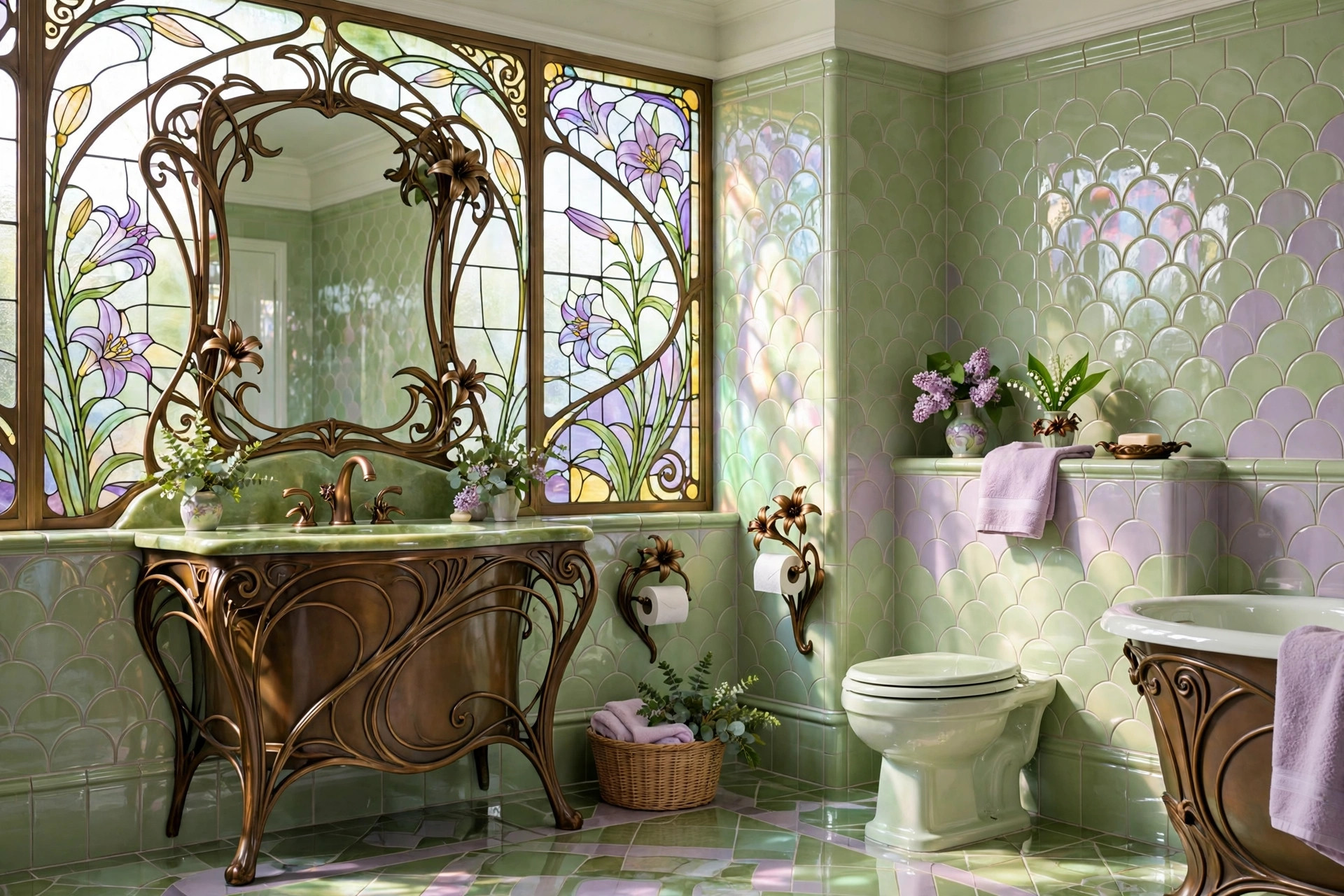
The defining feature of Art Nouveau is the whiplash curve — a long, sinuous line that sweeps, curls, and tapers like a plant stem. On a genuine medicine cabinet, this line is not decoration applied to a box; it is the structure of the piece. The frame itself curves, the carved or inlaid stems flow around the corners, and the mirror or glass panel is shaped to follow the movement rather than sitting inside a rectangle.
That is the first test: does the decoration feel integral, or does it look stuck on? Reproductions often take a plain rectangular cabinet and add cast resin ornaments, a printed floral decal, or a thin appliqué border. Run your hand along the surface. On a genuine piece, carved decoration is part of the wood — you can feel the grain continue through the carving. On a reproduction, applied ornaments sit proud of the surface with a visible seam or glue line at the edges, and the wood grain underneath does not follow the shape.
Look at the motifs themselves. Authentic Art Nouveau favours specific plants: irises, poppies, water lilies, thistles, and dragonflies, drawn from nature with long, elegant stems. The carving or inlay should be asymmetrical — one side of the cabinet different from the other, following the natural growth of a plant. A perfectly symmetrical floral pattern is a strong sign of a modern reproduction, because period craftsmen worked freehand and embraced asymmetry.
Materials: Wood, Glass, and Mirror
A genuine Art Nouveau medicine cabinet is made from solid wood — usually oak, mahogany, walnut, or fruitwood — with a hand-applied finish. Open the door and look at the inside edges and the back panel. Solid wood shows the same grain on the inside as on the outside; veneer over MDF or particle board shows a different, often cheaper material underneath. Check the back panel: period cabinets have a solid wood back, sometimes with a maker’s label or stamp, while reproductions often use thin plywood or hardboard.
The mirror is one of the best dating tools you have. A mirror that is genuinely 100-plus years old shows its age: look for foxing — small dark spots and cloudy patches in the silvering, especially around the edges — and a slightly wavy reflection caused by the hand-poured glass of the period. Modern mirrors are perfectly flat and perfectly clear. If the mirror looks brand new and the cabinet is claimed to be from 1900, the mirror has been replaced, which is common and not fatal — but it means one piece of evidence is gone, and the price should reflect that.
Art glass is another hallmark. Some Art Nouveau cabinets feature stained or leaded glass panels with floral designs in muted greens, ambers, and violets. Genuine period glass has texture, bubbles, and slight variations in thickness; modern reproduction glass is usually smooth and uniform. Hold a light behind the panel: real period glass shows a rich, uneven glow, while reproduction glass looks flat and even.
Joinery and Hardware Tell the Truth
Turn the cabinet over — figuratively, at least — and look at how it was put together. Period furniture was joined with dovetails, mortise-and-tenon joints, and wooden pegs. Look inside the cabinet and at the corners of the door: hand-cut dovetails are slightly irregular, with thin pins and tails of varying widths. Machine-cut dovetails, which became common later, are perfectly uniform. Screws are another clue: genuine period cabinets use slotted screws, often handmade, with slightly off-centre slots; Phillips-head screws did not become common until the 1930s, so their presence means the cabinet has been repaired or is a reproduction.
The hinges and latch are equally revealing. Period hardware is solid brass or iron, often with a hand-finished patina, and the hinges are usually small butt hinges mortised into the wood. Modern reproductions frequently use concealed European-style hinges or stamped steel hardware. If the hinges look like they came from a modern hardware store, the cabinet probably did too.
Check the shelves as well. Original medicine cabinets have wooden or glass shelves held in adjustable slots or on small wooden cleats. Plastic shelf supports or metal shelf pins in pre-drilled rows are modern additions.
Maker’s Marks and Provenance
Genuine Art Nouveau furniture was made by identifiable workshops and designers, and many pieces carry marks. Look for a stamped, burned, or paper label on the back panel, inside the door, or underneath the cabinet. Names associated with the period include Majorelle and Gallé in France, and the workshops of the Vienna Secession and the Glasgow School. A clear maker’s mark from a known workshop is the strongest evidence of authenticity you can find.
Provenance matters too. Ask the seller where the cabinet came from — a house clearance, an estate sale, a dealer with a written history. A cabinet with a documented chain of ownership is worth more and is far less likely to be a reproduction. Be cautious of vague stories: “found in an old house in France” is not provenance, it is a sales pitch.
One caution: Art Nouveau was revived in the 1960s and 1970s, and many revival pieces are now fifty years old and show genuine age. A 1970s revival cabinet is a legitimate vintage piece, but not a period original — price it as a revival, typically $150–$400 rather than $800–$3,000.
What to Pay and When to Walk Away
A genuine Art Nouveau medicine cabinet in good original condition typically sells for $800–$3,000, depending on the maker, the quality of the glass and carving, and the condition of the mirror. Exceptional pieces by named makers can go higher. A reproduction or revival piece in good condition is worth $150–$500 as a decorative item.
Walk away if several red flags stack up: perfectly symmetrical decoration, applied ornaments with visible seams, a particle-board back, Phillips screws, modern concealed hinges, and a flawless mirror with no foxing. Any one of these could have an innocent explanation — a replaced mirror, a later repair — but several together mean the piece is not what the seller claims.
The Quick Checklist
Before buying, check five things: the decoration flows through the structure rather than sitting on top; the wood is solid with matching grain inside and out; the mirror shows foxing and a slightly wavy reflection; the joinery is hand-cut with slotted screws and period hinges; and there is a maker’s mark or credible provenance. Pass most of these, and you are likely looking at a real Art Nouveau medicine cabinet — a small piece of a beautiful, brief moment in design history, and a centrepiece your bathroom will be proud of.

GIPHY App Key not set. Please check settings