

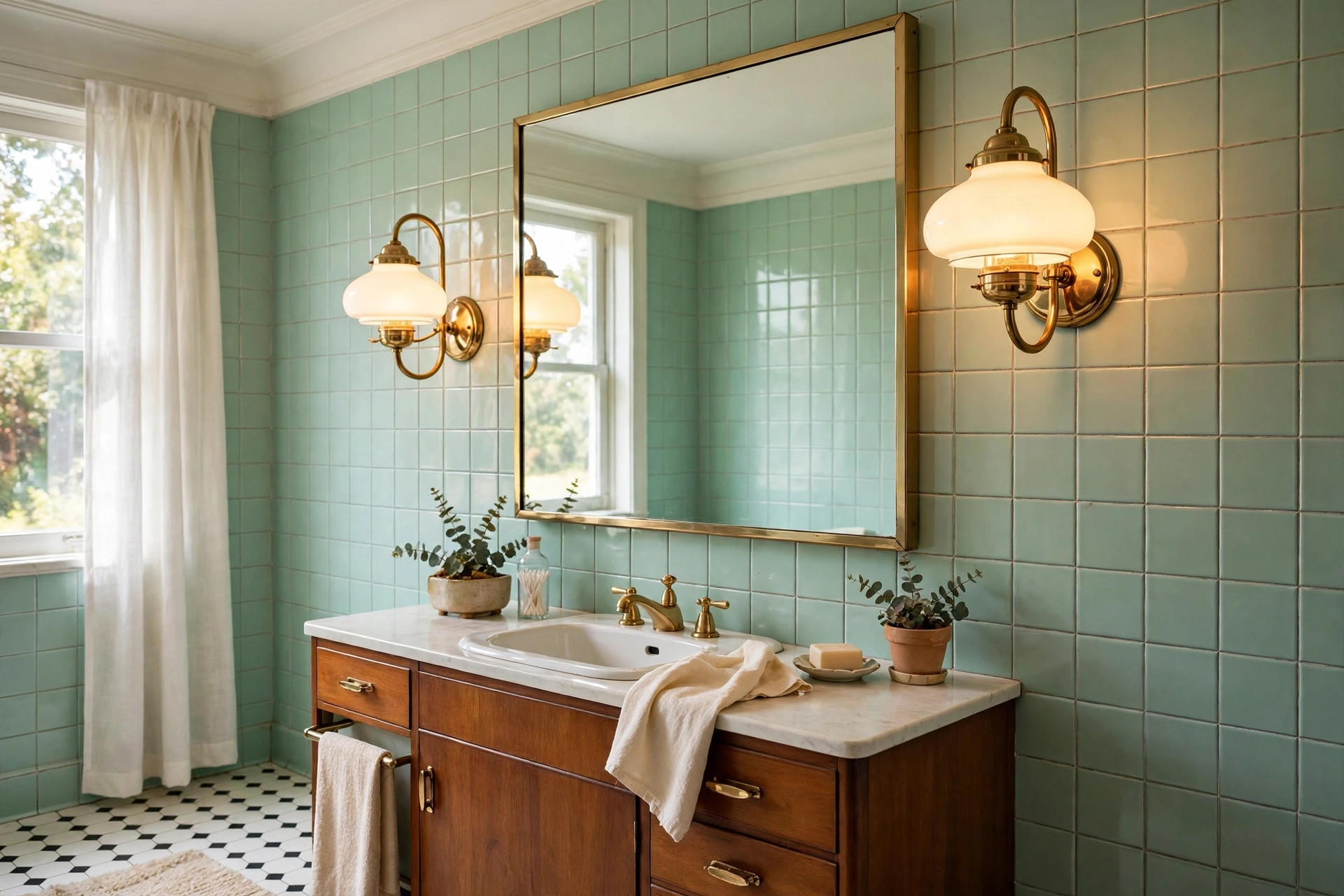
How to identify real 1960s wall sconces is a skill that pays for itself the first time you use it. Original 1960s lighting has a warmth and a quality of making that reproductions rarely match — solid brass that has aged gracefully, hand-blown glass with tiny bubbles, and a design confidence that came from a decade when lighting was treated as sculpture. But the market is full of pieces described as “1960s style” or “mid-century inspired,” and those phrases are doing a lot of quiet work.
Genuine 1960s sconces typically sell for $80 to $400 each, with designer pieces reaching $600 or more, while good reproductions sell for $40 to $120. The checks below take about ten minutes and need nothing more than a torch.
Start With the Materials: Brass, Glass and Weight
The 1960s were a decade of honest materials, and the first test is simply to pick the sconce up. An original is usually heavier than it looks. Brass was the dominant metal: solid brass arms, backplates and fittings, often lacquered when new. Over sixty years that lacquer wears thin in places, and the brass underneath develops a soft, uneven patina — darker in the crevices, warmer where hands have touched it. A reproduction is often made from thin stamped steel or aluminium with a brass-coloured finish, and it feels light and slightly hollow by comparison. If a magnet sticks firmly to a supposedly brass part, you are holding plated steel, not solid brass.
Glass is the second giveaway. Many 1960s sconces use opal glass, frosted glass, or hand-blown coloured glass shades. Hold a shade up to the light and look for tiny air bubbles, slight variations in thickness, and a gentle unevenness in the colour — signs of hand production. Modern reproduction glass is usually moulded or machine-made: perfectly uniform, free of bubbles, and often slightly too clear or too white. Murano glass is famously irregular, with swirls of colour machine glass cannot copy.
Teak and rosewood appear on Scandinavian sconces, and genuine 1960s wood has a deep, oiled richness modern stained pine cannot imitate. Period chrome is thick and slightly warm in tone, while modern chrome is thinner and bluer. Plastic in a structural part is suspicious — 1960s plastics were used for shades, not arms or fixings.
Read the Wiring and the Fittings
Turn the sconce over and look at the back. This is where reproductions most often betray themselves, because makers rarely bother to fake what buyers do not see. Original 1960s wiring used cloth-covered or rubber-insulated cable, often in black or brown, and the internal connections were made with ceramic or early Bakelite terminal blocks and porcelain lamp holders. The screws will be slotted, not Phillips or Pozidriv, and they will show signs of age — slight darkening, a little wear on the slots.
A reproduction will usually have modern PVC-insulated wiring in bright colours, plastic terminal blocks, and modern cross-head screws throughout. Untouched period wiring is strong evidence of age; modern wiring tells you the piece has been rebuilt or was made recently. Either way, have a vintage fitting rewired before use — usually $40 to $80 per fitting.
Check the lamp holders: a 1960s sconce usually takes a small Edison screw or bayonet bulb in a ceramic or heavy brass holder, while reproductions often use plastic holders. Period shades attach with thumb screws, grub screws or a bayonet twist; reproductions often rely on a friction fit or a modern clip.
Look for Maker’s Marks and Labels
Many, though not all, original 1960s sconces carry a maker’s mark. Italian makers such as Stilnovo, Arredoluce and Sciolari often stamped their name or a model number into the backplate or onto a small metal label. Scandinavian makers — Louis Poulsen, Fog & Møller, and the many smaller Danish workshops — used paper labels, stamped marks, or engraved signatures. Use a torch and check the back of the backplate, the inside of the arm, and the underside of the shade fitting.
A genuine period mark is usually stamped, engraved or printed with the printing methods of the time: slightly uneven lettering, a paper label that has yellowed, a stamp that is not perfectly aligned. A reproduction mark, if it exists at all, is usually laser-etched with perfect uniformity or printed on a bright white modern label. Be wary of a mark that looks too crisp, or a seller who claims a famous maker but cannot show you any mark. Photograph any mark you find and search for it later — model numbers in particular can be traced to old catalogues, and a match is one of the strongest proofs of authenticity you can get.
Study the Design: Proportions, Patina and Wear
Look at the proportions first. Period sconces tend to be compact and purposeful: arms that curve with confidence, shades that sit in balance with the fitting, and nothing added purely for decoration. Reproductions often exaggerate — a shade slightly too large, an arm slightly too long, a curve slightly too dramatic — because they are copying a look rather than a design.
Sixty years of life leaves traces: a faint ring where the backplate sat against the wall, darkening where fingers adjusted the shade, a small chip polished smooth long ago. Artificial ageing usually shows uniform distressing — the same scuffs on both sconces in a pair. If a pair looks identically worn, be cautious; genuine pairs age as individuals.
Our Top Picks
A pair of solid brass sconces with opal glass shades is the classic 1960s bathroom choice: warm brass, softened light, and a flattering glow at the mirror. A single-arm teak and brass sconce suits a smaller bathroom or a narrow wall beside a mirror. Warm-white, dimmable LED filament bulbs complete the look, giving a 1960s glow with modern efficiency.
A Note on Safety
Have any vintage sconce inspected and rewired by a qualified electrician before installing it, especially in a bathroom. Bathroom lighting must meet your local regulations for zones and moisture protection. A proper rewire and a check of the earthing typically costs $40 to $80 per fitting, and it is the one expense you should never skip. An original 1960s sconce, properly restored and safely wired, will light your bathroom beautifully for another sixty years.

GIPHY App Key not set. Please check settings