


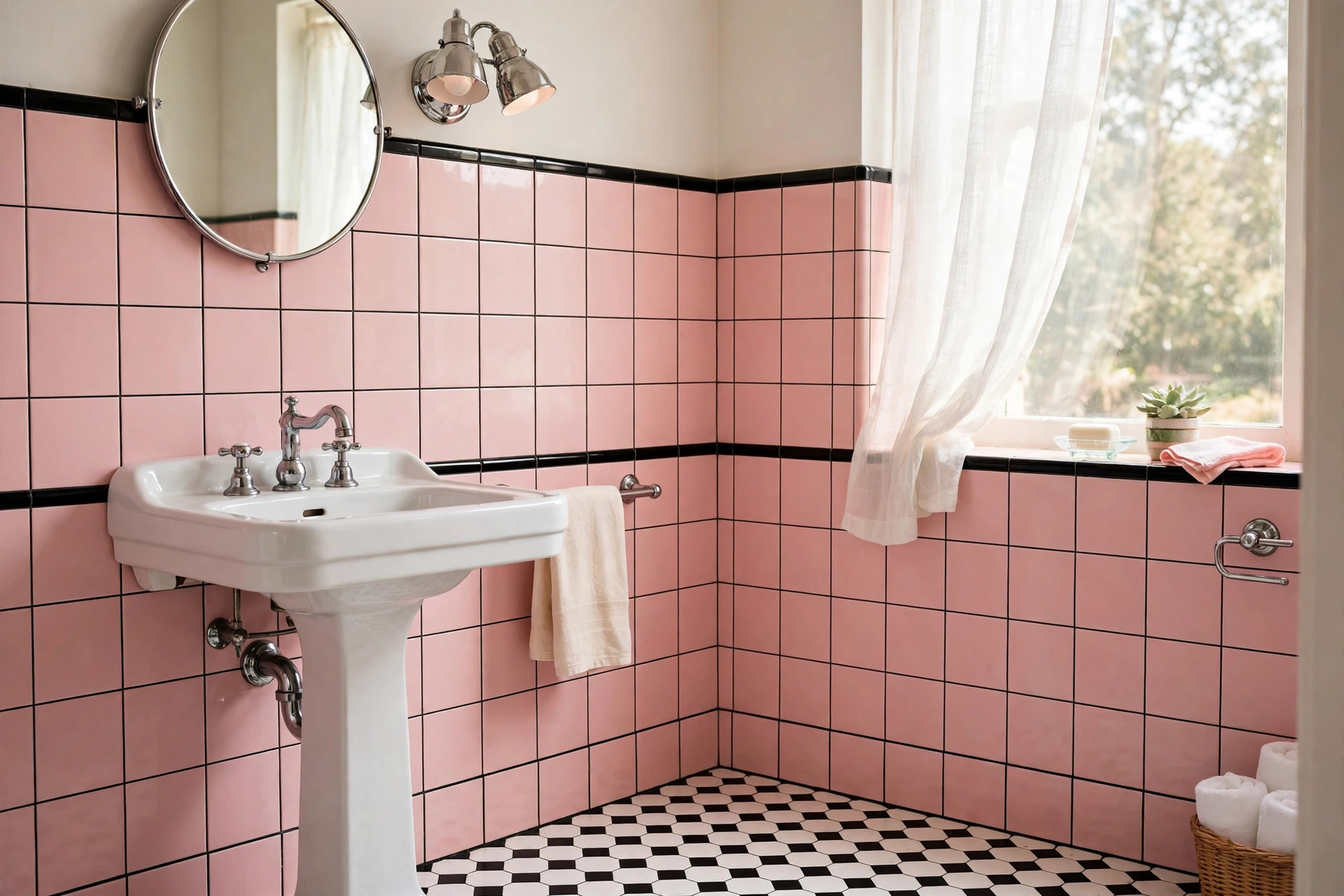
So you have bought a house and inherited a 1950s pink bathroom — the famous “Mamie pink” tile, possibly a matching pink tub and toilet, black accent trim, and chrome fixtures. Your first instinct might be to rip it all out. But the 1950s pink bathroom keep or renovate question deserves a more honest answer than demolition-by-default, because these bathrooms are better built than most of what replaced them.
Why the Pink Bathroom Exists
Pink bathrooms swept America in the 1950s, peaking after First Lady Mamie Eisenhower famously decorated with the colour. Manufacturers like American Standard produced entire suites in pastel pink, and builders installed millions of pink-tiled bathrooms between roughly 1946 and 1965. The tile was typically 4¼-inch glazed ceramic, often with a contrasting black or burgundy trim — quality materials laid by skilled tilers over a proper mud-set bed.
That construction quality matters: a 1950s tile job, if intact, is often more waterproof and longer-lasting than a 1990s or 2000s retile. The mud-set method — tile laid over a thick bed of mortar — creates a solid, monolithic surface that modern thin-set installations rarely match for sheer durability.
The Case for Keeping It
The tile is probably excellent. If the glaze is intact, the grout is sound and tiles are not hollow or falling off, you are looking at a bathroom that could outlast a brand-new renovation. Regrouting and a deep clean can make it look remarkable.
It has genuine character. In my opinion, an original pink bathroom in good condition is a selling feature for the right buyer — it is distinctive, memorable and increasingly appreciated. Mid-century homes with intact original bathrooms photograph beautifully and stand out in listings.
Renovation is expensive. A full bathroom gut renovation typically runs $10,000–25,000 or more. Keeping the pink tile and refreshing everything around it — paint, lighting, mirror, textiles, fixtures — can cost under $1,500 and take a weekend. That price difference alone settles the 1950s pink bathroom keep or renovate question for many homeowners, especially when the existing tile is in good shape.
Sustainability. Keeping tonnes of tile and cast iron out of landfill is the greenest renovation choice you can make.
The Case for Renovating
Be honest about the downsides too:
- Damage beyond cosmetic. Cracked, crazed or missing tiles, crumbling grout beds and water damage behind the tile mean the waterproofing has failed. A pretty surface over a rotten substrate is a trap — get a professional assessment.
- Lead and plumbing concerns. Pre-1978 homes may have lead paint and old galvanised plumbing. If you are opening walls anyway, that is the time to address it.
- You genuinely hate it. You live there. If pink tile makes you unhappy every single morning, no amount of heritage argument outweighs that. Life is short.
- Layout problems. A 1950s bathroom is often tiny (5×7 feet was standard) with no storage. Sometimes the layout needs changing regardless of the tile.
The Middle Path: Refresh Instead of Replace
Most people wrestling with the 1950s pink bathroom keep or renovate decision land happily in the middle. A strategic refresh keeps the character and kills the dated feeling:
- Paint the walls a warm white, soft grey or pale sage — pink tile against white looks fresh; against beige it looks tired.
- Update the lighting. A new vanity light with warm bulbs ($40–80) transforms the room’s mood.
- Swap textiles. Crisp white towels, a simple shower curtain and a modern bath mat neutralise the pink without fighting it.
- Replace the toilet seat and taps if worn — white and chrome calm the palette down.
- Add black accents deliberately — black-framed mirror, black hardware — to echo the original trim and make the design look intentional.
- Regrout discoloured grout lines ($15–25 for grout plus a weekend of labour) for the single biggest visual upgrade.
Sourcing Matching Pink Tile for Repairs
If you keep the bathroom but have a few cracked or missing tiles, matching Mamie pink is very doable. Architectural salvage yards are the best source — the standard 4¼-inch wall tile was produced in enormous quantities, and single tiles or small lots typically cost $2–8 each. Bring a loose tile (or a good photo in natural light) to match the exact shade, since pink varied between manufacturers. A few reproduction companies also make 1950s-style pastel tile at around $10–20 per square foot. Replacing a handful of damaged tiles and regrouting the room can make an original bathroom look nearly new for a few hundred dollars — far less than a gut renovation.
What It Does to Home Value
Here is the honest, un-hyped version: an original pink bathroom in good condition neither adds nor subtracts much value for most buyers — it is neutral to slightly positive in mid-century neighbourhoods, and a mild negative where buyers expect modern finishes. A bad renovation (cheap tile, poor workmanship) hurts value more than original pink tile ever will. If you do renovate, do it properly or not at all.
My Honest Take
If the tile is sound, keep it. The 1950s pink bathroom is a well-made, historically interesting, increasingly rare feature — and with a thoughtful refresh it can be genuinely beautiful rather than merely tolerated. Renovate when the bones have failed or the layout does not work, not because a colour went out of fashion. Colours come back; craftsmanship does not. And if you do decide to keep it, say so proudly — the best vintage bathrooms are the ones their owners clearly love.

GIPHY App Key not set. Please check settings