


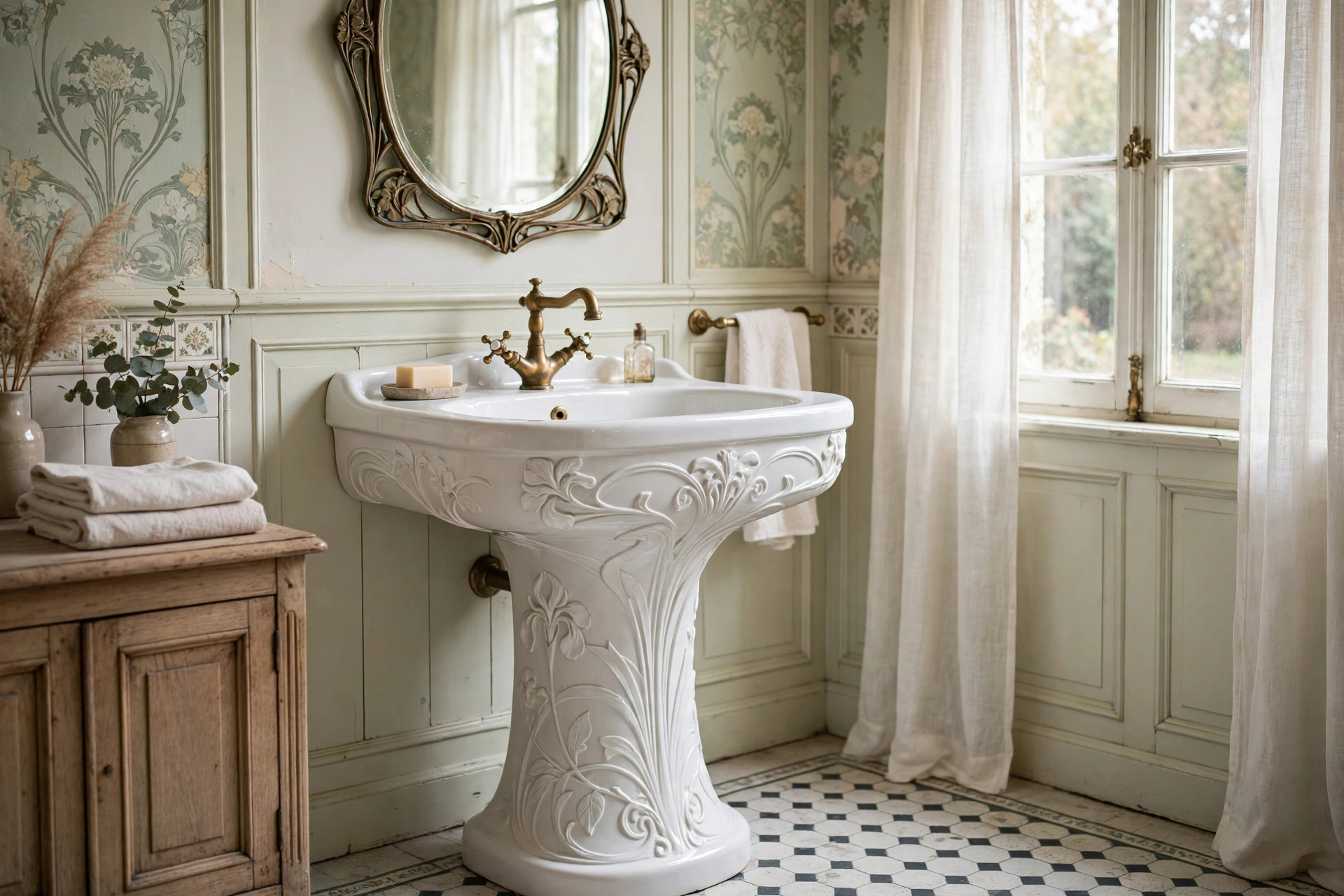
How to identify real Art Nouveau pedestal sinks is a question that matters before you spend serious money, because a genuine 1895–1910 piece can cost several thousand dollars while a convincing reproduction costs a few hundred. The originals were made when ceramic sanitaryware was still a craft industry: each sink was slip-cast, hand-finished, and glazed by people who knew the clay. That handwork leaves traces a factory reproduction rarely reproduces — in the curves, the glaze, the weight, and the marks underneath. Here are the checks that count.
Read the Form: Curves, Relief, and Asymmetry
Start with the silhouette. An Art Nouveau pedestal sink is never a straight-sided box: the rim undulates in a gentle organic wave, the pedestal tapers and swells like a plant stem, and the whole piece has a sense of movement. The relief decoration should be part of that movement — water lilies, irises, poppies, or whiplash stems modelled in low relief, growing out of the form rather than sitting on it, with stems that curve around the pedestal and petals that follow its shape. On a reproduction, the decoration is often a shallow, uniform pattern applied to the surface, or a printed transfer with no depth at all. Asymmetry is a good sign: period craftsmen worked freehand and rarely made the left side mirror the right.
Period sinks are also taller and narrower than modern ones. Expect a basin depth of 5 to 7 inches and an overall height of 32 to 34 inches — noticeably higher than a modern pedestal sink. If the sink is short and wide, with a deep bowl designed for modern taps, it is borrowing from later design rather than the 1895–1910 original.
Inspect the Glaze, the Clay, and the Weight
The glaze on a genuine Art Nouveau sink is soft and warm white, often with a faint cream or ivory tone, and it shows its age under raking light: look for fine crazing — a network of hairline cracks in the glaze — and for slight unevenness in thickness, with a drip or a thicker pool near the drain or the back of the basin. Modern glazes are harder, brighter, and perfectly even. A flawless, brilliant-white glaze on a sink claimed to be 120 years old is a warning sign, not a selling point.
Turn the basin over, or look at the underside of the pedestal, where the clay was left unglazed or only partly glazed. Period clay is a warm buff or pale cream, sometimes with kiln marks, small stilt scars, or a slightly rough texture where the piece sat in the kiln. Modern reproductions often have a stark white body, or a fully glazed underside. Weight is the final check in this section: a genuine basin and pedestal together weigh 60 to 90 pounds, because the ceramic is thick and dense. A reproduction in thinner, lighter ceramic feels noticeably different when you lift it — if it feels light for its size, ask why.
Find the Maker’s Mark
The maker’s mark is the strongest single piece of evidence you can find. Look on the underside of the basin, the back of the pedestal, or inside the overflow channel for an impressed or printed mark. The French makers Sarreguemines and Choisy-le-Roi are the best-known names, alongside Belgian firms and English makers such as Doulton and Twyford. An impressed mark — stamped into the clay before firing — is stronger evidence than a printed transfer, which is easier to fake and easier to add later. Compare the typeface, spacing, and wording against published references: a mark that reads correctly, with the right maker’s name and period styling, is a strong vote for authenticity, while a mark that looks too crisp, too modern, or oddly placed should make you cautious.
Check the Plumbing, the Fittings, and the Condition
Period plumbing details are hard to fake convincingly. A genuine Art Nouveau sink usually has a large round overflow, a chain-stay hole for the plug chain, tap holes set for 8-inch widespread faucets, and a waste outlet of 1.25 inches or 1.5 inches, with hand-finished edges around each opening. Modern reproductions often have a small slot overflow, a single centre tap hole, or a standard modern waste size. Look at the edges of the tap holes and the overflow: on a period piece they were finished by hand and show slight irregularities, while a modern mould leaves them sharp and uniform.
Condition should be honest. A sink that has been in use for a century will usually carry a small chip on the rim, a hairline crack, or staining around the drain — and those marks, properly disclosed, are part of its history. Be more suspicious of a sink that claims to be original yet looks untouched. Restoration is possible but not cheap: budget $300 to $800 for professional ceramic repair and reglazing, and $200 to $500 for a plumber to fit period-style wastes and traps. A badly repaired crack or a reglazed basin is not a deal-breaker, but it should be reflected in the price.
Provenance, Price, and Buying Safely
Ask where the sink came from. A genuine piece often has a story — removed from a period house, sold by an estate, or held by a salvage dealer with a written history — and that provenance, even informally documented, adds confidence. Be wary of vague claims: “French, circa 1900” with no further detail is a sales pitch, not provenance. The price should also make sense: a genuine Art Nouveau pedestal sink typically sells for $1,500 to $5,000 at salvage dealers or auction, depending on the maker and condition, while a reproduction costs $250 to $800 new. A “genuine 1900” sink listed for $300 is almost certainly not what it claims to be.
Buy from an architectural salvage dealer who will give you a written attribution, a condition report, and photographs of the maker’s mark, the underside, and the basin in raking light. A dealer who can provide those is usually selling a genuine piece; one who cannot, or who pressures you to decide quickly, is a reason to walk away. Take your time, check the mark against a reference book, and remember that the best pieces are worth waiting for.
Our Top Picks
- Restored original Art Nouveau pedestal sink: A genuine 1895–1910 basin and pedestal with its maker’s mark and period glaze, professionally restored, suited to a period bathroom.
- Art Nouveau-style reproduction pedestal sink: A modern ceramic sink with whiplash curves and floral relief in the Art Nouveau manner, a practical choice where an original is out of reach.
- Period-style brass basin waste and trap set: A brass waste and bottle trap in a period finish, to complete the look of an Art Nouveau sink without modern chrome.

GIPHY App Key not set. Please check settings