


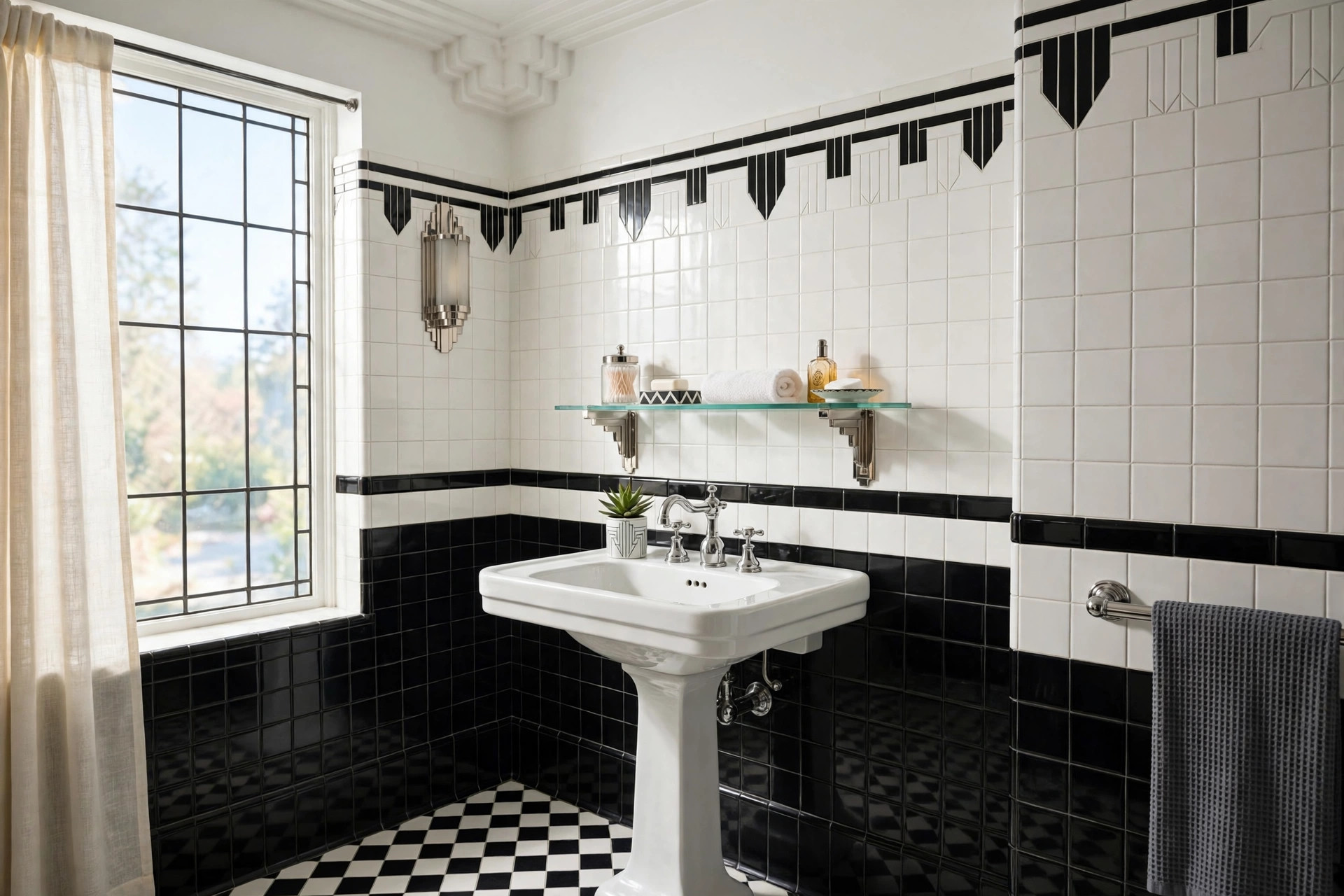
How to spot a real 1930s glass shelf is a skill worth having if you love Art Deco bathrooms, because the decade’s glass shelving is widely reproduced and the copies are getting better. A genuine 1930s shelf is a small piece of design history: it was made when plate glass was still a luxury material, chrome was the fashionable new finish, and bathrooms were becoming display spaces rather than purely functional rooms. The clues are small — a tint in the glass, a style of bracket, a type of screw — but they are consistent, and together they are hard to fake.
Look at the Glass: Tint, Thickness, and Edge
Start with the glass itself. Glass made in the 1930s has a subtle green or aqua tint when you look through the edge, because the iron content of the sand used then was higher than in modern low-iron glass. Modern “clear” glass has a much paler edge, and modern low-iron glass is almost colourless. Hold the shelf edge-on to a white surface: a faint green cast is a good sign of age, though it is not proof on its own, since some modern glass also carries a green tint.
Thickness is the next check. A 1930s glass shelf is usually 1/4 inch (6 mm) or 5/16 inch (8 mm) thick — thinner than the 3/8-inch (10 mm) tempered glass used for most modern shelves, because plate glass of the era was expensive and shelves were expected to hold light toiletries, not heavy loads. If the shelf is 1/2 inch thick and very heavy, it is almost certainly modern.
Crucially, a genuine 1930s shelf is not tempered glass. Tempering became common for shelving much later, so an original shelf will be annealed plate glass. That has two consequences: first, if you look at the glass through polarised sunglasses, a tempered shelf shows a faint mottled pattern that an annealed shelf does not; second, an original shelf deserves respect — annealed glass breaks into sharp shards, so handle it carefully and do not load it heavily. The edge finish is also telling: 1930s shelves usually have a simple flat polished edge or a small bevel, not the wide decorative bevels and arrised edges common on modern reproductions.
Examine the Brackets and Fixings
The brackets are often the best evidence, because 1930s chrome work has a character modern plating struggles to match. Period brackets were typically cast brass or steel with a nickel or chrome plate, and the plating was relatively thick and warm in tone. Look for a slightly soft, mellow chrome with tiny imperfections — small pits, a faint orange-peel texture, or a warm grey undertone. Modern chrome is usually brighter, bluer, and mirror-perfect, and it is often plated over zinc alloy rather than brass.
Study the bracket shape. A 1930s bracket is usually a simple, elegant form: a curved support arm with a stepped or streamlined profile, sometimes with a small decorative scroll at the front, designed to hold the glass in a shallow channel or on a flat rest with a small lip. Ornate Victorian-style brackets with heavy scrollwork do not belong to the 1930s. Also check how the bracket meets the wall: period brackets were fixed with slotted-head screws, often in brass or steel, and the screw heads may show a slightly off-centre slot or a hand-finished dome. Modern Phillips-head screws are a clear anachronism — if you see them, the bracket has been refitted or replaced.
Check for Age Marks and Wear Patterns
Ninety years of use leaves a record. On the glass, look for fine surface scratches that run in random directions, particularly on the top face where bottles were slid back and forth, and for a faint cloudiness in the centre of the shelf where cleaning cloths wore the surface over decades. On the chrome, expect wear on the front edge of the bracket where hands gripped it, and a duller tone on the underside where it was rarely polished. A shelf that is uniformly pristine, with no scratches, no wear, and mirror-bright chrome, is either a reproduction or has been so thoroughly restored that its age is academic.
Also look for old fixing holes and ghost marks. A shelf removed from its original bathroom may carry extra holes, a faint rectangular shadow on the wall plate where a tile met it, or traces of old paint on the back of the bracket. These imperfections are reassuring: a faker makes a clean object, while a real one carries its history on its surface.
Provenance, Price, and Safe Use
Ask the seller where the shelf came from. A credible salvage dealer can often name the house, and a shelf with a matching pair of brackets and its original screws is far more convincing than a lone piece of glass. Be cautious of online listings that describe a shelf as “1930s style” — the word “style” is doing a lot of work there — or that show the shelf photographed against a white background with no context. A genuine 1930s glass shelf with its original chrome brackets typically sells for $60 to $200 depending on size and condition, while a modern reproduction costs $25 to $60 new. A “genuine 1930s” shelf listed at $19 should raise an eyebrow.
If you buy an original, use it wisely. Annealed plate glass should not carry heavy loads: keep it to toiletries, a small vase, and folded hand towels, and stay well under 10 pounds for a 24-inch shelf. Have the brackets fixed into studs or solid tile backing with proper fixings, and consider a discreet modern safety film on the underside if the shelf hangs above a bath or a child’s reach — it is invisible in normal use and holds the glass together if it ever breaks. Clean the glass with a microfibre cloth and a mild glass cleaner, and polish the chrome gently with a soft cloth; avoid abrasive cleaners that will strip the old plating.
Our Top Picks
- Salvage 1930s glass shelf with chrome brackets: An original plate-glass shelf with period brackets and slotted screws, suited to an Art Deco or 1930s-style bathroom above a pedestal sink.
- Modern tempered glass shelf in a Deco profile: A 3/8-inch tempered shelf with polished chrome brackets in a streamlined 1930s profile, a safe everyday alternative where a fragile original is not practical.
- Gentle chrome polish and microfibre cloth set: A non-abrasive polish and lint-free cloths for maintaining old chrome plating without stripping it.

GIPHY App Key not set. Please check settings