


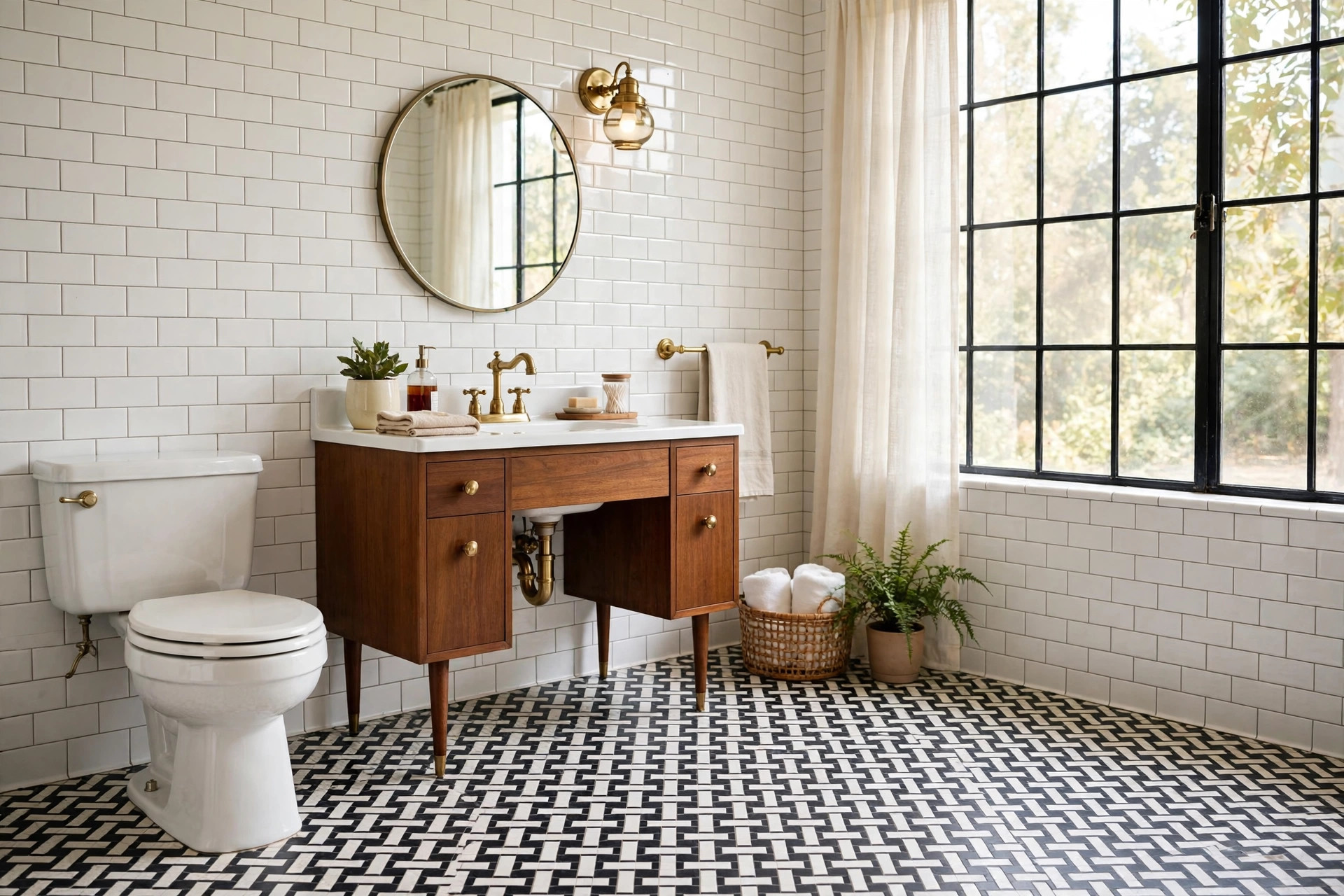
How to identify real mid-century modern basketweave tiles matters more than ever, because the pattern is back in fashion and reproductions are everywhere. The basketweave mosaic — small rectangular tiles woven over and under each other like a basket, usually in black and white — was a staple of American bathrooms from the late 1940s through the early 1960s. Originals carry the marks of their era in their glaze, their dimensions, and the way they were laid. Learn those marks and you can tell a 1955 floor from a 2025 lookalike in a few minutes.
Know the Pattern and the Period Palette
First, confirm you are looking at a true basketweave. The classic layout pairs small rectangles — typically 1 by 2 inches — arranged in alternating horizontal and vertical pairs, with a small square dot tile at each intersection. The effect is a woven textile rendered in ceramic. In period bathrooms the dominant scheme is white rectangles with black or dark grey dots, though pastel versions exist: pale pink and white, mint green and white, or soft blue with white dots were popular in the 1950s.
Colour is a useful first filter. Mid-century pastels are soft and slightly chalky — think powder pink, seafoam, butter yellow — because the pigments of the era could not produce the saturated tones modern glazes can. A basketweave in vivid teal, hot pink, or jet-black gloss with razor-sharp colour edges is more likely modern. Also note the dot colour: originals often used a black or charcoal dot even in pastel fields, while many reproductions match the dot to the field or use a high-contrast pure white.
Measure the Tiles and the Sheet
Tile size is one of the most reliable tells. Mid-century basketweave mosaics were sold on mesh sheets, usually 12 by 12 inches, with rectangles measuring about 1 by 2 inches and dots around 1/2 inch square. Modern reproductions often enlarge the pattern for faster installation — rectangles of 1 by 3 inches, or sheets of 12 by 24 inches — and the difference is visible once you know to look. Carry a tape measure: if the rectangles are noticeably longer than twice their width, or the sheet is larger than a foot square, question the date.
Thickness matters too. Original ceramic mosaics are typically 1/4 inch (6 mm) thick, sometimes slightly less, and feel light in the hand. Modern porcelain reproductions are often thicker and heavier, around 5/16 to 3/8 inch, because porcelain is fired denser and is sold for floors as well as walls. A loose tile that feels chunky and heavy for its size leans modern.
Read the Glaze, the Edges, and the Clay Body
Glaze is where period tiles really show their age. Mid-century glazes are glossy but not glassy: hold a tile at an angle to the light and look for fine crazing — a network of hairline cracks in the glaze surface. Crazing develops over decades as the glaze and the clay body expand at different rates, and it is very hard to fake convincingly. A tile with even, delicate crazing across the whole surface is almost certainly old. Be aware that some modern “crackle glaze” tiles imitate this, but their crackle is usually bolder, more uniform, and visible without raking light.
Look at the edges. Original mosaics were often cushion-edged, with a softly rounded edge rather than a sharp rectified cut. Run a fingertip along the edge: a gentle roundness suggests a period tile, while a crisp 90-degree edge suggests a modern rectified porcelain. Check the back as well. Old tiles have a slightly rough, unglazed biscuit back, sometimes with traces of the mesh and old adhesive, and the clay body is often a warm buff or pale terracotta colour. Modern porcelain backs are usually a uniform pale grey-white with a clean grid pattern pressed in.
Inspect the Installation and the Grout
The way the tile was laid tells its own story. Mid-century basketweave was usually set in a thick bed of cement mortar, often over a wire lath or a mud bed an inch or more thick — you can sometimes see this at a floor edge, a vent, or where a tile has come loose. Modern installations use thinset, a layer only a few millimetres thick. If you are lifting a floor and find a thick mortar bed with a slightly uneven surface, that supports a period date.
Grout lines are another clue. Original installations typically have grout joints of about 1/8 inch, slightly irregular in width because the tiles were hand-set on mesh and nudged into place. Modern reproductions often have perfectly uniform 1/16-inch joints, sometimes with a rectified edge that allows almost no grout at all. Also look at the grout colour: period grout was usually white or light grey and has often yellowed or picked up a warm tone with age, while modern grout stays bright white or is deliberately coloured to match.
Provenance, Price, and What to Do With Originals
If you are buying salvage tile, ask where it came from. Reputable architectural salvage dealers can usually name the house and the decade, and a full sheet still on its original mesh with old mortar on the back is far more convincing than a single loose tile. Price is a guide: genuine mid-century basketweave in good condition typically sells for $25 to $60 per square foot at salvage, reflecting the labour of careful removal, while a modern porcelain reproduction costs $8 to $20 per square foot new. A seller offering “original 1950s” tile at $6 a square foot is almost certainly selling a reproduction.
If you already have an original floor, protect it. Clean with a pH-neutral cleaner and a soft brush, and avoid acidic cleaners, which attack old grout and can dull the glaze. Re-grouting is usually a better investment than replacement: a careful re-grout with a period-appropriate sanded grout can make a tired floor look fresh for $8 to $15 per square foot installed. If tiles are missing, salvage dealers and specialist suppliers sometimes carry matching lots, but be prepared to hunt — matching a 1950s pastel exactly can take months, and a near match in a hidden corner is often the pragmatic answer.
Our Top Picks
- Salvage mid-century basketweave sheets: Original mesh-mounted sheets in black and white or pastel, sourced from a documented period house, for patching or a small feature floor.
- Porcelain basketweave reproduction: A modern porcelain mosaic in the classic 1-by-2-inch format with cushion edges, a practical choice for a wet-room floor where a period tile’s porosity is a concern.
- pH-neutral tile and grout cleaner: A gentle, non-acidic cleaner with a soft-bristle grout brush, safe for vintage glazes and old grout lines.

GIPHY App Key not set. Please check settings