


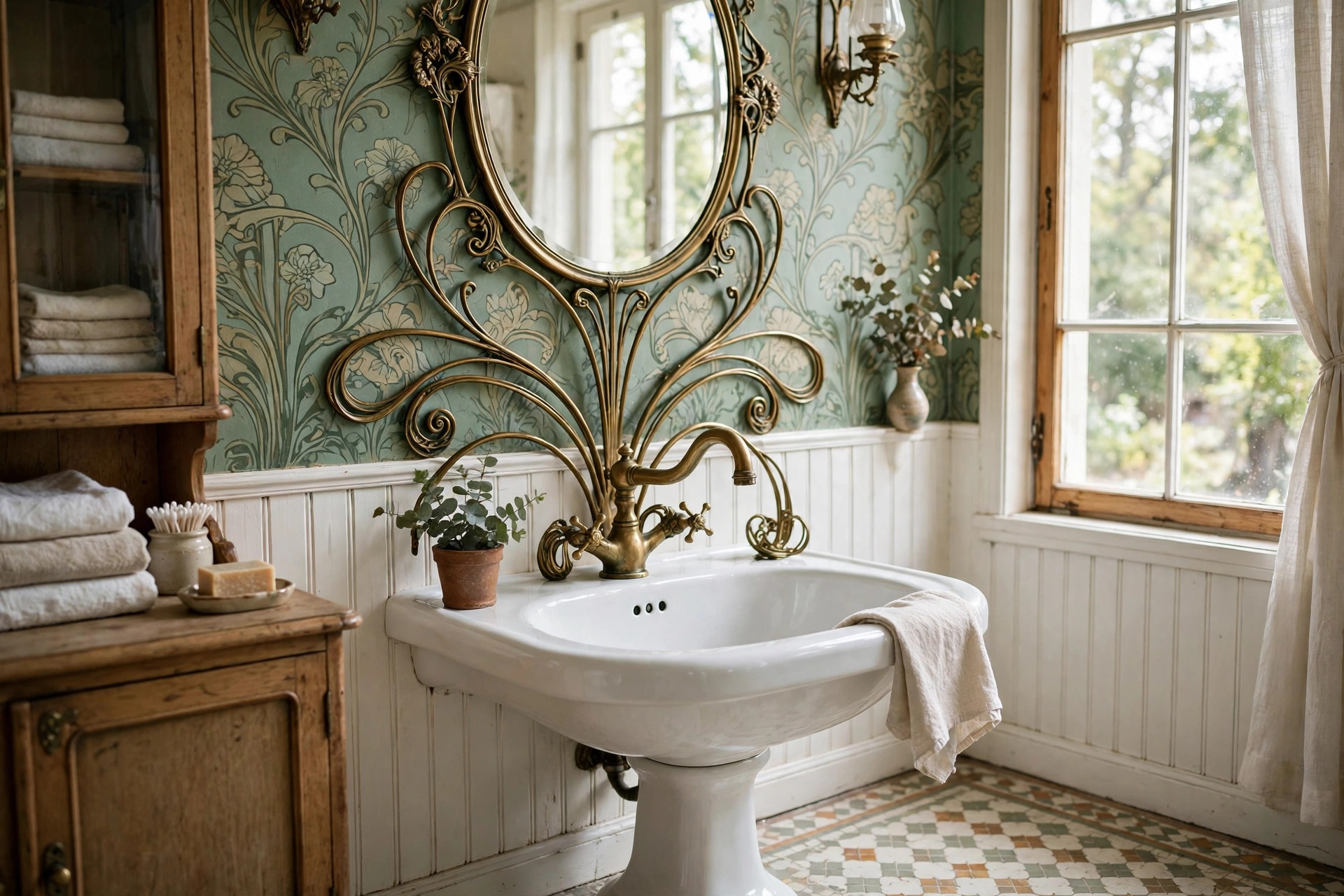
How to identify real Art Nouveau brass faucets is a question that trips up even experienced salvage hunters, because the style’s flowing lines are easy to copy and hard to fake well. Genuine pieces date roughly from 1890 to 1910, and they carry the fingerprints of their era in ways a modern reproduction rarely manages: hand-finished casting, specific alloys, period valve mechanisms, and a certain asymmetry that mass production smooths away. This guide walks through the seven checks that matter most, so you can buy with confidence at a salvage yard, an auction, or an online listing.
Start With the Silhouette: Whiplash Lines and Asymmetry
Art Nouveau is defined by the whiplash curve — a long, sinuous line that sweeps, bends back on itself, and ends in a flourish. On a faucet, look for a spout that rises and curls like a plant stem, handles shaped like leaves or unfurling buds, and escutcheons (the decorative plates at the base) that flow into the body rather than sitting on it as separate discs. The key test is asymmetry: genuine Art Nouveau design is deliberately off-balance, with a curve that favours one side. A reproduction tends to be symmetrical because symmetry is cheaper to mould. If the left and right handles are perfect mirror images of each other, be suspicious — period makers embraced variation.
Also check the proportions. Original faucets were made for deep ceramic or stone basins, so spouts are often taller and more arched than modern ones, typically rising 6 to 10 inches above the deck with a reach of 5 to 8 inches. A squat, stubby faucet with Nouveau-style decoration pasted on is almost certainly a modern piece borrowing the look.
Read the Metal: Alloy, Weight, and Patina
Real period brass is heavy. Pick the faucet up: a genuine early-1900s brass faucet feels dense and solid, often weighing 3 to 6 pounds for a basin set, because it was cast thick. Modern reproductions are frequently hollow-cast or made from thinner zinc alloy with a brass-coloured finish, and they feel noticeably light and tinny by comparison. If a magnet sticks, walk away — period brass is non-magnetic, while many cheap reproductions use plated steel underneath.
Patina is the next clue. A century of use leaves a warm, uneven brown-gold tone with darker recesses in the crevices of the casting, and the high points may show a brighter polish where hands touched them daily. Be wary of a uniform “antique” finish: modern chemical ageing produces an even, slightly greenish-brown tone that looks the same in every hollow. Genuine patina is irregular and cannot be faked convincingly at a glance. That said, a faucet that has been aggressively polished to a mirror shine is not necessarily fake — collectors and restorers have been polishing brass for decades — so treat patina as supporting evidence, not proof on its own.
Examine the Casting and the Finish
Look closely at the surface under good light. Period sand-cast brass shows a slightly textured, almost orange-peel surface under magnification, with fine mould lines and occasional tiny casting pits. Modern reproductions, usually die-cast, have a smoother, more uniform surface with crisp, sharp edges. Also inspect the underside and the back of the spout — areas a faker does not bother to finish. Originals show tool marks, file marks, and hand-finishing; reproductions often show mould seams and a rough, unfinished interior.
Check the threads and fittings too. Pre-1910 faucets commonly used imperial pipe threads and may have slightly irregular, hand-cut threads. Modern reproductions use standardised metric or modern NPT threads with machine-perfect uniformity. If the faucet screws onto a modern supply line with zero fuss, that is not proof of fakery — many originals have been re-threaded during restoration — but combined with other clues it adds up.
Look for Maker’s Marks and Period Valve Mechanisms
Many quality makers stamped their work: look for a name, initials, or a trademark on the underside of the spout, inside the escutcheon, or on the valve body. French makers such as those in Nancy and Paris, Belgian firms, and American companies like J.L. Mott all produced Art Nouveau bathroom brass. A legible maker’s mark with a matching period typeface is strong evidence. Cross-check the name against reference books or museum collections; a mark that belongs to a maker who never produced Nouveau work is a red flag.
The valve mechanism is one of the best tells. Original faucets from 1890 to 1910 typically used compression valves with ceramic or leather washers, operated by a spindle that turns several rotations. Turn the handle: a period valve feels smooth but requires multiple turns from closed to fully open. Many reproductions hide a modern quarter-turn ceramic disc cartridge inside a vintage-looking body, and the handle snaps from off to on in a quarter turn. A quarter-turn action on a supposedly 1905 faucet is almost conclusive evidence of a reproduction — or at least of a heavily modernised original.
Provenance, Price, and Practical Checks
Ask where the faucet came from. A credible salvage dealer can usually tell you the building it was removed from, and a piece with a documented removal from a period house in Paris, Brussels, or New York carries far more weight than one with no history at all. Photographs of the faucet in situ before removal are gold. Online, be cautious of listings that use stock-style photos, vague descriptions like “vintage style,” or prices that seem too good: a genuine Art Nouveau brass basin set in restorable condition typically sells for $400 to $1,500 at auction or salvage, while a reproduction sells new for $120 to $350. If a “genuine 1900s” set is listed at $89, the price is telling you the truth the description is not.
Before you buy, check the practicalities. Measure the spout reach against your basin — a tall Nouveau spout over a shallow modern basin will splash. Confirm the hole spacing: period sets were often made for 8-inch widespread drilling, but many were custom. Budget $150 to $400 for professional restoration if the valves need re-washering, the threads need chasing, or the finish needs conservation rather than a full re-plate. And remember that an original faucet may not meet modern water-efficiency or lead-content standards; a plumber can fit a modern aerator and check the alloy, but factor that into the cost.
Our Top Picks
- Restored period brass basin set: A professionally re-washered original set with compression valves and a conserved patina, suited to a period pedestal sink or marble-top vanity.
- Solid brass reproduction with ceramic disc valves: A well-made modern reproduction in heavy cast brass with traditional cross handles, a practical choice where modern water regulations or reliability matter more than provenance.
- Brass restoration and conservation kit: A gentle cleaner, fine bronze wool, and Renaissance-style microcrystalline wax for maintaining a period finish without stripping a century of patina.


GIPHY App Key not set. Please check settings