

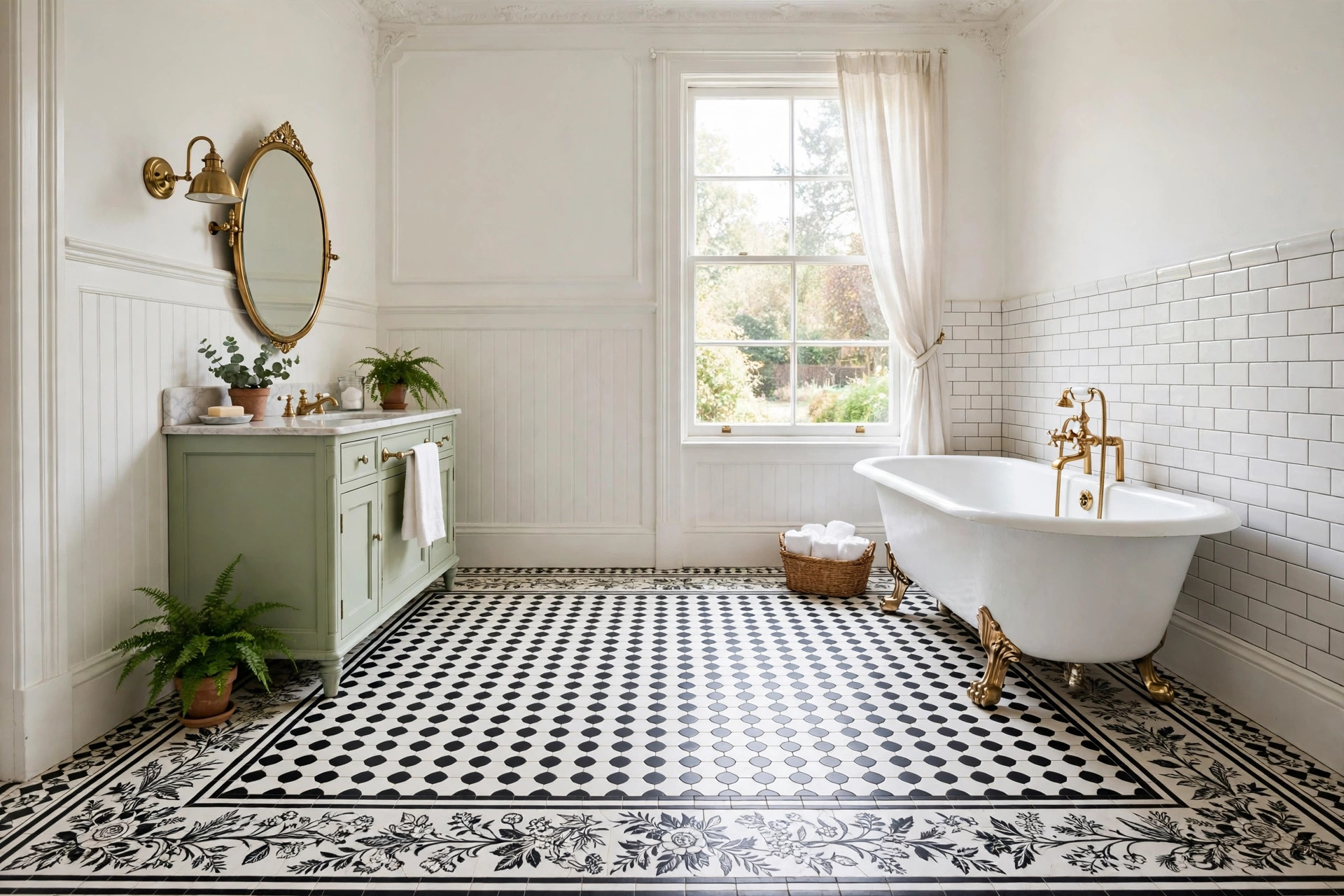
Few floors say “Victorian bathroom” quite like hexagonal tile. Small, honeycomb-shaped tiles in black and white, sometimes with a soft grey, sage or dusty blue accent, have covered bathroom floors since the late 1800s. They are durable, easy to clean, forgiving of uneven subfloors, and they suit everything from a grand Victorian restoration to a small retro cloakroom.
This Victorian hex tile for sale buyer shortlist will help you choose the right size, colour and finish, compare prices, and avoid the most common buying mistakes. Whether you are retiling a whole floor or creating a small feature area in front of a clawfoot tub, use this guide as your checklist before you order.
What Counts as Victorian Hex Tile?
Traditional Victorian hex tiles are small unglazed porcelain or ceramic hexagons, usually 1 inch across, laid in patterns of black and white with occasional coloured accents. The classic design is a white field with a black border, a black-and-white checkerboard of hexagons, or a white field scattered with single black or blue tiles in a regular pattern. Larger 2-inch hex tiles are a later variation, popular in 1920s and 1930s bathrooms, and they suit bigger rooms where a 1-inch tile would look too busy.
Modern reproductions copy the look in glazed porcelain, which is easier to clean and less porous than the original unglazed tile. Both are good choices, but they behave differently — unglazed tile needs sealing, glazed tile does not — so decide which finish suits your household before you buy.
The Sizes on Your Shortlist
Size changes the whole look of a floor, so choose it before you choose a colour. One-inch hex tiles are the most authentic Victorian choice, and they work beautifully in small bathrooms where a larger tile would need too many cuts. A standard 5-by-8-foot bathroom floor needs roughly 40 square feet of tile, and 1-inch hex tiles are usually sold on mesh sheets of 12 by 12 inches, which makes laying them much faster.
Two-inch hex tiles suit larger bathrooms and open-plan wet rooms, where they read as a calmer, more modern take on the Victorian pattern. They are also easier to lay and grout, and they cost a little less per square foot because fewer tiles are needed. If your bathroom is wider than 8 feet, consider the 2-inch size; if it is a small cloakroom, the 1-inch size will look more in period.
Colours and Patterns to Consider
The classic Victorian palette is simple: matte white, matte black, and one accent colour. White with black is the safest choice and the easiest to live with, while a white floor with scattered dusty-blue or sage-green hexagons adds a gentle retro touch without overwhelming the room. Grey hex tiles sit between the two — softer than black, but still clearly patterned.
For a border, a single row of black hex tiles around a white field is the traditional finish, and it frames the room beautifully. A floral or geometric mosaic border, made from tiny hexagons in two or three colours, is more decorative and suits a larger floor where the pattern has room to breathe. Keep the pattern simple in a small room: a busy floor and a busy wall can fight each other, so pair a patterned hex floor with plain wall tiles.
Prices: What to Expect
Victorian hex tile is not the cheapest floor tile, but it is not the most expensive either. Expect to pay $6 to $12 per square foot for good quality 1-inch unglazed porcelain hex tile on mesh sheets, and $8 to $15 per square foot for glazed porcelain in the same size. Two-inch hex tiles usually cost $5 to $10 per square foot. Decorative borders and mosaic sheets cost more — $15 to $30 per square foot is typical for a patterned border strip.
For a 40-square-foot bathroom floor, budget $240 to $480 for the tile itself, plus $40 to $80 for adhesive, grout and sealer, and $300 to $600 for professional installation if you are not laying it yourself. Always order 10 percent extra for cuts and breakages, and keep a spare sheet for future repairs — dye lots vary, and the same colour can look slightly different from one batch to the next.
Where to Buy: The Shortlist
Start with specialist tile retailers that stock period designs, rather than general DIY stores. Specialists usually carry the full range of sizes and colours, offer sample tiles, and can advise on sealing and grout colour. Ask for a sample before you order a full floor — a single mesh sheet or a handful of loose tiles will tell you more than any photograph.
Reproduction tile makers and heritage tile companies are a good second source, especially if you want an exact match for an existing floor. They often sell by the sheet and can make up a custom border to your measurements. Online tile retailers are useful for price comparison, but check the delivery cost for heavy tile, the returns policy for unopened boxes, and whether the tile is in stock or made to order.
Salvage yards occasionally have genuine Victorian hex tile, lifted from old houses, but matching a full floor from salvaged tile is difficult. Salvage is better for a small repair or a feature panel than for a whole room, unless you are happy to mix old and new tile in a deliberate patchwork.
Checks to Run Before You Order
Order samples first, and look at them in your bathroom under natural light and under your bathroom lighting. A white tile that looks warm in a shop can look cold and blue under LED light, and a black tile can show every speck of dust. Lay the sample on the floor, step back, and live with it for a day or two before you commit.
Check the tile thickness — most hex floor tiles are 6 to 8 millimetres thick — and make sure it matches the height of any adjoining floor. Check the mesh backing, too: a well-made sheet holds its tiles evenly spaced, while a cheap sheet can have loose or crooked tiles that make grouting a misery. Ask whether the tile is frost-proof if it will be used in an unheated room, and whether it is rated for floor use, not just walls.
For unglazed tile, ask about sealing. Unglazed porcelain absorbs moisture and stains more easily, so it needs a penetrating sealer before grouting and again after. Budget $25 to $40 for a bottle of sealer, and allow a day for it to cure. Glazed tile needs no sealer, which makes it a better choice for a busy family bathroom.
Grout Colour Matters More Than You Think
Grout is the frame around every hexagon, and the wrong colour can change the whole floor. White grout keeps a black-and-white floor crisp but shows dirt quickly, especially in a bathroom. Light grey grout is a practical compromise — it hides dirt, suits both black and white tiles, and keeps the pattern clear. Dark grey or charcoal grout makes white tiles stand out and hides stains well, but it can make a black-and-white floor look muddy if it is too dark.
Use a grout designed for narrow joints — 1/16 inch to 1/8 inch is typical for hex tile — and ask your tiler to seal the grout as well as the tile. In a wet area, an epoxy grout resists staining and mould better than standard cement grout, though it costs more and is harder to apply.
Installation Tips Worth Knowing
Hex tile is forgiving, but it still needs a flat, clean subfloor. Any dip or bump will show as uneven grout lines, so level the floor first. Dry-lay a few sheets before you stick anything down, and plan the layout so the cut tiles fall at the edges of the room, not in the middle of the floor. Start from the centre of the room and work outwards, and keep the sheets aligned — a sheet that drifts by a few millimetres will throw the whole pattern off.
If you are laying the tile yourself, allow a full weekend for a small bathroom, including sealing and grouting time. If you hire a tiler, ask whether they have laid small-format hex tile before, and ask to see a photograph of a previous job. Experience with mosaic and hex tile matters more than a low day rate.
Our Top Picks
- Classic 1-inch black-and-white hex tile on mesh sheets: the most authentic Victorian choice, with a white field, a black border and a timeless look. Choose unglazed porcelain for a period feel, or glazed porcelain for easier cleaning in a family bathroom.
- Two-inch white hex tile with scattered sage accents: a calmer, slightly more modern take that suits larger bathrooms and pairs beautifully with a clawfoot tub and pastel wall tiles. Order a spare sheet for repairs.
- A decorative hex mosaic border strip: the finishing touch for a larger floor, in black, white and dusty blue. Use it to frame the room or to edge a shower area, and keep the main field plain so the border can shine.
Victorian hex tile rewards a little patience. Order samples, compare prices, check the thickness and finish, and plan your grout colour before you buy. Get those details right, and your bathroom floor will look as good in twenty years as it does on the day it is laid.

GIPHY App Key not set. Please check settings