


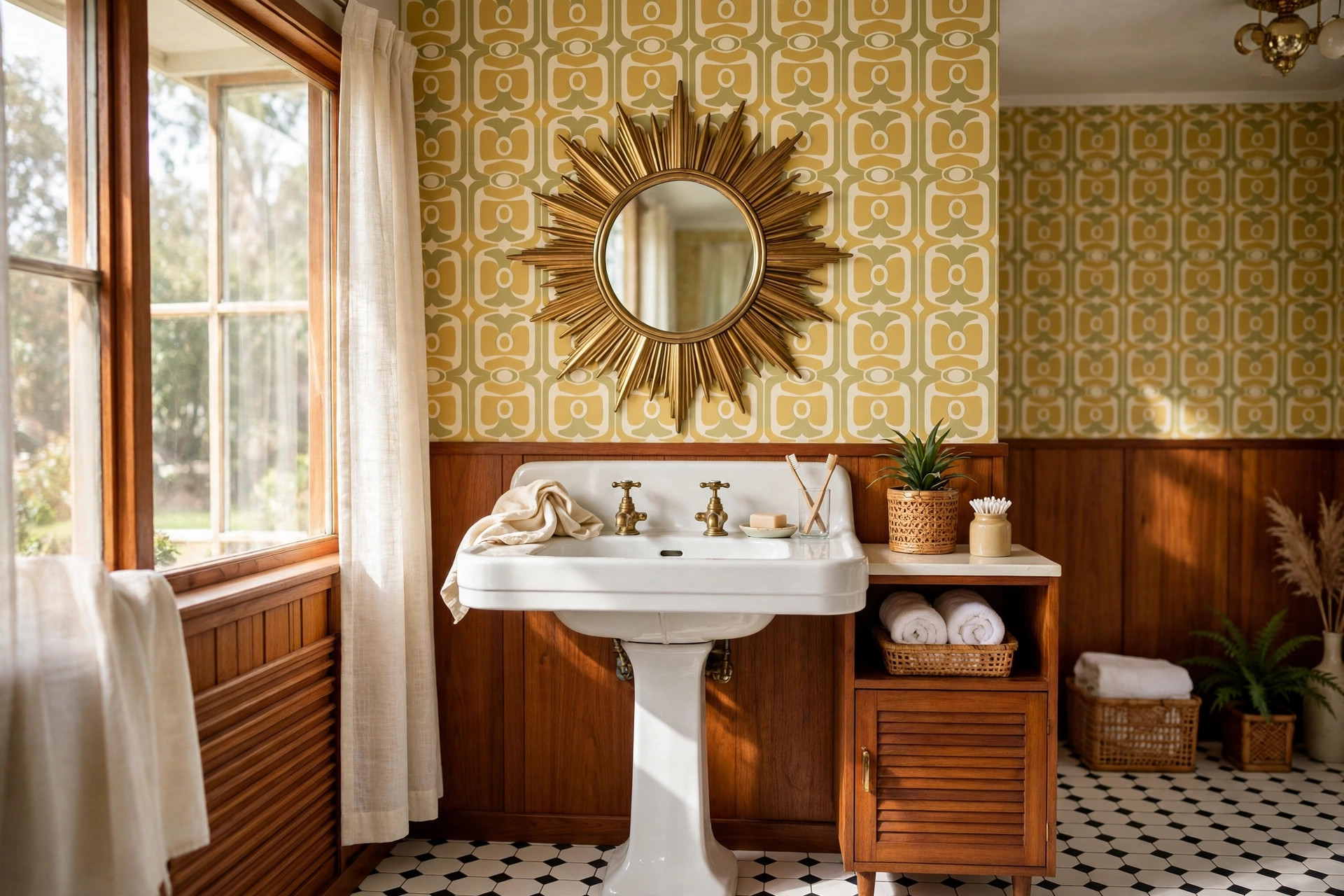
Knowing how to spot a real 1960s bathroom mirror can save you from paying vintage prices for a piece that rolled off a factory line last year. The 1960s produced some of the most joyful mirrors ever made — sunbursts, atomic starbursts, sculptural teak frames, and bold geometric shapes — and their popularity has made them one of the most reproduced categories in vintage home decor. The good news is that a genuine sixties mirror carries plenty of clues, from the glass itself to the back of the frame.
A real 1960s bathroom mirror was made to hang in a room full of steam, splashes, and daily use, so it was built with solid materials and honest construction. Reproductions are usually made to look the part in a photograph. Up close, in your hands, the differences are hard to miss once you know what to look for.
Look at the Glass First
The glass is the single best clue. A genuine 1960s bathroom mirror uses plate glass, usually 4 to 6 millimetres thick, with a silvered backing applied by hand or by early industrial processes. Over sixty years, that silvering ages in a particular way: it develops small dark spots, faint cloudy patches, and a soft foxing around the edges. This gentle deterioration is called desilvering, and it is one of the most reliable signs of age.
Hold the mirror at an angle to a window and look at the reflection. Old plate glass often has a very slight waviness or a faint greenish tint at the edge. Modern mirrors use float glass that is almost perfectly flat and optically clear, with a bright, hard reflection. If the reflection is razor-sharp and the edge of the glass is perfectly clear and colourless, the mirror is probably new.
Check the edge of the glass itself. A sixties mirror usually has a plain polished edge or a simple bevel, typically 12 to 25 millimetres wide. The bevel on a genuine piece was cut and polished by hand or on early machines, so it may have tiny irregularities. A modern reproduction often has a machine-perfect bevel or a decorative etched border that is too crisp and too even. Also look for a maker’s stamp or an etched mark in the corner of the glass — brands such as Pilkington in Britain sometimes marked their plate glass, and a period mark is a strong sign of authenticity.
Study the Frame and Its Materials
The frame is where sixties design really shows itself, and it is also where reproductions most often go wrong. Genuine 1960s bathroom mirrors were commonly framed in teak, walnut, rosewood, brass, or chrome, and later in the decade in moulded plastic and fibreglass. Teak was the signature material of the mid-sixties: warm, honey-brown, with a straight, close grain. If the frame claims to be teak but the grain looks printed, or the wood feels suspiciously light and plasticky, it may be a modern veneer over MDF.
Run your finger along the back of the frame. A genuine sixties mirror usually has a hardboard or plywood backing, held in place with small clips, screws, or turn buttons, and the back often shows the marks of its making: staple holes, a pencil note from the factory, or a paper label. Many British and Scandinavian makers glued a paper label to the back with the maker’s name, the model number, and sometimes the country of origin. Danish makers and British firms such as G-Plan labelled their pieces. A surviving label is a strong sign of authenticity, though labels can be faked, so treat one as supporting evidence rather than proof on its own.
Recognise the Shapes and Styles of the Decade
Knowing the design vocabulary of the sixties helps you spot pieces that are merely “sixties-style.” The classic shapes include the sunburst or starburst, with brass or wooden rays radiating from a round central mirror; the large round or oval mirror in a slim teak frame; the rectangular mirror with a floating shelf or a built-in light; and the sculptural free-form mirror with an asymmetrical, kidney or amoeba outline.
The sunburst is the most copied shape of all. On a genuine sixties starburst, the rays are usually made from individual pieces of brass rod or carved wood, each one fixed separately to a central hub, and they may be slightly uneven in length or angle because they were assembled by hand. On a modern reproduction, the rays are often a single stamped or moulded piece, perfectly symmetrical and suspiciously uniform. The centre mirror of a genuine starburst is usually 30 to 45 centimetres across, and the whole piece spans 60 to 90 centimetres. Oversized versions, 120 centimetres or more across, are almost always modern.
Check the Back, the Price, and the Seller
Turn the mirror over and examine the back carefully. A genuine 1960s bathroom mirror usually hangs from a wire, a chain, or a pair of metal D-rings screwed into the frame, or from a keyhole bracket. The hardware will show signs of age: a little surface rust, worn plating, or a darkened patina. The screws will be slotted, and the wire, if original, may be a braided steel picture wire rather than a modern plastic-coated cable.
A genuine 1960s bathroom mirror in good condition typically sells for $80 to $400, depending on size, maker, and style. A signed Danish teak mirror or a large brass sunburst by a known maker can fetch $500 to $900. If a seller is asking $500 for a starburst mirror with no maker, no label, and suspiciously perfect glass, you are probably paying for the story rather than the mirror. Ask where it came from, and where possible buy in person: bring a small torch to check the back of the glass, a magnet to test brass frames, and a tape measure to check the dimensions.
Our Top Picks
If you want the sixties look in your bathroom, these are the pieces worth hunting for:
- A teak-framed round mirror, 50 to 60 centimetres across: the most versatile sixties shape, warm enough to soften a white bathroom and small enough to hang above a pedestal sink.
- A brass sunburst mirror with individually fixed rays: the statement piece of the decade, best hung above a bath or on a feature wall where the rays can catch the light.
- A rectangular mirror with a slim teak frame and a floating shelf: practical as well as pretty, with room for a small plant or a bottle of bath oil, and a shape that suits both period and modern bathrooms.
A real 1960s bathroom mirror brings warmth, character, and a little bit of space-age optimism to a room. Learn the glass, read the frame, and check the back — and you will be able to spot the genuine article every time.

GIPHY App Key not set. Please check settings