


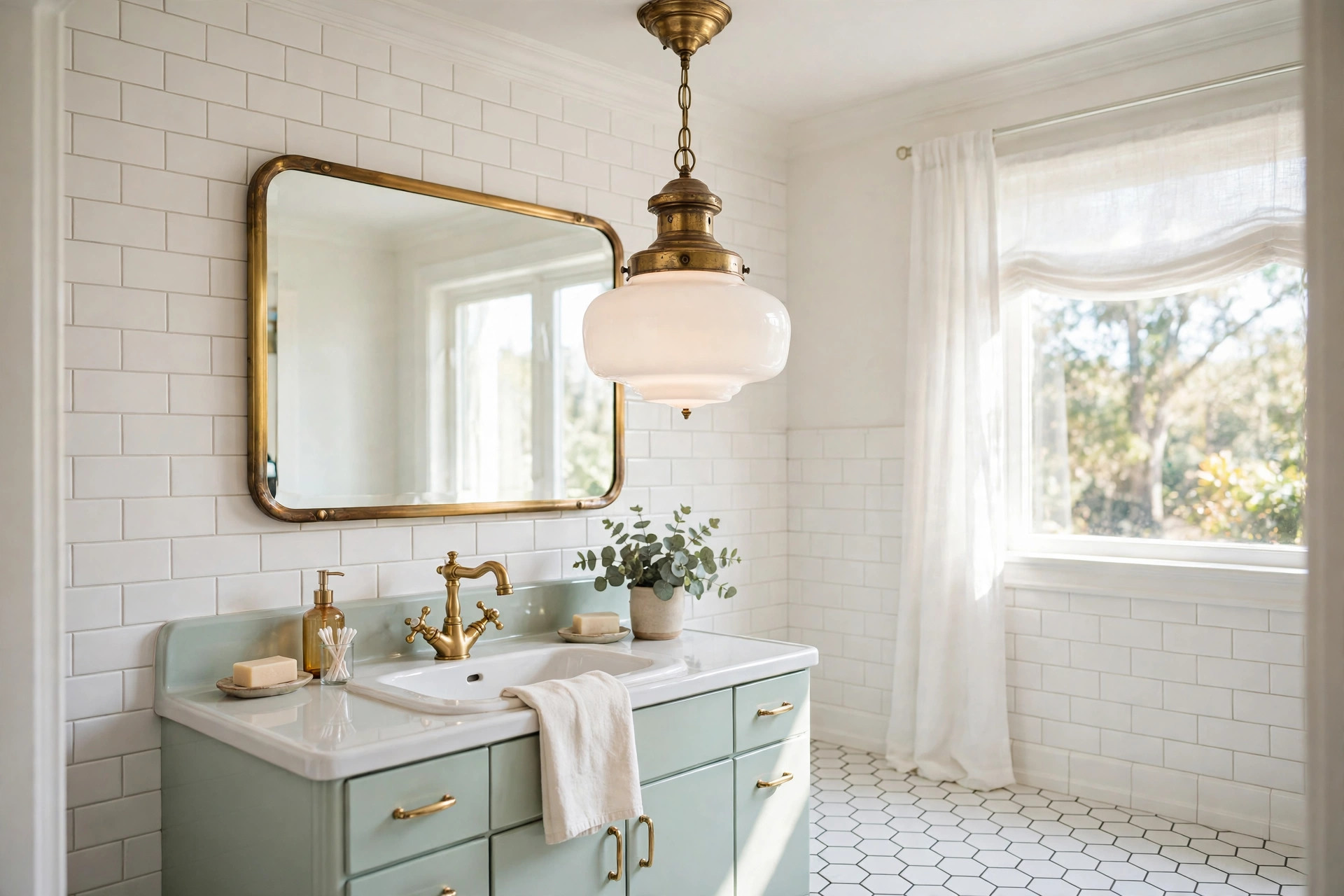
A vintage pendant light can turn an ordinary retro bathroom into a room with real soul — that warm brass glow over a clawfoot tub, a milk-glass shade above a pedestal sink, a 1950s enamel pendant in sage green. When it works, nothing else looks quite like it. When it does not, you can be left with frayed wiring, a cracked shade and a fitting that will not hang straight.
This guide to 17 things to check before buying a vintage pendant light walks you through every check that matters, from safety and wiring to size, style and price. Work through the list before you pay, whether you are buying in a flea market, an antique shop, on Etsy or from a salvage yard. Most checks take less than a minute, and together they can save you a costly rewiring job — or a light you never dare to switch on.
Safety First: Wiring, Socket and Shade
1. Check the wiring first, always. Old pendants were often wired with cloth-covered cable or early rubber insulation, both of which dry out, crack and crumble with age. Look inside the canopy and along any exposed cord for bare copper, brittle sheathing or scorch marks. If the cord feels stiff or sheds fibres when bent gently, plan on a full rewire — usually $40 to $90 through an electrician, or $15 to $30 in parts if you do it yourself. Never install a pendant with suspect wiring in a bathroom, where steam makes faulty electrics far more dangerous.
2. Test the socket and lampholder. Ask the seller to fit a bulb and switch the light on. A socket that flickers, buzzes or only works when you wiggle the bulb usually has worn contacts. Replacement porcelain or brass Edison screw sockets cost $8 to $25, but rare fittings use obsolete sizes that are harder to source. Check whether the socket accepts a standard LED bulb, which runs cooler and suits bathroom use.
3. Look for cracks, chips and repairs in the shade. Hold glass and enamel shades up to the light. Hairline cracks in milk glass, chips around the rim of an enamel shade and crazing in ceramic are easy to miss in a dim shop. Run your fingertip gently around the rim and the fitter opening. A cracked glass shade over a bath is a safety risk, and a repaired enamel shade can lose much of its value, so ask the seller directly whether the shade has been repaired.
4. Test the switch, pull chain or dimmer. If the pendant has a pull chain or rotary switch, test it several times. Chains that stick and switches that spark point to worn internals. Replacement pull-chain switches cost $6 to $15, but on some antique fittings the switch is built into the socket and needs a full socket replacement. In a bathroom, a wall switch is safer than a pull chain hanging over a wet area.
5. Think about bathroom zones and damp. A pendant over a bath or shower needs a higher ingress protection rating and a fully enclosed shade, while a pendant over a vanity in a well-ventilated bathroom is a lower-risk spot. Keep open glass shades and exposed bulbs well away from direct spray, use enclosed shades near the bath, and choose LED bulbs rated for damp locations. If in doubt, ask an electrician whether your chosen spot is suitable before you buy.
Size, Weight and Fit
6. Measure the drop and the shade diameter. A pendant that looks perfect in a shop can overwhelm a small bathroom or hang too low over a sink. Over a vanity, the bottom of the shade should sit roughly 30 to 36 inches above the countertop, and at least 7 feet above the floor in a walkway. For a standard 5-by-8-foot bathroom, a shade 10 to 14 inches across usually looks balanced; anything over 16 inches can dominate the room. Bring a tape measure and note your ceiling height before you shop.
7. Weigh the fitting. Vintage pendants made from solid brass, cast iron or thick glass are heavier than modern reproductions. If the fitting weighs more than 5 pounds, check that your ceiling has a joist or a rated mounting bracket where you plan to hang it. Budget $20 to $40 for a reinforced ceiling brace if needed.
8. Check the ceiling canopy and mounting hardware. The canopy is the small cup that covers the ceiling connection, and it is often missing on salvage pendants. Without it you will see bare wires and a messy junction box. Check that the canopy fits the cord, matches the finish and includes its retaining screw. Missing canopies can be replaced for $10 to $30, but an exact match in aged brass or nickel is harder to find. Also count the chain links so you know the drop can be adjusted.
9. Check the cord length and colour. Measure the cord from canopy to socket and check it is long enough for your ceiling height, with slack for adjustment. Braided fabric cord in cream, black or sage green suits most vintage bathrooms and costs $1 to $2 per foot. If the original cord is frayed, budget for a replacement in a colour that matches the fitting.
10. Look at how it hangs. Ask the seller to hang the pendant or hold it by its cord so you can see whether it sits level. A shade that tilts usually means a bent fitter, a damaged socket or an unevenly weighted shade. Minor tilt can sometimes be fixed by adjusting the shade ring, but a bent brass stem or a warped enamel shade is much harder to correct — and a crooked pendant over a vanity will catch your eye every morning.
11. Check for matching parts and missing pieces. Vintage pendants often lose diffusers, finials, shade rings and glass chimneys over the decades. Check that every part on display is included in the sale. A missing fitter ring — the metal ring that holds a glass shade to the socket — can be surprisingly hard to replace, especially in the older 2.25-inch, 3.25-inch and 4-inch fitter sizes. Measure the fitter opening and note the size before you leave.
Finish, Authenticity and Price
12. Inspect the finish up close. Patina is charming; corrosion is not. Look for green verdigris on brass, rust spots on steel and flaking chrome. Light tarnish can be polished, but pitting and deep rust cannot be reversed without replating, which can cost $60 to $150 per fitting. Test a hidden spot with a soft cloth to see whether the shine comes back.
13. Confirm the bulb type and wattage rating. Old fittings were often rated for 40-watt or 60-watt incandescent bulbs, and the shade may trap heat. Check the label inside the socket for a maximum wattage. A 9-watt LED gives roughly the light of a 60-watt incandescent while running far cooler, but the bulb still needs to fit physically inside the shade — bring a spare LED bulb when you shop and test the fit.
14. Ask about provenance and age. A genuine 1920s milk-glass pendant and a 1980s reproduction can look similar, but their prices should not be. Ask where the light came from and whether any parts have been replaced, and look for maker’s marks, patent numbers or stamps inside the shade or on the socket. A confident, specific answer is worth more than a vague “it’s old.”
15. Spot reproductions and fakes. Reproductions are not always a bad buy, but they should be priced as reproductions. Look for overly perfect finishes, modern Phillips screws, plastic parts where brass should be, and “aged” paint that rubs off easily. Genuine vintage brass usually shows uneven wear, and old glass often has small bubbles or slight asymmetry. If a seller claims a light is Victorian but the wiring is modern PVC, trust the evidence, not the label.
16. Compare the price against similar sales. Before you pay, check what similar pendants have actually sold for, not just what they are listed for. A common 1960s enamel pendant in fair condition might sell for $45 to $85, while a rare 1920s brass and milk-glass pendant in excellent condition can fetch $200 to $400 or more. If a price seems far below the usual range, ask why — it may be a reproduction, or it may have a hidden fault.
17. Agree returns, delivery and final cost. Does the seller accept returns if the light does not work at home? How will a fragile glass shade be packed, and who pays if it arrives broken? Add up the full cost — purchase price, rewiring, replacement parts, a ceiling brace and delivery — before you decide. A $60 pendant that needs $80 of work is a $140 pendant, and you may find a ready-to-hang example for the same money.
Our Top Picks
- A rewired milk-glass schoolhouse pendant: the classic choice for a retro bathroom, with a soft diffused glow, a simple brass fitter and a shape that suits pedestal sinks and clawfoot tubs alike. Look for an opal glass shade with no chips and a new fabric cord.
- A sage-green enamel industrial pendant: a durable, easy-to-clean shade with a wide downward glow, ideal over a vanity or a freestanding bath. Choose one with intact enamel inside and out, and a shade 12 to 14 inches across for a medium bathroom.
- A small brass pendant with a clear glass shade: a lighter, airier option that shows off a filament-style LED bulb and suits bathrooms with lower ceilings. Check the glass thickness and the fitter size before you buy.
Work through these 17 checks in order and you will buy with confidence. The right vintage pendant should feel solid, hang straight, switch on cleanly and suit the size of your room. If a light fails several checks, walk away — another one will come along, and your bathroom deserves a fitting you can enjoy safely for years.

GIPHY App Key not set. Please check settings