


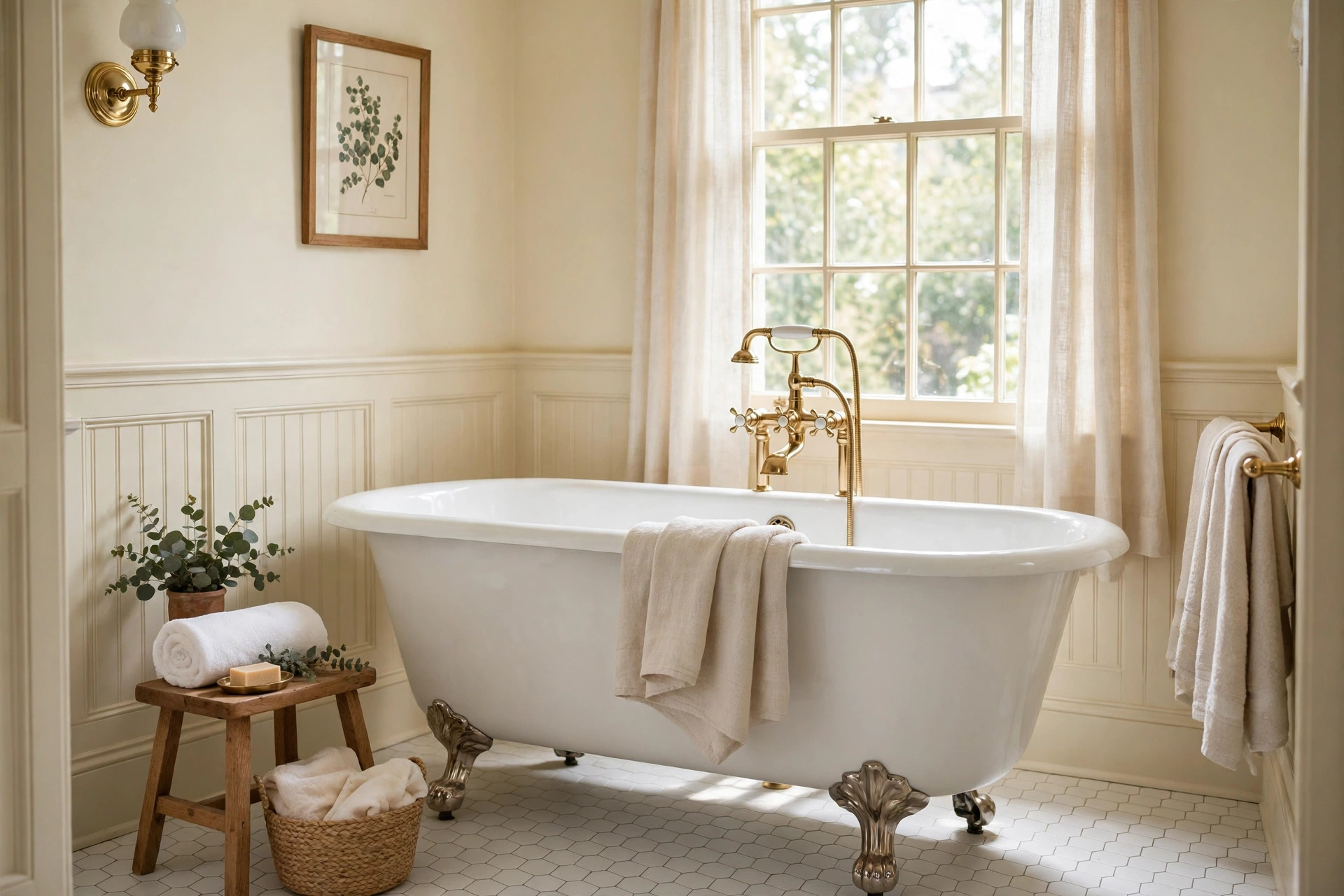
Learning how to identify real Edwardian tub fillers is the difference between bringing home a piece of bathroom history and paying antique prices for a modern copy. The Edwardian era, roughly 1901 to 1910, produced some of the most elegant bath fittings ever made, and the market is full of reproductions that look convincing at first glance. With a careful eye and a little patience, you can learn to tell the genuine article from the imitation before you spend a penny.
A real Edwardian tub filler was built to last a century, and most of them have. They were cast from solid brass, finished by hand, and designed for the deep freestanding roll-top baths of the period. Reproductions are usually made to look old rather than to be old. The clues are in the weight, the metal, the markings, and the small engineering details that modern makers rarely bother to fake.
Start With the Weight and the Metal
Pick the filler up. A genuine Edwardian tub filler is heavy — a freestanding floor-mounted filler can weigh 8 to 12 pounds, and even a deck-mounted pair of taps feels substantial in the hand. The body is solid cast brass, often 3 to 4 millimetres thick. Reproductions are frequently made from zinc alloy or thin brass-plated steel, and they feel noticeably light and hollow by comparison.
Look at the metal where it is hidden: underneath the base, inside the spout, or behind a handle. Real Edwardian brass has a warm, slightly uneven tone and often shows faint file marks from hand finishing. Scratch a discreet spot gently with a fingernail and solid brass stays brass-coloured all the way through, while a plated reproduction reveals a silvery or grey base metal underneath. Chrome on genuine pieces was applied over solid brass and tends to wear in patches that show the brass beneath; modern chrome over zinc peels in flakes and shows a dull grey core.
A magnet is a useful pocket tool. Brass is not magnetic, so a magnet should not stick to a genuine filler. If it clings firmly to the body, you are almost certainly holding plated steel. Test the main body and the spout, not the fixings, since some internal screws are steel even on real pieces.
Read the Maker’s Marks
Edwardian manufacturers were proud of their work, and most stamped their name, a trademark, or a patent number somewhere on the fitting. Look on the underside of the base, on the back of the spout, inside the handle escutcheons, and on the valve bodies. Names to look for include Thomas Crapper & Co., Shanks, Twyfords, Doulton, and American makers such as J.L. Mott and Standard Sanitary. British pieces may also carry a registration diamond or a “Rd” number.
The style of the marking matters as much as the name. Genuine stamps were punched or cast into the metal, so the letters are crisp, slightly irregular, and sit a little below the surface. Modern reproductions often use laser etching, which looks too perfect, or they carry no mark at all. A filler with no marking whatsoever is not automatically fake — small provincial foundries made unmarked pieces — but combined with other warning signs, a blank body should make you cautious.
Study the Design Details
Edwardian design has a particular language, and reproductions often get the grammar slightly wrong. Genuine fillers from the period feature graceful, restrained curves rather than the exaggerated swan necks seen on many modern “Victorian-style” copies. Cross handles are the classic Edwardian choice, usually with porcelain centres marked “HOT” and “COLD” in serif lettering. Lever handles existed but were less common in domestic bathrooms before 1910.
Check the proportions. An Edwardian freestanding filler typically stands 28 to 36 inches tall from the floor, with the spout reaching 6 to 8 inches over the rim of the bath. The spout is usually a gentle gooseneck or a straight, slightly tapered tube, often with a simple open outlet rather than a modern flow restrictor. If you can see inside the spout and find a plastic aerator or a modern cartridge, the piece is either a reproduction or has been heavily rebuilt.
Look closely at the joints. Genuine pieces were assembled with threaded connections and finished with hand-polished escutcheons that sit flush against the bath or floor. Solder blobs, visible glue, or rough cast seams on the outside of the body are red flags. Old brass castings do have seams, but they were filed smooth before finishing, so a rough ridge running down the side of a spout suggests a cheap modern mould.
Check the Valves, Wear, and Price
The inside of a filler tells a story the outside cannot. Genuine Edwardian valves use a traditional compression design: a brass spindle, a leather or fibre washer, and a quarter-turn or multi-turn handle. If you are allowed to unscrew a handle, look for a solid brass spindle with a square or splined end. Modern ceramic disc cartridges, plastic stems, and brightly coloured O-rings are all signs of a reproduction or a full modern rebuild.
Wear patterns are equally revealing. A century of use leaves its mark: the finish thins on the tops of the handles where hands have gripped them, the base shows a faint ring where it met the floor, and the spout tip may be slightly worn. This wear should look natural and uneven. Be suspicious of “distressing” that looks uniform, such as evenly darkened crevices or artificially tarnished surfaces. Real age is patchy; fake age is consistent.
Price is a useful reality check. A genuine Edwardian tub filler in restorable condition typically sells for $400 to $1,200, depending on the maker, the condition, and whether it is floor-mounted or deck-mounted. A rare maker such as Thomas Crapper & Co. in good working order can fetch $1,500 or more. If a seller is offering a “genuine Edwardian” floor filler for $120, the price alone should make you suspicious.
Our Top Picks
If you are shopping for an Edwardian-style filler and want the look without the detective work, these are the types of pieces worth considering:
- A reclaimed solid-brass floor filler from a salvage dealer: the safest route to a genuine piece, usually supplied with new washers and a guarantee of authenticity.
- A professionally restored deck-mounted pair with porcelain cross handles: ideal for a roll-top bath with tap holes, restored with new internal washers and a fresh nickel plate.
- A high-quality modern reproduction in unlacquered brass: if your budget will not stretch to an antique, a well-made reproduction from a reputable bathroom brand gives you the Edwardian silhouette with modern ceramic valves, and the unlacquered finish will age gracefully instead of pretending to be old.
A genuine Edwardian tub filler is more than a tap. It is a piece of craftsmanship from a time when bathrooms were built to last. Learn the weight, read the marks, study the design, and check the valves — and you will be able to spot the real thing with confidence.

GIPHY App Key not set. Please check settings