


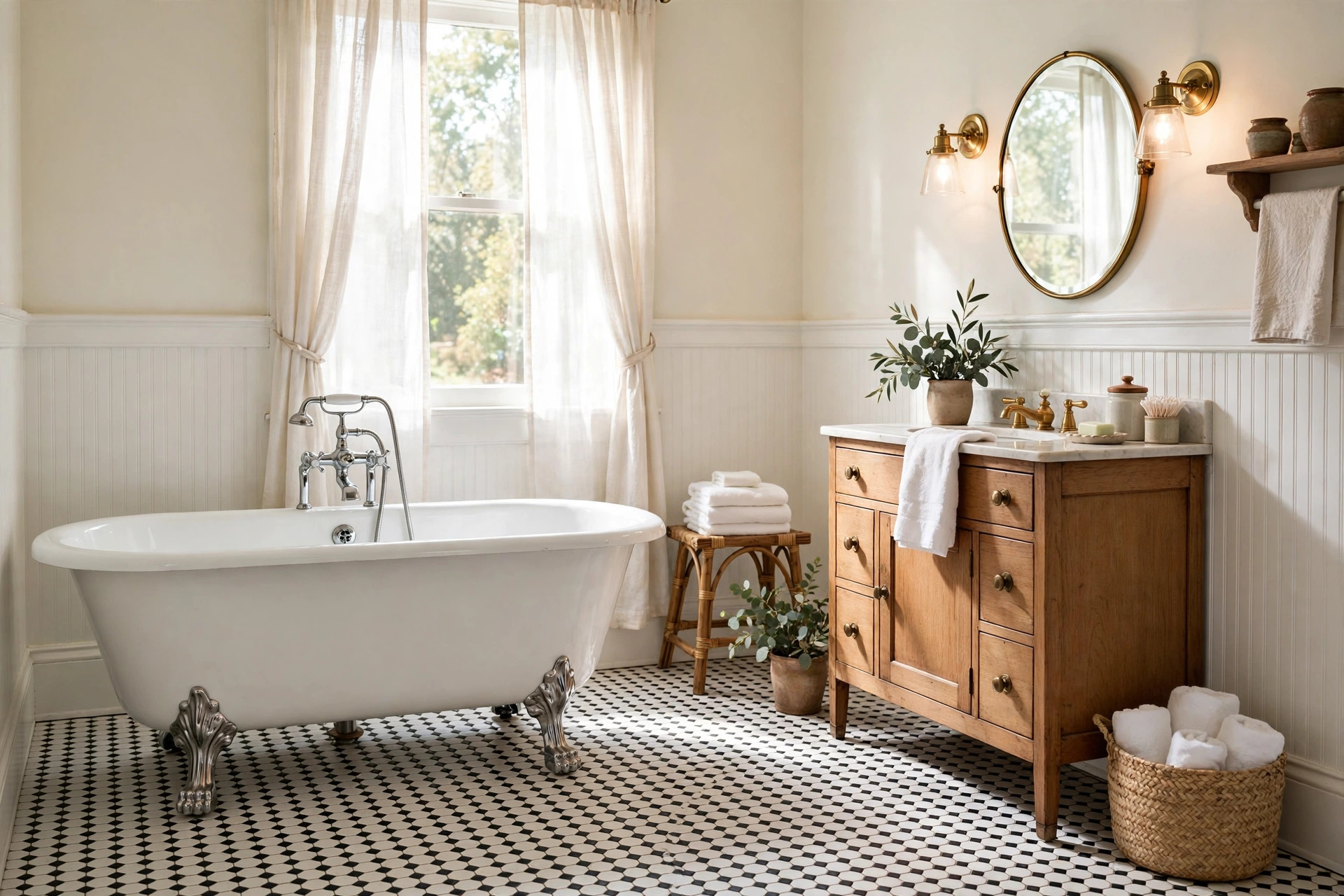
Few fixtures say “vintage bathroom” quite like a clawfoot tub. With its rolled rim, sculpted feet, and deep soaking basin, it is the centerpiece of a thousand Pinterest boards — including plenty of ours. But are clawfoot tubs still worth buying in 2026, when modern freestanding tubs offer similar looks with fewer headaches? The honest answer is: yes, for the right bathroom and the right buyer, but only if you go in with your eyes open about cost, weight, and upkeep. Here is the full picture.
What a Clawfoot Tub Costs in 2026
Price is the first reality check. A new acrylic clawfoot tub typically runs $800 to $1,500, while a new cast iron model starts around $1,500 and can climb past $4,000 for larger double-ended designs. Genuine antique cast iron tubs found at salvage yards or online marketplaces often sell for $300 to $900, but refinishing adds $300 to $600, and replacement feet or hardware can add another $100 to $300.
The tub itself is only part of the bill. Because a clawfoot tub stands free of the walls, you need a freestanding or floor-mounted faucet, which runs $200 to $500 for a decent vintage-style set, plus a handheld shower attachment if you plan to rinse off in it. Installation runs $500 to $1,500 depending on plumbing work, and if your bathroom floor needs reinforcing to carry a cast iron tub filled with water — easily 400 to 500 pounds all in — add several hundred more. All told, budget $2,000 to $5,000 for a complete, properly installed setup, and more for a high-end cast iron restoration.
The Case for Buying One
The case for a clawfoot tub starts with the soak. Most models are 60 to 72 inches long and 30 inches wide, with a depth of 24 to 27 inches — noticeably deeper than a standard built-in tub’s 14 to 16 inches. That depth means full submersion up to your shoulders, which is the whole point of a soaking tub. Cast iron holds heat beautifully, keeping bathwater warm far longer than acrylic or fiberglass.
Then there is the look. A clawfoot tub anchors a vintage bathroom in a way no built-in tub can. It pairs naturally with penny tile floors, beadboard walls, and checkerboard tile, and it photographs beautifully — a real consideration if you love your bathroom enough to share it. A well-chosen tub also adds character that buyers notice; in period homes, an authentic clawfoot tub reads as a feature, not a quirk.
Finally, clawfoot tubs are surprisingly practical in one respect: because they are freestanding, every side is accessible for cleaning and repair. A leak at the drain or a chip in the enamel can be reached without tearing out tile or drywall, which is more than you can say for most built-in tubs.
The Case Against
Now the honest downsides. First, clawfoot tubs are not shower-friendly. Without walls on three sides, showering means water goes everywhere unless you install a ceiling-mounted circular shower curtain rod with a full wraparound curtain — effective, but it hides the tub you bought for its looks, and the curtain needs regular washing to prevent mildew.
Second, cleaning around and under a freestanding tub is a chore. Dust, hair, and bathwater collect in the gap between the tub and the floor, and reaching behind it requires real effort. Third, cast iron tubs are heavy and cold to the touch at first — that wonderful heat retention works both ways, and the tub takes a few minutes of hot water to warm up. Fourth, getting in and out of a tub with a 24-inch wall is harder than stepping over a standard tub edge, which matters for children, older family members, or anyone with mobility concerns.
And there is the space question. A clawfoot tub needs breathing room — at least 4 to 6 inches of clearance on all sides to look right and to allow cleaning. In a bathroom smaller than about 50 square feet, it can dominate the room and crowd out storage.
Our Top Picks
If you decide a clawfoot tub is right for you, these three general styles cover most vintage bathrooms. First, the classic single-ended cast iron tub: a 60-inch rolled-rim tub with ball-and-claw feet, the most authentic choice for a 1920s or 1930s bathroom, best in a room with reinforced floors and a period faucet. Second, the lightweight acrylic slipper tub: a 67-inch double-ended design with one raised end for lounging, weighing under 100 pounds empty, making it the practical pick for upstairs bathrooms or homes where floor reinforcement is not feasible. Third, the double-ended cast iron soaker: a 72-inch tub with symmetrical ends and a center drain, the most luxurious option for a large primary bathroom, pairing beautifully with a floor-mounted filler and a vintage-style handheld shower.
Whichever style you choose, check the tub’s dimensions against your doorways before ordering — a 72-inch cast iron tub will not fit through a standard 30-inch interior door without a fight, and many a renovation has been delayed by that discovery.
The Verdict
So, are clawfoot tubs still worth buying in 2026? For a vintage-style bathroom with enough space, a realistic budget, and a household that actually takes baths, absolutely. Nothing else delivers the same combination of deep soaking comfort and period charm, and a quality tub — especially cast iron — can last a lifetime with basic care. But if your bathroom is small, your household showers far more than it soaks, or the budget is tight, a modern freestanding tub or a well-designed alcove soaker will serve you better for less money and less hassle.
The clawfoot tub is not a practical fixture pretending to be romantic. It is a romantic fixture with practical costs. Buy it because you love baths, you love the look, and you have the room — and you will never regret it. Buy it because it looked good in a photo, and the cleaning, the curtain, and the cold feet will remind you every week. Choose honestly, and this century-old icon still earns its place.

GIPHY App Key not set. Please check settings