


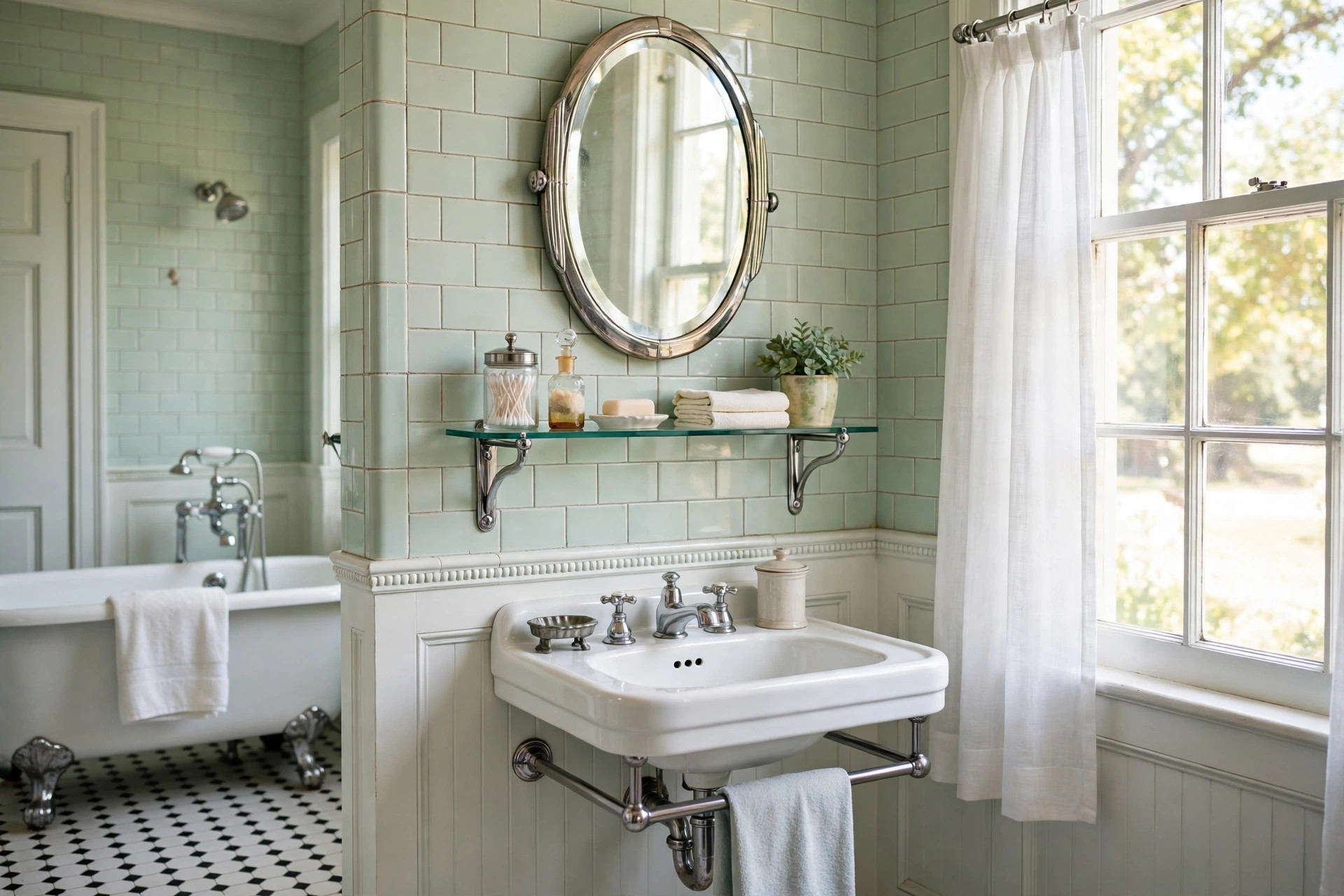
Glass shelves are one of the quiet icons of the 1940s bathroom. Slim, practical and elegant, they hung above sinks and beside mirrors in millions of homes, holding tooth mugs, medicine bottles and the odd treasured perfume bottle. Today they are highly collectible — a genuine pair with original chrome brackets can sell for $60–$150 — which means reproductions are everywhere. Telling a real 1940s shelf from a modern copy takes a trained eye, but the clues are consistent: the glass itself, the brackets, the edges and the small marks left by wartime manufacturing. Here is how to identify real 1940s glass shelves before you buy, or before you throw a genuine piece away during a renovation.
1. Read the Glass: Thickness, Tint and Texture
Start with the glass itself, because this is where most reproductions fail. Genuine 1940s bathroom glass shelves were usually made from plate glass 6–8 mm thick — noticeably heavier and thicker than the 4–5 mm glass used for most modern shelves. Pick it up: a real 1940s shelf has a satisfying weight, and its edges feel cool and substantial. Look at the tint. Glass from the 1940s often has a faint green or slightly grey cast when viewed edge-on, a result of the iron content in the sand used at the time and the less refined manufacturing processes of the era. Modern float glass is almost perfectly clear and colourless by comparison. Then check the surface: period glass frequently shows tiny seeds (minute bubbles), faint waves or a slight rippling when you look along its length, especially in reflected light. These imperfections are not damage — they are the fingerprint of pre-war and wartime glassmaking. A shelf that is optically perfect, dead flat and crystal clear is almost certainly modern.
2. Examine the Edges and Corners
The edges of a 1940s glass shelf tell their own story. Most original shelves have polished, slightly rounded edges — smooth to the touch, with a soft bevel rather than a sharp arris. Some have a distinctive pencil-polished edge, where the edge was ground and polished to a gentle curve. Look closely at the corners: period shelves often show tiny nibbles or wear at the corners from decades of use, and a corner that is too crisp and perfect should raise a question. Measure the shelf too. Standard 1940s bathroom shelves were commonly 18, 24 or 30 inches long and 4–5 inches deep — dimensions tied to the sinks and mirrors of the day. A shelf that is 600 mm long and 150 mm deep may be a modern metric piece. Also check for a maker’s etching or stamp in a corner: some period glass carries a small acid-etched mark, and while many originals are unmarked, a genuine mark is strong evidence. Beware of marks that look too fresh, too deep or too perfectly applied — they are sometimes added to modern glass.
3. Inspect the Brackets and Fittings
The brackets are often the best clue of all, because 1940s hardware was made differently from modern hardware. Original brackets were usually solid chrome-plated brass or, during the war years, painted steel or nickel — chrome was restricted for civilian use during the Second World War, so wartime shelves sometimes have simpler, plainer brackets in painted metal. Look at the weight and the fixings: a real 1940s bracket feels heavy for its size, and its screws are usually slotted-head rather than Phillips, which became common later. Check the chrome: period chrome often shows fine crazing, slight yellowing or tiny pitting, especially on the underside. Modern chrome is brighter, harder and more uniform. Look at how the shelf sits in the bracket — 1940s brackets usually grip the glass with a simple channel and a small set screw, and the glass may show a faint pressure mark where it has sat for eighty years. If the brackets are shiny, lightweight and held on with cross-head screws, they are probably replacements, even if the glass is old.
4. Consider the Context and the Wear
A glass shelf does not exist in isolation, so look at where it came from. A shelf removed from a 1940s house, still bearing the ghost of a tiled wall or the screw holes of its original position, is far more likely to be genuine than a shelf with no history at all. Ask the seller where it came from and look for consistency: the shelf, the brackets and the story should match. Then look at the wear pattern. Eighty years of use leaves a shelf with a particular kind of patina — faint cleaning scratches running along its length, a slightly duller patch where bottles sat, perhaps a water stain at one end. This wear is even and honest. Be suspicious of wear that looks deliberate: heavy scratching in one spot, artificial ageing or a shelf that is described as “mint condition” yet claims to be eighty years old. A genuinely mint 1940s shelf does exist, usually one that spent decades in a spare room, but it is the exception, not the rule.
5. Value, Care and What to Do With Your Find
Once you are confident a shelf is genuine, treat it well. Clean it with warm water and a soft cloth — never an abrasive pad, which will scratch period glass — and dry it immediately to avoid water spots. If the chrome brackets are pitted, a gentle polish with a soft cloth and a mild chrome cleaner is enough; do not try to re-plate them yourself, as that destroys their value. As for value, a single genuine 1940s glass shelf with original brackets typically sells for $30–$80, and a matched pair for $60–$150, with rarer sizes and unusual brackets fetching more. When mounting, always fix brackets into a stud or use proper wall anchors — an eighty-year-old glass shelf is heavy, and a bathroom is the worst place for it to fall. Fit the shelf level, keep heavy bottles near the brackets rather than the centre, and enjoy it: a real 1940s glass shelf is a small, everyday piece of history, and it earns its place in a vintage bathroom every single day.

GIPHY App Key not set. Please check settings